
Image: Doug Turetsky. Sourced: Flikr, licensing: CC 2.0.
The British pound has broken the ceiling that capped it since May, and the Dollar's troubles are doing the lifting.
The pound-to-dollar exchange rate will try and decisively break above the shelf that turned it back in May, June and July, and convert a months-long ceiling into support, opening the way towards the top of the long-term range towards 1.3660.
The advance that began with early August's soft U.S. labour market report has run without meaningful interruption since, and the pair now trades at its highest level since May.
From a tactical perspective, price action is increasingly constructive and the coming week is a question of whether it holds: UK inflation on Wednesday is the UK domestic test, while the Dollar side supplies the momentum through receding Federal Reserve rate hike expectations.
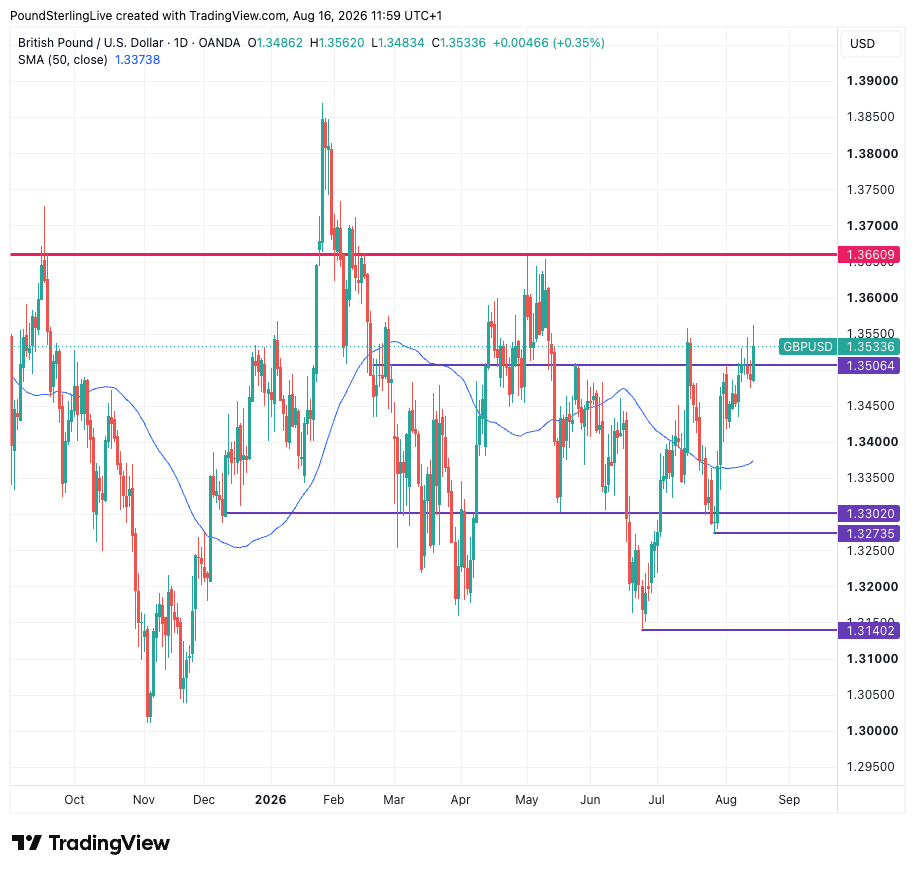
Above: GBP/USD daily chart. Image © Pound Sterling Live, chart created with TradingView.
Spot at 1.35336 sits above the old ceiling at 1.35064, having printed a high of 1.35620 in the latest session.
That level rejected the market three times through the summer, and a daily close above it was the development we said would be needed before anything more ambitious could be argued.
The close has now been delivered, and the standard behaviour from here is for 1.35064 to reverse roles and act as support on any dip.
The 50-day moving average at 1.33738 is rising beneath the market, and the sequence of higher lows that began at 1.31402 in July remains unbroken.
The initial target is the obstacle that is 1.3660, which has contained every rally since July 2025 and marks the top of the range that has defined this market for more than a year.
Support starts at 1.35064, then the moving average at 1.33738, with 1.33020 and 1.32735 beneath.
Our Pound to Dollar forecast is for a run towards 1.3660 in the coming week, provided 1.35064 holds as support on any early setback.
A daily close back below 1.35064 would mark this as a false breakout, which is the scenario that would do the most technical damage, because failed breakouts tend to travel.
The medium-term picture is nevertheless distinctly rangebound and the pair must clear 1.3660 to really shift the dial and avoid the pull of gravity. To be sure, the market is now attacking the top of the range with momentum and a fundamental tailwind, which is the strongest position Sterling has held against the Dollar this year.
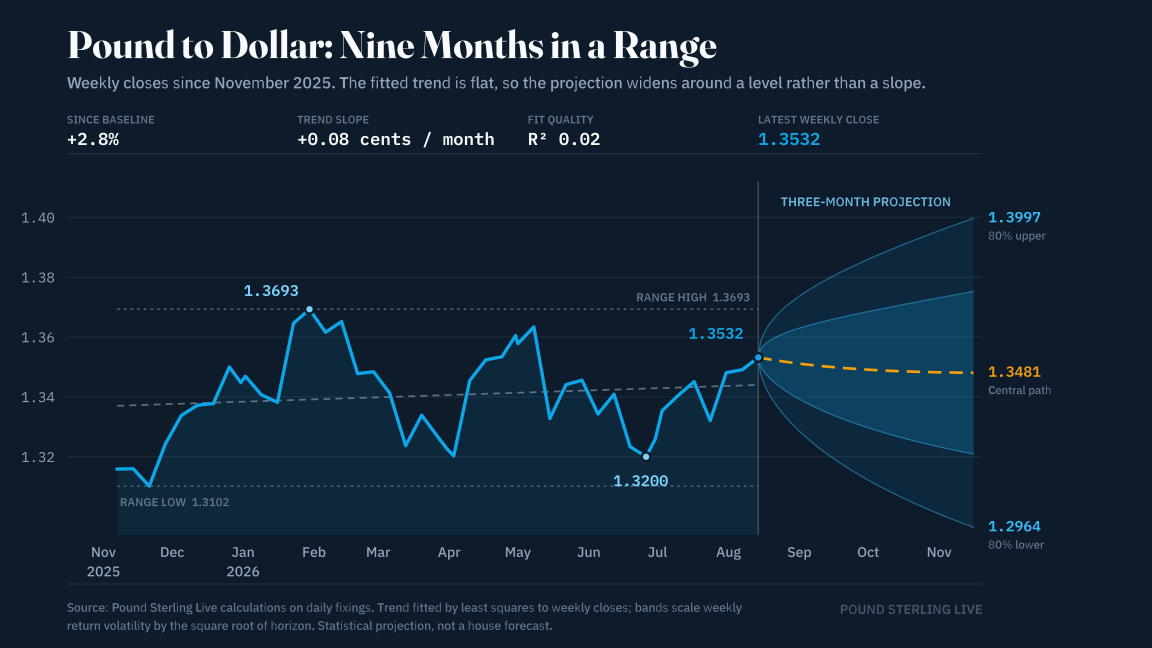
Why the Dollar is Falling Again
The Dollar has fallen through the course of August as U.S. rate hike expectations recede further into the distance, diminishing the attraction of U.S. fixed income products.
Those expectations took another step back last week when July inflation data showed lower gasoline prices contributing to a fall in annual headline CPI to 3.4% from 3.5%, with core inflation easing to 2.5% from 2.6%.
Producer price inflation also moderated and retail sales fell, so the U.S. economy's ability to surprise has waned.
The Bank Consensus, Without the Terminal
The median, mean, highest and lowest from the October survey update, plus named point forecasts out to 2027.
Free information pack, issued by World Wide Currencies.
That is critical for a currency that had benefited through June and July from U.S. economic surprises landing on the topside.
"Tentative signs of easing inflation and recent weakness in labour market data nevertheless support expectations that the Fed will keep interest rates unchanged in September," says Lloyds Bank in a weekly economics note.
"The USD remains vulnerable to further weakness," says a weekly FX strategy note from MUFG Bank.
"The recent run of softer US employment, wage, and retail sales data, together with limited evidence that higher energy prices are feeding through into core inflation, has given the Fed greater scope to keep rates on hold," explains the note.
The Term Premium Question
An evolving thematic headwind for the Dollar that has been cropping up in analyst notes of late is the rise in longer-dated U.S. bond yields.
These are the bonds that incorporate longer-term concerns about inflation and policy, something known as a term premium.
It is a premium in the sense that investors ask for a premium return on holding debt that is at risk of devaluation by inflation and policy missteps.
"Despite lower expectations for further Fed tightening, longer-term US Treasury yields have remained elevated, helping to keep broader financial conditions restrictive. This may reflect a rise in term premia," says Lloyds Bank.
"Investors are demanding greater compensation for inflation risks associated with persistently higher energy prices and concerns over rising government debt levels," the bank adds.
We have noted a number of analysts linking this concern with the Dollar's August lull.
Some say they are not yet concerned about the premia issue, and explain the Dollar's recent underperformance as a simple and understandable reaction to the decline in short-term bond yields.
Those are the yields most tightly correlated to future Fed rate expectations, and they would therefore reflect the slide in September rate hike bets.
Taken together, we would imagine there is enough working against the Dollar to keep GBP/USD supported in the coming days.
Sterling Brings Its Own Ammunition

Image © Adobe Images
The Pound arrives at this breakout with a heavy domestic calendar of its own: labour market figures on Tuesday, inflation on Wednesday and the flash purchasing managers' surveys on Friday.
Wednesday is the one that matters most, with consensus looking for annual CPI to rise to 2.9% from June's low and some forecasters, Lloyds among them, expecting 3.0%.
A print at the top of those expectations would firm the case for a September rate increase at the Bank of England, putting UK rate expectations and U.S. rate expectations in open divergence.
That divergence is the cleanest fundamental argument for the breakout extending, because it widens the rate gap from both sides at once.
Our house view on the pound is that the UK economy can continue outperforming expectations in the coming months, and further positive data surprises can bolster the Pound into year-end.
For those with Dollar payment requirements, the pair is trading closer to the top of its year-long range than at any point since spring, and the medium-term Pound to Dollar forecast only turns genuinely bullish on a close above 1.36609, a level that is now within the week's reach.