
Commodity price headwinds blow into AUD near-term shows new research. Image © Adobe Images
Commonwealth Bank sees limited sterling upside before the Australian Dollar turns the tables in 2027.
Commonwealth Bank of Australia has updated its forecasts for the Australian Dollar's cross rates, and the profile it sets out for sterling is a short, shallow advance followed by a decisive reversal.
The bank expects the Australian Dollar to fall against all of the major currencies over the next few quarters, weighed down by lower commodity prices and interest rate differentials moving against it. It considers AUD/USD to have peaked near 0.7250 in mid-May.
Against the Pound, however, the near-term weakness is described as slight, and the recovery that follows is more instructive.
It expects the Pound -to-Australian Dollar exchange rate to edge up only modestly over the coming quarters before turning decisively in the Australian Dollar's favour from the first quarter of 2027.
The Aussie lender characterises Sterling's near-term resilience against the Australian Dollar as subdued, and the subsequent move in its favour as strong.
Going Against the Flow
The substance of Commonwealth Bank's position is that it pushes back against current market pricing on both UK and Australian central banks.
On the Reserve Bank of Australia, the bank expects the cash rate to stay at 4.35% through the remainder of 2026, followed by 50 basis points of cuts in 2027. It describes its own view as materially below what the market is pricing.
That call has just received support from the RBA itself.
Pound Sterling Live reported on 11 August that the Australian Dollar softened after the Board voted unanimously to hold, with the accompanying Statement on Monetary Policy revising the unemployment forecast slightly higher across the horizon.
A central bank raising its unemployment projections is not one preparing to tighten, and the unanimity removed the dissenting hawk some traders had positioned for.

The Bank Consensus, Without the Terminal
The median, mean, highest and lowest from the October survey update, plus named point forecasts out to 2027.
Free information pack, issued by World Wide Currencies.
The Board nevertheless wrote its trigger into the statement, committing to raise the cash rate further if upside risks materialise, so the hiking cycle is dormant rather than retired.
On the Bank of England, the divergence is wider still with Commonwealth Bank noting the market is pricing almost two further rate increases from the Bank of England while its own forecast is for no change this year and two cuts during 2027.
The reasoning is that the Bank will look through higher energy-driven inflation because the UK economy is soft enough to limit the pass-through into underlying prices.
If that assessment proves correct, the rate differential argument that has underpinned sterling's summer strength weakens considerably.
The UK Fiscal Question
The more durable element of Commonwealth Bank's sterling view has nothing to do with interest rates.
The bank expects UK fiscal credibility and sustainability to remain an issue over the coming years, keeping upward pressure on gilt yields and acting as a persistent drag on the Pound.
That is a structural argument rather than a cyclical one, and it does not resolve with a single data release.
It also lands in a week when the same theme has been visible in sterling's domestic coverage, with nerves over Prime Minister Andy Burnham's stated desire for fiscal flexibility shadowing the Pound's recent advance.
Commonwealth Bank lists intensifying UK fiscal concerns as one of the scenarios in which the Australian Dollar outperforms its forecast, and a Bank of England that does raise rates as the scenario in which sterling does better.
What the Chart and the Forward Curve Say
Pound Sterling Live's own analysis has the GBP/AUD peaking near-term at 1.9316 in July, with the subsequent pullback reading as a natural unwind of sterling's outperformance in the month to mid-July rather than the end of the recovery that began in May.
Spot sits at 1.9107, unchanged on the day, having traded between 1.9103 and 1.9118.
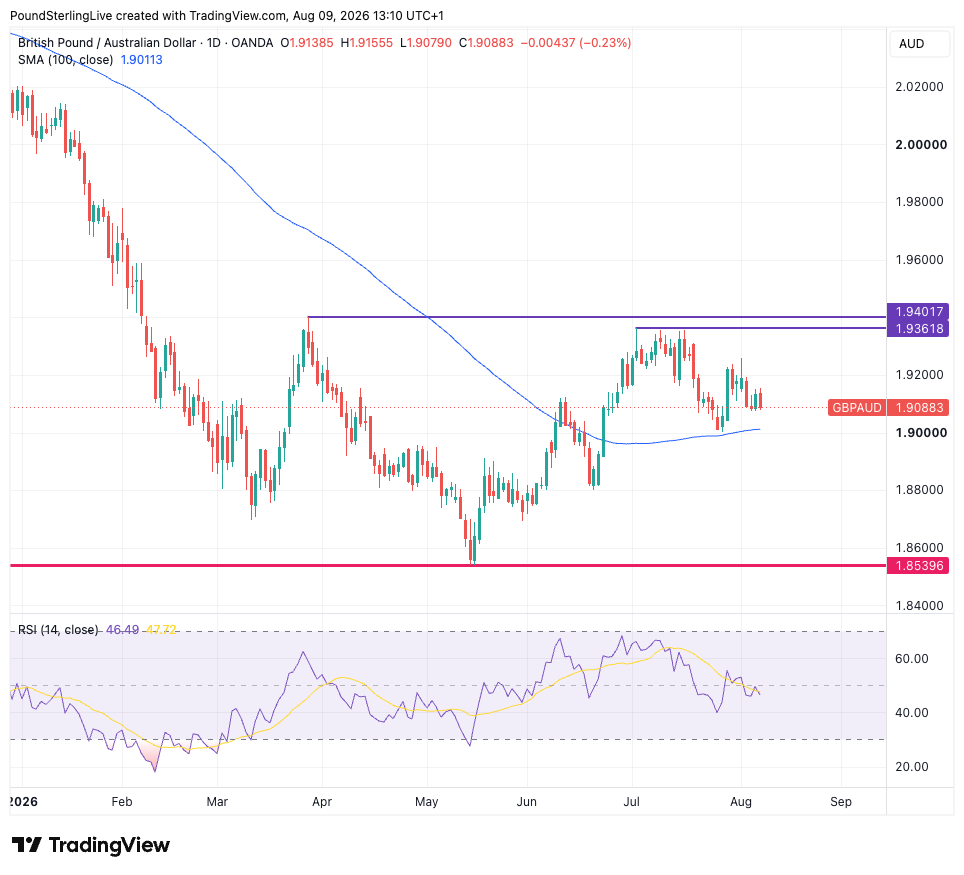
The pair is down 0.12% over one week and 0.80% over one month, and 5.76% lower across the year, with the twelve-month range running from 2.0201 down to 1.8540.
Market pricing points modestly the other way from here; forward points imply forward points imply the Pound-to-Australian Dollar rate at 1.9117 in one month, 1.9136 in three months, 1.9161 in six months and 1.9194 in one year.
That market-implied path and Commonwealth Bank's forecast agree on direction into early 2027 and part company after it. The forwards drift the Pound gently higher throughout; the bank expects the Australian Dollar to take the pair lower from the first quarter of 2027 as the global economy recovers and commodity demand improves.
GBP/AUD has also historically tended to rise when the U.S. Dollar is outperforming, which means renewed Middle East escalation and higher oil prices could lift the pair even while the bilateral arguments point the other way.
Commonwealth Bank identifies the same conflict as the major downside risk to AUD/USD, noting that the longer the Strait of Hormuz stays closed, the greater the chance markets downgrade the global growth outlook.
For those with Australian Dollar payment requirements, the practical reading is that the near-term case for sterling rests on a rate differential that one of Australia's largest banks expects to erode, and on a fiscal position it expects to remain a liability.
The Australian Dollar's own weakness over the coming quarters is the offsetting factor, which is why the forecast is for drift rather than a decisive move in either direction before 2027.