
Image © Adobe Images
A strong streak for pound sterling shows no signs of dying as a dollar sell-off and Bailey comments offer fresh impetus.
The Pound to Euro exchange rate has shrugged off Wednesday's shooting star candle and overbought momentum readings to trade firm into the weekend, with the past 24 hours of dollar selling proving more supportive of the pound than the euro.
The pair is at 1.1846, within a few pips of this week's 16-month high at 1.1867.
Thursday's close at 1.1844 negated the reversal signal flagged in our previous article, which required a daily close below 1.1821 for confirmation.
The Relative Strength Index (RSI), a momentum gauge where readings above 70 mark an overbought market, has held above that threshold for more than a week and sits at 75.
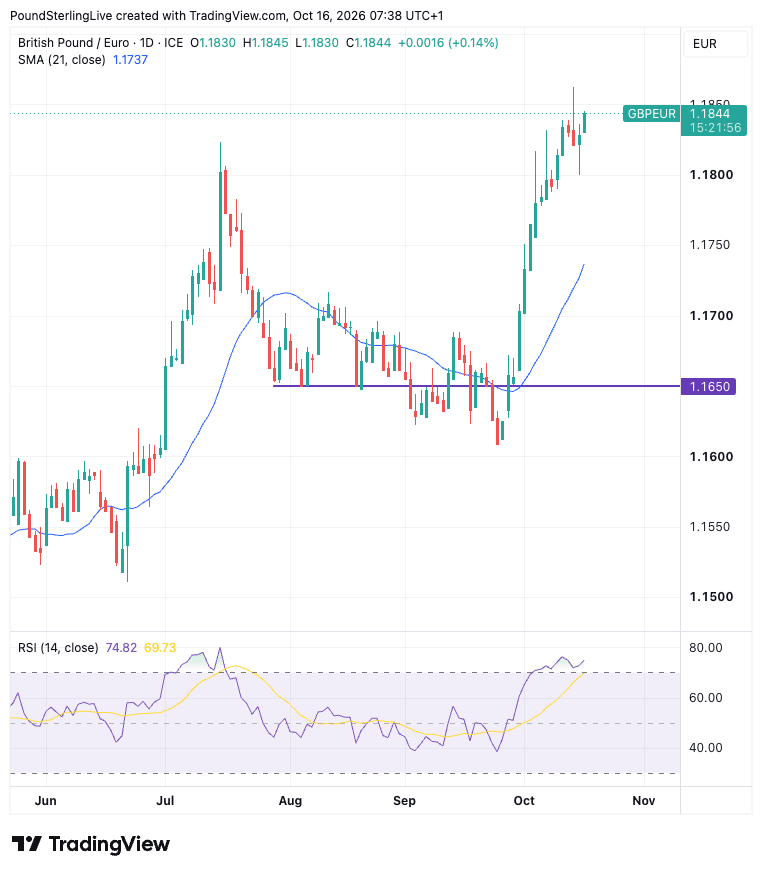
Above: GBP/EUR at daily intervals with the 21-day moving average and the RSI in the lower panel.
The dollar has given back all of its post-inflation gains, with the Pound to Dollar rate up 1.2% from Wednesday's low to 1.3310 while the Euro to Dollar rate has recovered 1.0% to 1.1231.
That two tenths of a percent of outperformance is what keeps GBP/EUR pinned to its highs.
"Upbeat US CPI data for September reignited the USD rally to new one-year highs, following in the footsteps of the knee-jerk reaction higher in USD rates/yields. Those moves were nonetheless swiftly reversed, and even more, as it seemed that global markets could not take much more tightening in US financial conditions," says Crédit Agricole in its weekly FX note.
Fed Chair Kevin Warsh added to the dollar's slide on Friday by declining to offer guidance on the 28 October decision.
"Markets reduced October Fed interest rate hike pricing to just 4bps, down from around 7bps before Warsh spoke," says Kristina Clifton, Senior Economist at Commonwealth Bank of Australia.
The pound has been the beneficiary of the week's equity turbulence, with the UK's AI-linked growth story turning it into a shelter when the AI trade sells off.
"The pound is the top performing G7 currency this week, and the Gilt market is the best performer amongst its peers on Thursday. When the AI trade sells off, the UK is the harbour in the storm," says Kathleen Brooks, Research Director at XTB.
Bailey Adds a Fresh Layer of Support
Bank of England Governor Andrew Bailey told the Institute of International Finance meeting in Bangkok that the UK economy "is actually turning out to be more resilient than we expected it to be," and that there are signs the neutral interest rate has risen.
A higher neutral rate means Bank Rate is doing less to restrain the economy than the Bank assumed, which lowers the bar for a November hike and raises the ceiling on where rates settle.
UK money markets price a 91% probability of a hike on 5 November, with Corpay noting a total of four hikes priced by next September.
ING has raised its Bank of England call to two hikes, saying inflation is set to top 4%.

Daniella Arcadipane, Senior Currency Specialist at Indigo
Moving a life-changing sum abroad? You won’t be doing it alone.
One specialist explains every step in plain English and stays with it until the money lands. FCA authorised, FRN 594433.
Talk to a specialistThe euro side offers no such support, with the European Central Bank's Olli Rehn saying he sees no second-round inflation effects from higher energy prices and that a measured policy response is appropriate.
"The EUR should continue to trade as collateral damage of global geopolitical risks and sovereign credit risks at home," says Crédit Agricole.
UniCredit says investors have little incentive to add exposure to French bonds until spreads widen enough to trigger a credible policy response, adding that "things may have to get worse before they get better."
What Would End the Streak
Spot sits 0.9% above its 21-day moving average at 1.1737, and PSL's modelling shows a deviation of this size closes through either a pullback or a period of consolidation; this week's price action says consolidation.
The pound's yield support rests on a November hike and the series of increases markets price behind it, and the gap between those two is where a setback would come from.
Commonwealth Bank of Australia backs the first part and rejects the second.
"We agree with current pricing for a high chance of a BoE interest rate increase at its next meeting in November. However unlike the market we don't expect a series of interest rate hikes," says Kristina Clifton, Senior Economist at CBA.
If the Bank delivers in November and then signals a pause, the four hikes priced by next September unwind, and the pound loses the rate advantage that has carried it through this week's dollar sell-off.
Crédit Agricole makes the same point, saying rates markets are pricing a very aggressive tightening cycle despite the UK's resilience, and noting that Chief Economist Huw Pill, the MPC's biggest hawk, refused to validate current expectations this week.
The bank forecasts EUR/GBP at 0.86 in three months, equivalent to 1.1628 in GBP/EUR, a fall of close to two cents from here.
Next week's UK inflation and labour market data are the final hurdles before the November meeting, with OCBC forecasting headline inflation at 3.4%, its highest this year.
KBC says a weekly close below 0.8455 in EUR/GBP, equivalent to 1.1827 in GBP/EUR, would be an important technical signal, and the pair sits above that level with the week's close approaching.
Our house view is that the pound stays capped into the 28 October Budget and recovers in its wake, and a weekly close above 1.1827 keeps the 16-month high at 1.1867 as the next target.
Daniella Arcadipane, Senior Currency Specialist at Indigo
Moving a life-changing sum abroad? You won’t be doing it alone.
One specialist explains every step in plain English and stays with it until the money lands. FCA authorised, FRN 594433.
Talk to a specialist