

Image © Adobe Images
A surprise fall in employment and a retreat in global bond yields have cooled bets on another Australian rate hike.
The Australian dollar is steadying against the pound on Friday but holds onto most of the losses it suffered after a surprise fall in employment, with the Pound to Australian Dollar rate at 1.9161, close to its highest level since August.
The Aussie had drawn support from bets that the Reserve Bank of Australia would raise interest rates again in November, which lifts the returns on Australian assets. Weak jobs data undercuts the case for that hike and removes some of that support.
Markets now price around a 10% chance of a November hike, down from about 30% before Thursday's data, and that's translating into a weaker Aussie dollar.
Two days earlier, hawkish minutes from the RBA's September meeting had revived expectations for that move.
Employment fell by 39,300 in September, against expectations for a 20,000 gain. The unemployment rate rose to a cycle high of 4.7%.
"Beneath the monthly noise, the labour market continues to loosen gradually, with jobs growth running slower than labour force growth. We expect the unemployment rate to peak at 4.8% in mid-2027, though there is upside risk to this forecast," says Westpac.
Falling Yields and an AI Selloff
The jobs miss landed as global bond yields fell on safe-haven buying, with an AI-led selloff in equities spreading through Asian markets.
Australian rates followed US Treasuries lower, compounding the repricing of RBA expectations.
The selloff also hit the Aussie directly, as a high-beta currency that tends to fall when investors cut risk.
"The US dollar eased alongside lower Treasury yields, although the AUD underperformed following weaker Australian labour market data," says Westpac in its morning report.
Corpay says the Aussie is under pressure from two directions in a recent update: risk aversion triggered by AI spending concerns, and a jobs report that has cut RBA hike odds.
China adds a further weight. Its September trade data showed iron ore imports falling around 6% on the year, and the iron ore price briefly dipped below $90 a tonne.
"Falling steel mill margins, particularly to current negative levels, reduce the incentive to produce steel and therefore weigh on China's iron ore import demand," says Commonwealth Bank of Australia.

Daniella Arcadipane, Senior Currency Specialist at Indigo
Moving a life-changing sum abroad? You won’t be doing it alone.
One specialist explains every step in plain English and stays with it until the money lands. FCA authorised, FRN 594433.
Talk to a specialistWestpac's latest nowcast also shows Australian growth momentum deteriorating noticeably through August and September.
The pound has had the opposite backdrop. Bank of England Governor Andrew Bailey said this week that the UK economy has been more resilient than expected and that the neutral interest rate appears to have risen.
ANZ and Westpac Hold Their RBA Hike Calls
Turning to the hawks, ANZ says the data changes the odds without changing its call.
"While today's labour force data make a November rate hike less likely than before, we continue to think a 25bp rate hike is more likely than not. Much will depend on the evolution of data and events between now and the November meeting," says ANZ.
"The data complicate the RBA's 'a little tight' messaging, but with inflation the clear priority, we still expect a 25bp hike in November," says Westpac.
Crédit Agricole argues the RBA will look past the figures, because a new survey method introduced by the Australian Bureau of Statistics has made the labour data even more volatile than usual.
"So, the labour market data will carry less weight than usual with the RBA leaving another rate hike on the table," says Crédit Agricole.
CBA keeps a hold as its base case but describes the November meeting as live, with risks "firmly tilted to the upside".
GBP/AUD Holds Above 1.90
GBP/AUD cleared horizontal resistance at 1.90 and its 21-day moving average at 1.8952 in Thursday's surge, peaking at 1.9189 on Friday morning before easing to 1.9161.
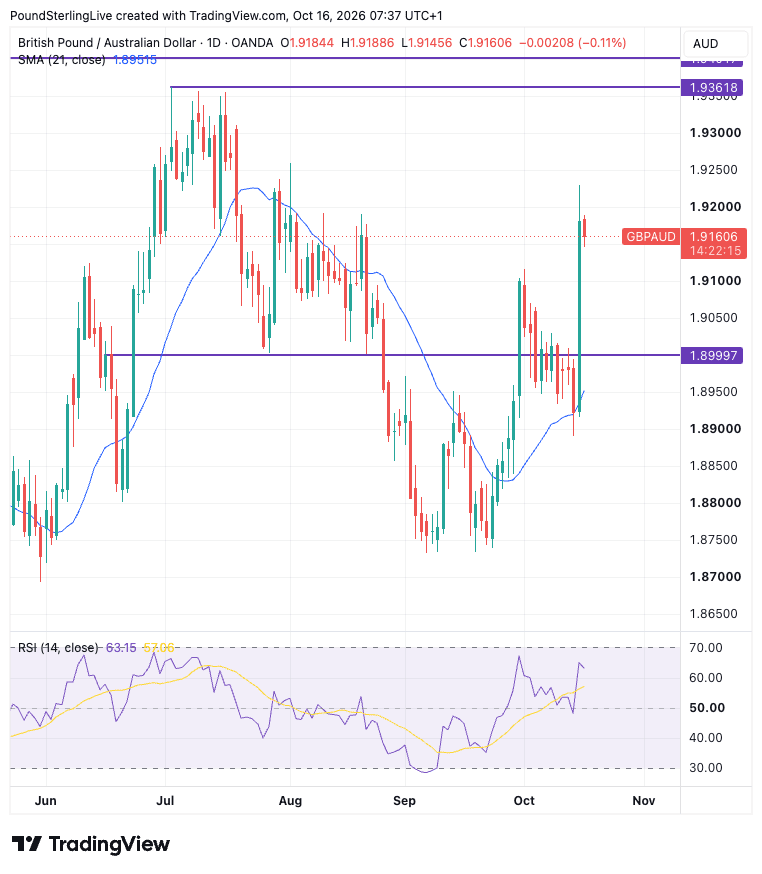
Above: GBP/AUD daily chart, with the 21-day moving average in blue. Image © Pound Sterling Live, chart created with TradingView.
Friday's modest pullback fits our modelling. It treats a move this far from the 21-day average as a gap that tends to close, so a pause or a dip towards 1.90 is the near-term base case before any test of the July high at 1.9362.
The Aussie also has a little help from the US dollar on Friday. The greenback slipped after Federal Reserve Chair Kevin Warsh offered no guidance on the near-term rate outlook, lifting the Australian Dollar to US Dollar rate around 0.5%.
Corpay adds that bearish positioning in the Aussie should limit further large falls.
RBA Deputy Governor Andrew Hauser and Assistant Governor Chris Kent speak next week. CBA expects any hawkish comments to support the Aussie only temporarily.
The decisive test is third-quarter inflation data on 28 October. A hot print would revive the November hike case and pull GBP/AUD back below 1.90, while a soft one opens the way to 1.9362.
Daniella Arcadipane, Senior Currency Specialist at Indigo
Moving a life-changing sum abroad? You won’t be doing it alone.
One specialist explains every step in plain English and stays with it until the money lands. FCA authorised, FRN 594433.
Talk to a specialist