

Image © Adobe Images
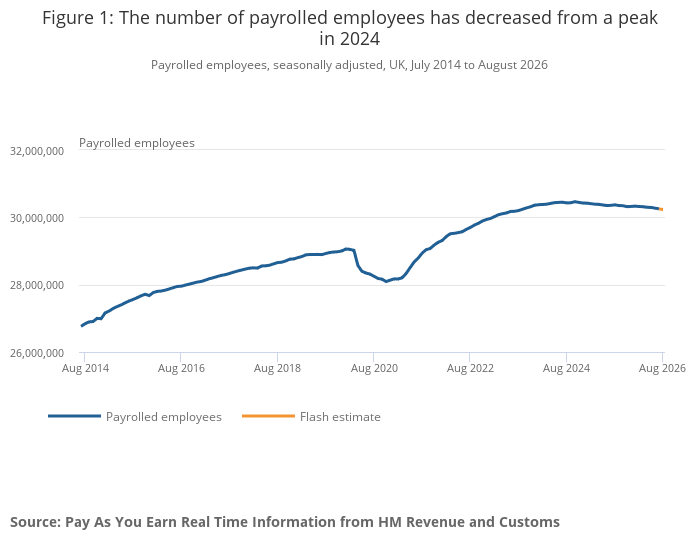
The economy is 2.1% larger than a year ago on 95,000 fewer jobs, a productivity gain that leaves the Bank of England with a conundrum.
UK GDP grew 0.1% in August against a consensus for a 0.1% fall, the fourth consecutive monthly beat, and annual growth of 2.1% is the strongest since October 2022.
The expansion has come without a single net hire.
"If you believe the HMRC jobs data, UK GDP growth has hit 1.8% this year in the first eight months of the year, with 95k FEWER jobs. Who said productivity growth was dead in the UK?" says Sanjay Raja, Chief UK Economist at Deutsche Bank.
The sector data say where the output is coming from: information and communication is up 7.1% on the year and professional, scientific and technical activities up 9%, together contributing 1.3 percentage points of the 2.1% annual growth.
"The expansion in the two rapidly growing sectors of the UK economy has not resulted in any pickup in employment. In fact, employment in both sectors has declined since the start of 2025," says Andrew Wishart, Senior UK Economist at Berenberg.
Three in ten UK businesses now use AI, rising to 60% in information and communication, and of AI users with ten or more staff 6% report reduced headcount against fewer than 1% reporting an increase, with administrative and clerical roles most affected.
Output Per Worker Is the Good News
Rising output on a flat or falling headcount is a productivity gain, and productivity is what raises real wages for those in work and the tax base for the Treasury.
Pantheon Macroeconomics puts underlying growth at 2.8% annualised so far this year and Q3 on track for 0.7% quarter-on-quarter, against the Bank of England's own forecast of 0.4%.
"We have to shift from describing UK growth this year as resilient to calling it strong," says Rob Wood, Chief UK Economist at Pantheon Macroeconomics.
The cost is that the growth is not creating work, and unemployment is forecast at 5.3% this year by the IMF.
Why Lower Rates Would Not Help
A cut in Bank Rate works by making borrowing cheaper for firms that need to borrow to invest and hire, and British firms are not in that position.
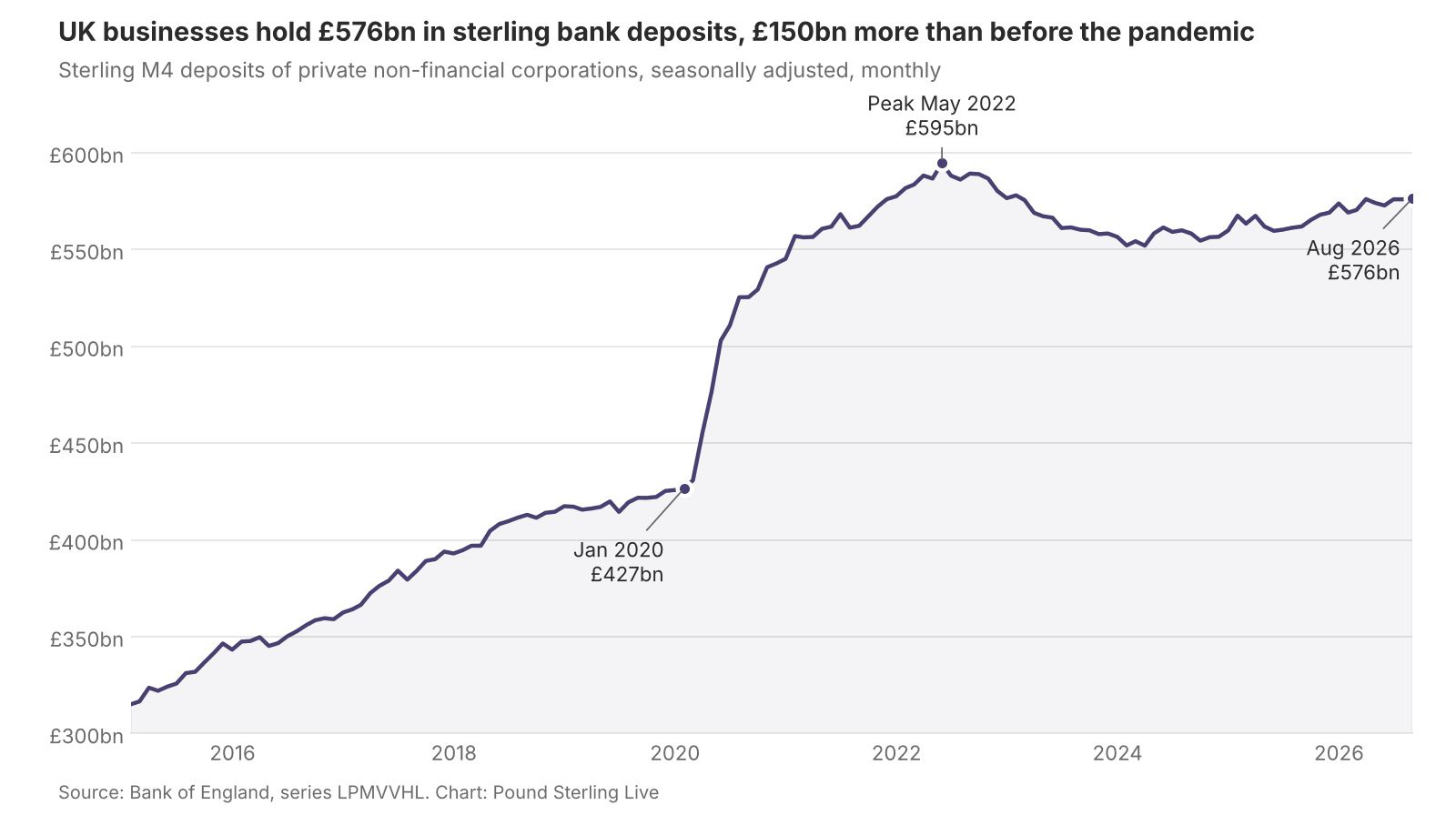
Private non-financial corporations held £576.4bn in sterling bank deposits at the end of August, the highest since January 2023, 2.6% up on the year and £150bn above the level in January 2020.
The same firms borrowed £7.7bn net in August at an effective rate of 5.57% on new loans and bought back £1.6bn of their own equity, while annual business investment growth has been revised up to 5.2%.
Firms with cash to spare, borrowing freely at current rates and investing in software rather than staff are not waiting on cheaper credit to hire, so the unemployment that jobless growth leaves behind is outside the reach of monetary policy.
That is our house view on rates: the Bank of England stays higher for longer, because the economy does not need its help and inflation does.
"The MPC currently faces no trade-off between high inflation and weak growth. The UK has grown much faster than rate-setters expected and is expanding well above any estimates of UK potential growth. The evidence that Bank Rate at 3.75% is restrictive is increasingly thin on the ground," says Wood, who expects hikes in November and February.
Investec also looks for November and February, taking Bank Rate to 4.25% by the end of the first quarter.
The Case for One Hike Only
Berenberg reads the same jobs data the other way: growth concentrated in two sectors makes it hard to set rates for the whole economy, and with no cyclical labour-market tightening to follow it expects a single hike on 5 November.
"Barring a renewed surge in energy prices, we remain content with our view that the BoE need only hike once," says Wishart.
Deutsche Bank sees the engine slowing from its first-half pace, with consumer-facing services down 0.3% for a second month, construction contracting for a fourth and the ICT sector itself slipping 0.5% in August.
"Undoubtedly, there may be some hiccups to come in the run up to year end, especially as energy prices continue to bite household incomes, and higher rates continue to drag on spending and investment," says Raja.
Pantheon concedes its Q3 tracking "seems too good to be true, given still-depressed business sentiment" and allows for downward revisions.
The 5 November decision is now a question of one hike or two, and the firms sitting on £576bn in the bank are the reason neither answer involves a cut.