

Image © Adobe Images
UK long-end yields have risen less than peers since March, pointing to global term premium rather than British credit risk.
The 30-year gilt yield breached 6% this month and the market treated it as an ordinary data point.
"It is telling that 30yr yields breaching the 6% mark would have previously attracted more attention but passed with little or no adverse commentary beyond the obligatory headlines," says Barclays.
The reason is in the cross-market comparison.
Barclays, writing for the IFS Green Budget, finds 30-year gilt yields have risen around 0.6 percentage points since the Spring Forecast, against 0.7 to 1.0 points for comparable sovereign bonds, with the 10-year moving from 4.4% to 5.4%.
"The rise in yields on UK sovereign debt over the last year have been in line with, or even slightly smaller than, the increases seen across other major economies," says Barclays.
A UK-specific risk premium would show up as gilts underperforming peers; the opposite has happened.
France is the market carrying the sovereign risk, with OAT spreads over Bunds at their widest since the 2011 to 2012 crisis, and gilts have been a relative beneficiary.
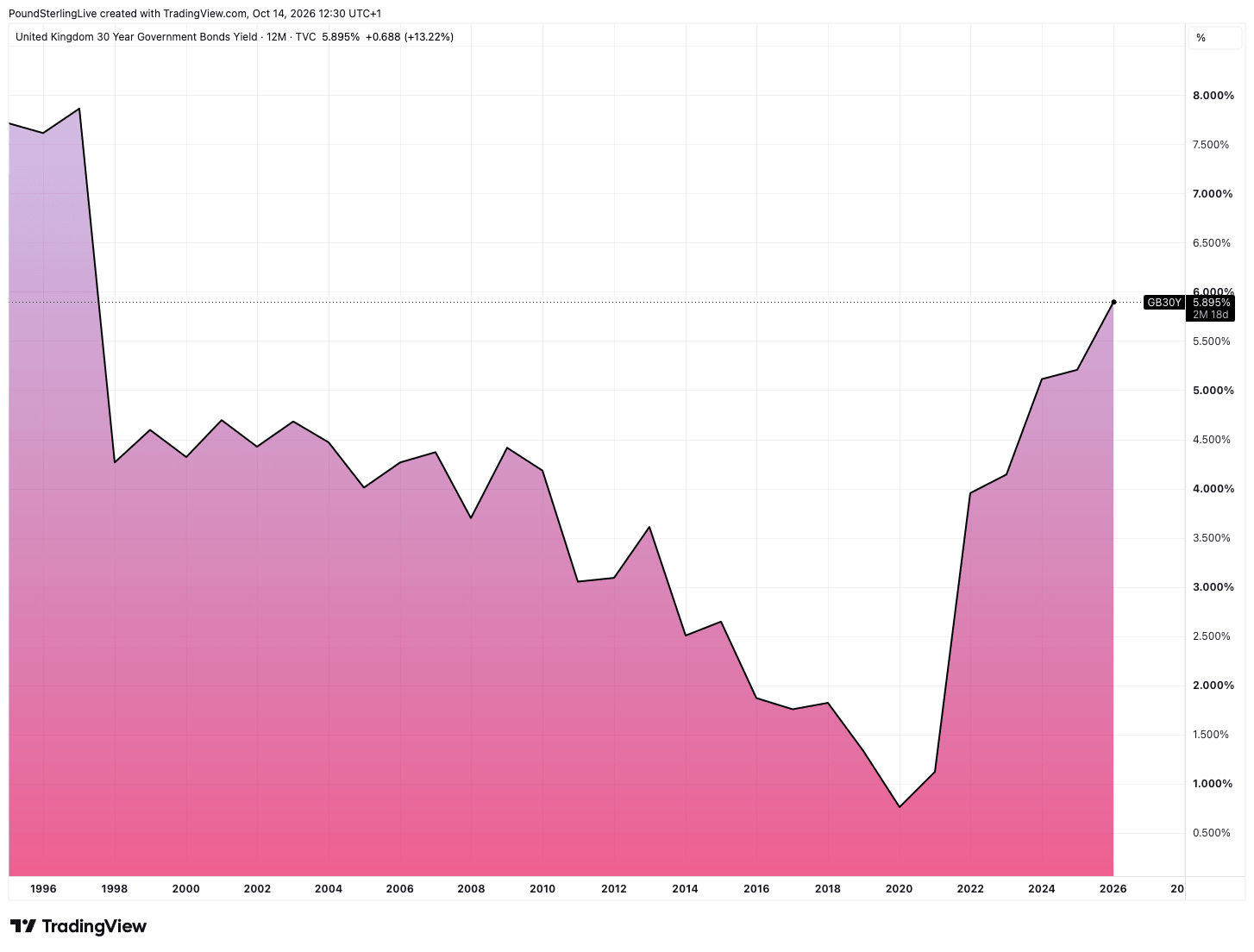
Is the UK's Premium on the Wane?
Berenberg separates the move into two parts: the post-pandemic normalisation of rates, which it accepts, and the 2026 surge, which it does not.
"This year, larger rises in the policy-sensitive two-year gilt yield than the 10-year yield demonstrate that near-term expectations for interest rates are now the main driver," says Andrew Wishart, Senior Economist at Berenberg.
Those expectations price four Bank of England hikes, which Berenberg says are not needed, and it expects one in November followed by easing in late 2027.
"If these lofty expectations are not met, the 10-year gilt yield will probably reverse much of its 2026 surge in 2027," says Wishart, who forecasts the 10-year at 4.7% by end-2027.
UBS reads the current level as containing a premium that can still come out.
"UK assets continue to trade with a degree of fiscal scepticism embedded in valuations. If investors conclude that fiscal credibility remains intact without a significant deterioration in the growth outlook, the fiscal premium attached to UK assets could begin to decline," says the UBS Chief Investment Office.
Positioning Into 28 October Budget
Barclays' point is that the scrutiny gilts would normally attract at these levels is being spent on France, and the Budget is being drafted to avoid reclaiming it.
"With market attention currently elsewhere, Chancellor Healey will likely try to keep it that way," says Barclays.
The risk sits in positioning: gilt asset-swap spreads are heavily held by banks and discretionary macro investors, and Barclays expects the macro community to lighten up ahead of the OBR's new gilt remit, with invoice spreads trading weaker in the near term.
Pantheon Macroeconomics expects headroom cut to £19bn from £23.9bn, which makes the fiscal forecast a function of the yields the market is currently ignoring.
"Another 30bp rise in gilt yields and Bank Rate would cut it by about £5B. That leaves asymmetric upside risk to gilt yields," says Rob Wood, Chief UK Economist at Pantheon Macroeconomics.
The Yield Outlook: Fade the Burn?
If Barclays is right that gilts carry global term premium and not a UK premium, then a Budget that avoids attention leaves the UK premium unbuilt, and the 10-year's direction is set by the Bank of England path rather than by the OBR.
That path is the disagreement: the market prices four hikes, Berenberg and Commonwealth Bank of Australia price one, and Barclays and Pantheon Macroeconomics price two, so even the hawkish end of the sell-side sits below the curve.
The near-term skew is for a modest cheapening into the Budget as macro positioning lightens, after which the 10-year trades the November Bank of England decision, with a single hike and a softening energy market the condition for Berenberg's 2027 decline to begin from the current 5.4%.