
Image © Adobe Images
ING has reversed its view of the pound in five weeks, naming it the G10 currency to own after the dollar.
ING has upgraded its outlook for the pound against the euro, naming sterling its preferred G10 currency outside the dollar after abandoning a view held only five weeks ago that the Bank of England would not hike at all.
"Aside from the dollar, we like the pound in the G10 space; it looks like the Bank of England will have to hike after all, and warmer UK-EU relations could see sterling rewarded," says ING in its October FX Talking report.
In early September, ING expected the Bank of England to hold into 2027 and then cut twice, and forecast the euro-to-pound rate at 0.87 by year-end, equivalent to 1.1494 in pound-to-euro terms.
It now expects a November hike, and flags "outside risk to the 0.8400 area" in the euro-to-pound rate while the French budget remains unresolved, equivalent to 1.1905.
The IMF Confirms the Growth Story
The upgrade coincides with the International Monetary Fund raising its 2026 UK growth forecast to 1.3% from 1.0% on Tuesday, naming larger AI investment as the reason and ranking the UK joint second in the G7.
Our in-house modelling identified that AI investment cycle in August as the reason the consensus was underestimating the UK, and forecasting the pound too low.
Deutsche Bank estimates AI-related spending added 0.3 to 0.4 percentage points to UK GDP in the first seven months of the year.
"The contribution of AI-related output shouldn't go understated," says Sanjay Raja, Chief UK Economist at Deutsche Bank.
GBP Price Action Responds
The economic pulse is translating into GBP strength on the non-USD crosses while helping limit GBP/USD downside.
The pound-to-euro rate trades at 1.1834, up 3.3% in 2026 and at a 16-month high, giving euro buyers their best rate since June 2025.
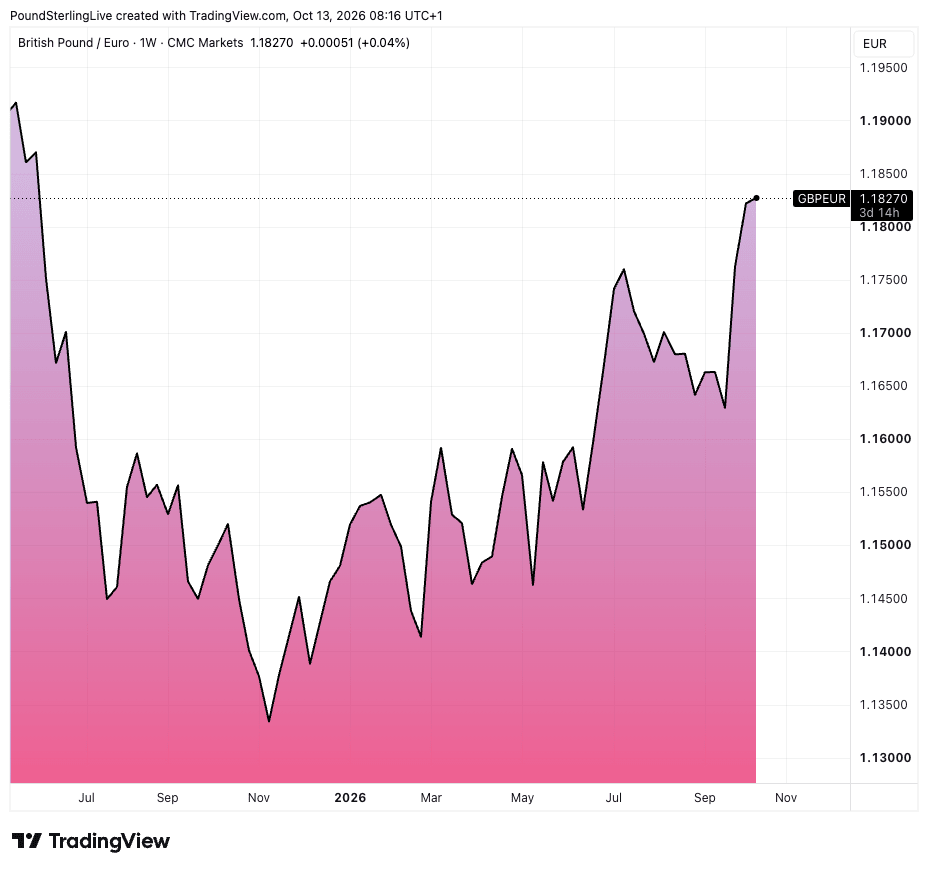
Above: GBP/EUR at daily intervals, at a 16-month high.
The pound-to-dollar rate is down 1.7% this year at 1.3214, though sterling has resisted dollar strength better than the rest of the G10.
The third quarter tested that outperformance: the pound-to-euro rate rallied to near 1.1820 in July, fell to 1.1610 in September and ended the quarter 0.3% higher, with the pound-to-dollar rate flat.
October has delivered the breakout, as French bond stress weighs on the euro and the Bank of England edges towards a hike.

Daniella Arcadipane, Senior Currency Specialist at Indigo
Moving a life-changing sum abroad? You won’t be doing it alone.
One specialist explains every step in plain English and stays with it until the money lands. FCA authorised, FRN 594433.
Talk to a specialistThe Converts
ING joins a widening group.
Rabobank lowered its euro-to-pound forecasts last week, arguing France's troubles leave sterling "less vulnerable to a sell off vs. the EUR than it would be otherwise."
Commonwealth Bank of Australia has raised its pound-to-dollar forecasts, and Société Générale says warmer UK-EU relations would make the euro-to-pound rate "attractive over the longer-term," meaning lower.
Barclays argues the prevailing narrative on the UK has become too negative, and Quilter Cheviot's Tim Armitage says the economy has "confounded economic expectations for the year."
A view that sat outside consensus in August now has five major houses behind it.
A Contrarian Signal?
When a minority view becomes consensus, the trade can be close to exhaustion, because the buyers have already bought.
Sterling is not there yet, because the forecasters have moved before the money.
"CFTC positioning data suggests that speculators have been short of GBP for some time," says Rabobank.
A market still short of the pound has buying left to do, which puts the sentiment shift nearer its beginning than its end.
The consensus is also incomplete: UniCredit, Nomura and MUFG all expect the euro to recover against the pound over six to 12 months, and the IMF itself cuts 2027 UK growth to 1.2% on energy costs and high long-term rates.
Deutsche Bank's Raja sees growth slowing to 0.1% in the fourth quarter as the energy shock reaches households.
The Budget Test
The 28 October Budget is where the new consensus meets its first test.
The IMF's fiscal tables show the UK with the most aggressive deficit-reduction plan in the G7, which leaves Chancellor John Healey little reason to deliver the fiscal shock the pound's bears require.
Our in-house modelling holds that the pound stays capped into the Budget and recovers once it passes without incident.
The signal to watch is positioning: a swing in speculative accounts from short to long would mark the moment the pound-to-euro rally becomes crowded, and above 1.18 that moment is drawing closer.
Daniella Arcadipane, Senior Currency Specialist at Indigo
Moving a life-changing sum abroad? You won’t be doing it alone.
One specialist explains every step in plain English and stays with it until the money lands. FCA authorised, FRN 594433.
Talk to a specialist