Image © Adobe Images
The IMF has lifted its UK growth forecast on AI investment, bringing consensus closer to the view Pound Sterling Live set out in August.
The International Monetary Fund raised its 2026 UK growth forecast to 1.3% on Tuesday, up from 1.0% in July, and named larger AI investment as the reason.
The UK is now forecast to be the joint second-fastest growing economy in the G7 alongside Germany, and the two are the only members of the group to receive an upgrade.
The IMF frames the UK as a beneficiary of the technology cycle, with AI-related investment and exports driving the expansion, while energy importers outside the AI supply chain have been downgraded.
Our house view is that the pound ends 2026 higher against the euro and dollar because the UK economy is outperforming expectations, and in August we identified the dispersion of the AI trade from the U.S. into the UK as the reason the consensus was underestimating the cycle.
That view sat outside consensus at the time, with the prevailing institutional forecast calling for the economy to slow sharply into year-end and for the pound to fall against both currencies.
The pound-to-euro rate trades at 1.1839, a fresh 16-month high, and the pound-to-dollar rate at 1.3237; lower but sterling has resisted USD strength moreso than the rest of the G10.
Evidence of the AI Boost Runs Through Two Channels
The first is output, where information and communication has outgrown the wider services sector for more than a decade.
"The sector boom is real, and has long been visible in the output data," says Kallum Pickering, Chief UK Economist at Peel Hunt.
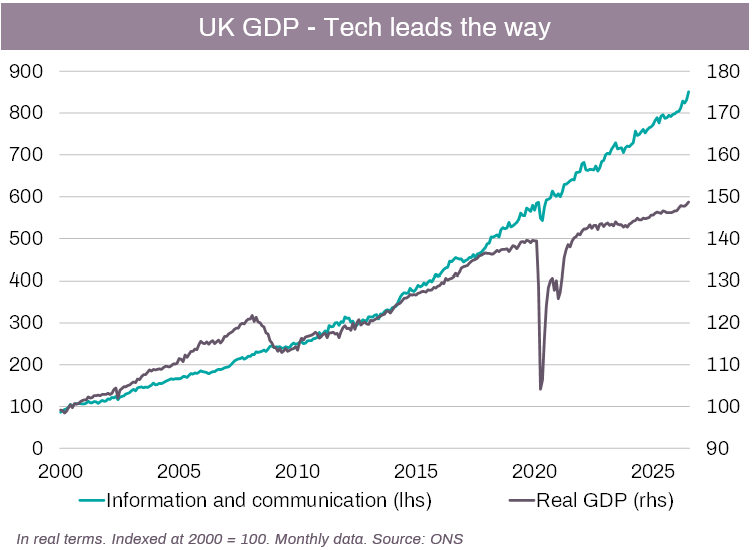
Above: Information and communication output against real GDP, indexed at 2000 = 100. Source: ONS, Peel Hunt.
The second is business investment, which rose 1.7% in the second quarter and saw annual growth restated at 5.2% from 0.8%, a revision that drove much of the Q2 GDP upgrade.
"The sector upswing is now showing up in business investment, which has accelerated beyond its long-run trend," says Pickering.
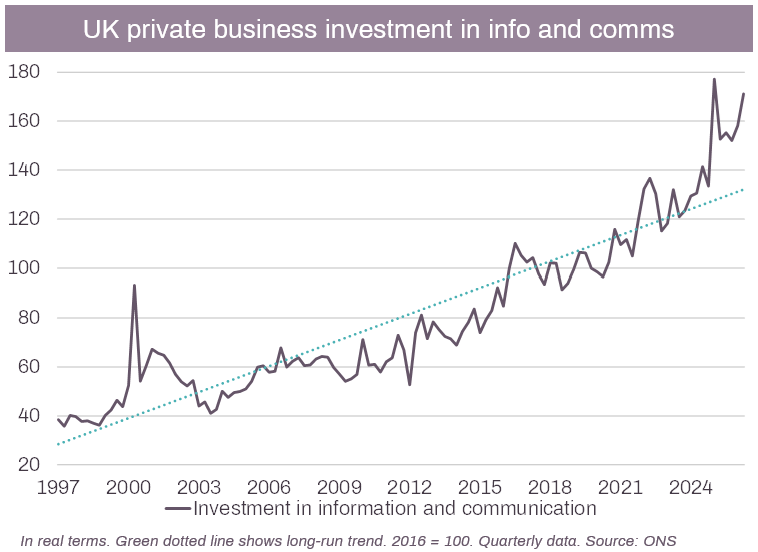
Above: Real business investment in information and communication against its long-run trend, 2016 = 100. Source: ONS, Peel Hunt.
Official ONS data for the second quarter showed British firms are demonstrating a willingness to invest capital, with business investment leaping by 1.7% quarter-to-quarter in Q2.
The dispersion of the AI trade from the U.S., where the hyperscalers reside, into closely linked economies is the likely culprit for this growth impulse.
Deutsche Bank estimates AI-related spending added 0.3 to 0.4 percentage points to cumulative GDP in the first seven months of the year.
"The contribution of AI-related output shouldn't go understated," says Sanjay Raja, Chief UK Economist at Deutsche Bank.
The bank sees the UK as the fastest-growing G7 economy in the first half and has raised its 2026 forecast to 1.4%.
Barclays argues the prevailing narrative on the UK has become too negative, citing stronger business investment and the potential for AI-driven productivity gains as reasons to question the consensus gloom.

Daniella Arcadipane, Senior Currency Specialist at Indigo
Moving a life-changing sum abroad? You won’t be doing it alone.
One specialist explains every step in plain English and stays with it until the money lands. FCA authorised, FRN 594433.
Talk to a specialistFor the government, the AI boost will be welcome, as it helps alleviate pressures posed by a tight fiscal setup ahead of the October 28 budget.
"Expectations of a sharp squeeze of the Chancellor's fiscal headroom may be overstated," says Jack Meaning, Chief UK Economist at Barclays.
UBS draws the currency conclusion.
"If investors conclude that fiscal credibility remains intact without a significant deterioration in the growth outlook, the fiscal premium attached to UK assets could begin to decline. That would be supportive not only for gilts, but potentially for sterling as well," says the UBS Chief Investment Office.
Tim Armitage, Investment Strategist at Quilter Cheviot, says the UK has "confounded economic expectations for the year" and broken its habit of starting strongly before fading in the second half.
IMF Downplays AI Boom
Despite the boost for the government in today's IMF findings, the institution is cautious in its outlook. Its baseline assumes no acceleration in productivity from AI, and it notes a gap between large task-level gains in studies and the modest effects in economy-wide data.
That is why it cuts 2027 growth to 1.2%, as higher energy prices and long-term interest rates weigh on consumption and investment.
Energy is another headwind, with gas and oil prices staying stubbornly high owing to geopolitical tensions in the Middle East.
"The unfolding energy shock has yet to fully hit households and businesses over the coming months," says Raja, who sees growth slowing to 0.1% in the fourth quarter.
Pickering's own caveat is the same constraint: productivity gains from moving closer to the technology frontier will be restrained until the UK resolves what he calls its self-inflicted chronic electricity shortage.
The AI trade itself is being tested, with the KOSPI down nearly 7% on Tuesday as investors question whether the investment can be justified by growth.
"Ahead of the reporting season, worrying questions are now being asked whether the large AI investments can be backed up by growth," says SEB.
The Budget: Discipline Is Already Priced In
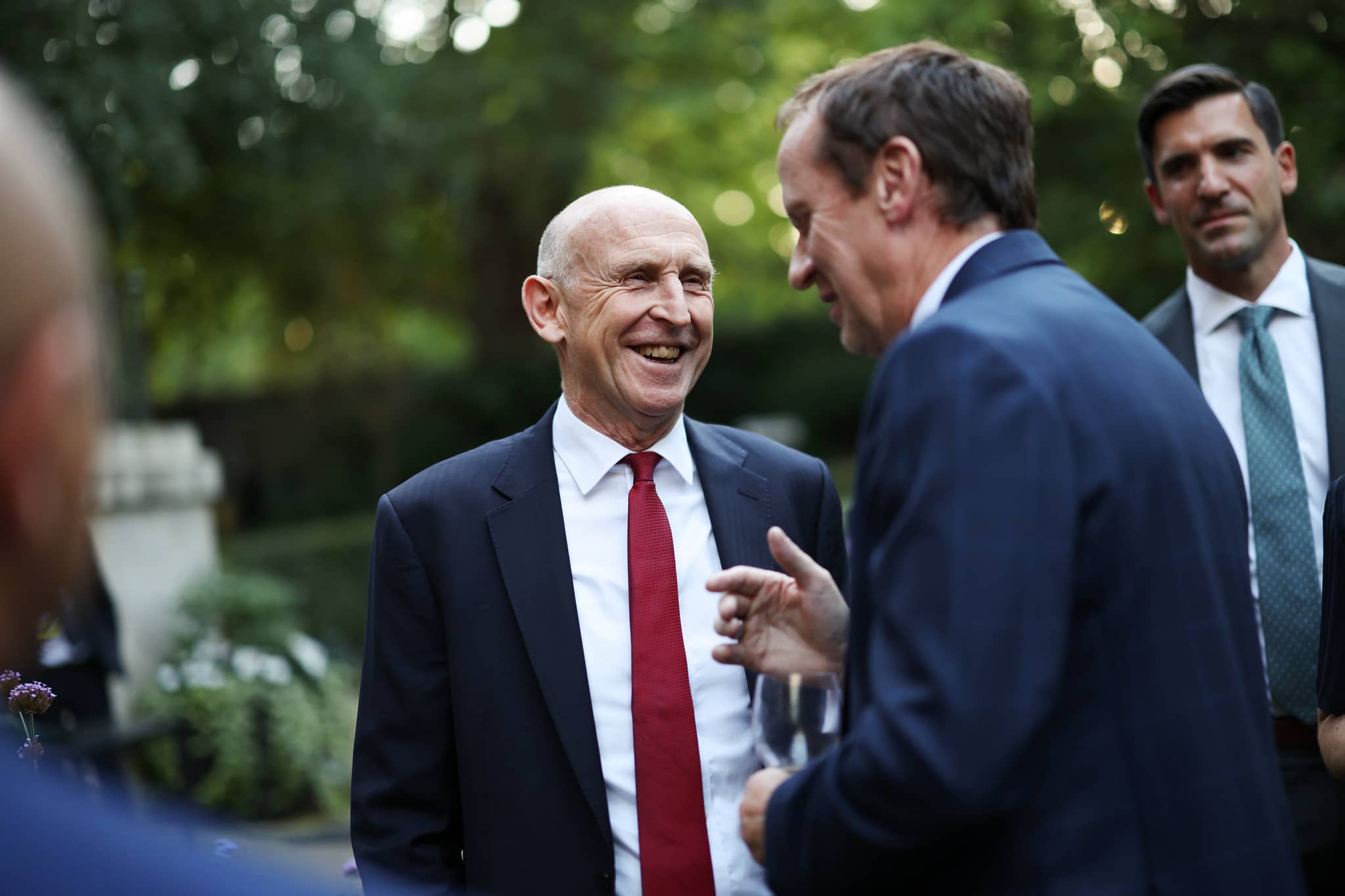
John Healey. Picture by Lauren Hurley / No 10 Downing Street.
The second leg of our house view is that the 28 October Budget disappoints the pessimists, and the IMF's fiscal tables support that read.
The UK has the most aggressive deficit-reduction plan of any G7 economy, with borrowing forecast to fall by almost four points of GDP by 2031, the largest projected reduction in the group, leaving the smallest deficit at 1.4% of GDP against 8.4% for the United States.
"Whilst there are plenty of examples of inefficient public spending, the overall profile is more disciplined than developed economy peers," says Simon French, Chief Economist at Panmure Liberum, who calls this widely under-appreciated by the commentariat.
A plan already more disciplined than its peers leaves Chancellor John Healey little reason to deliver the fiscal shock the GBP bears require, and the IMF's chief economist Silvana Tenreyro has told him to "stay the course".
French reads that instruction as doubt over whether the spending restraint pencilled in for the end of the Parliament is credible once defence demands are met.
"Those decisions tee up a very tough spending review in 2027 particularly for public sector pay, and the potential for backsliding," he says.
"Overall govt will be happy with how the IMF framed the update but fiscal storm clouds loom for next year," he adds.
That timing matters for the pound: the pressure French identifies lands at the 2027 Spending Review, not on 28 October, which leaves the near-term event as one where the Government has both the growth upgrade and the IMF's fiscal endorsement to cite.
A Budget that holds the consolidation line keeps the pound's economic support intact into year-end, and with the pound-to-euro rate at 1.1839 and the pound-to-dollar rate at 1.3237 the market is already pricing that outcome.
Daniella Arcadipane, Senior Currency Specialist at Indigo
Moving a life-changing sum abroad? You won’t be doing it alone.
One specialist explains every step in plain English and stays with it until the money lands. FCA authorised, FRN 594433.
Talk to a specialist