Image © Adobe Images
The Bank of England Governor signals waning patience with energy-driven inflation, firming the case for a November rate hike.
Bank of England Governor Andrew Bailey has signalled the central bank's tolerance for energy-driven inflation is running out, firming expectations for a November interest rate hike and lending the British Pound fresh support.
The remarks, delivered at the Istanbul Economic Forum on Thursday, move the Governor closer to the Monetary Policy Committee members who have voted for a hike since June.
"A 'look-through' approach only works if inflation expectations stay anchored to target," says Bailey. "If households and firms start building this shock into their wage and price setting behaviour, this temporary effect quickly turns into a persistent" one.
Looking through means a central bank tolerates a temporary jump in inflation caused by an external shock, such as the surge in oil prices, without raising interest rates.
Bailey made clear that tolerance depends on expectations, and he flagged the UK's as vulnerable.
"We are conscious that the history of recent years pointed to a risk of elevated inflation expectations," he says.
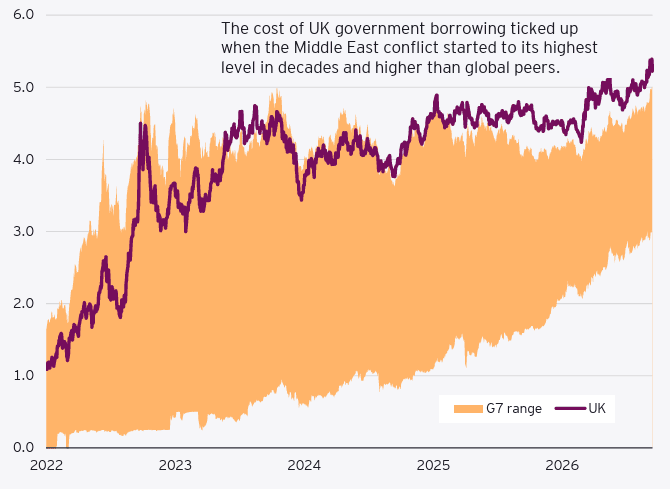
Above: UK ten-year bond yields trade at a premium to other G7 nations, a signal of inflation's expected persistence in the UK.
UK inflation has exceeded the 2% target in all but three months of the past five years, and the Bank expects it to rise above 4% in the coming months.
The longer energy prices stay high, the more difficult it becomes for the Bank to treat the shock as temporary, Bailey says.
The Governor laid the groundwork for this shift in September, when he and Deputy Governors Sarah Breeden, Clare Lombardelli and Dave Ramsden signalled they could back a rate hike, even as the MPC voted 6-3 to hold Bank Rate at 3.75%.

Daniella Arcadipane, Senior Currency Specialist at Indigo
Moving a life-changing sum abroad? You won’t be doing it alone.
One specialist explains every step in plain English and stays with it until the money lands. FCA authorised, FRN 594433.
Talk to a specialistMoney markets now price around a 90% chance of a quarter-point hike to 4.0% on 5 November.
Bailey also had a message for the Treasury ahead of the 28 October Budget.
"Whatever the stance of fiscal policy is, it must be credible and direct to that stability, and seen to be as such by markets," he says.
The 10-year gilt yield hit 5.44% on Wednesday, a 19-year high.
"We can't in any way be relaxed about the current state of financial markets," says Bailey.
Greene and Pill Press for Action
Turning to the MPC's hawks, Megan Greene warned the Bank against leaning on high bond yields to do its job for it.
"It's quite dangerous to just assume the markets will do your work for you .... At some point, you need to put your money where your mouth is," said Greene, speaking at a conference in Cape Town on Thursday.
Greene has voted for a hike at each of the June, July and September meetings, alongside Chief Economist Huw Pill and Catherine Mann.
"We need to ensure monetary policy is resolutely focused on inflation pressure," Pill said on Thursday.
Lombardelli, the swing vote whose shift would decide November, set out her conditions in Warsaw on 24 September.
"Policy is increasingly likely to need to tighten if elevated energy prices persist, absent clear evidence of disinflation or weaker activity," she said.
Brent crude trades near $103 a barrel, giving no sign of the energy relief that would satisfy her test.
Pound Finds Firmer Footing
Today, the Pound to Dollar rate is at 1.3244, recovering from 1.3207 on Thursday morning, when Federal Reserve minutes pointed to a December US rate hike.
The Pound to Euro rate is at 1.1788, close to its one-year high.
With both the Bank of England and the Fed now leaning towards hikes, sterling is holding its ground against the dollar, while the euro carries the weight of French fiscal stress.
CIBC Capital Markets warned ahead of Thursday's speeches that "any signs of policy patience" from the Bank's leadership would risk softening November pricing and amplify pressure on sterling. Bailey's remarks gave no such signal.
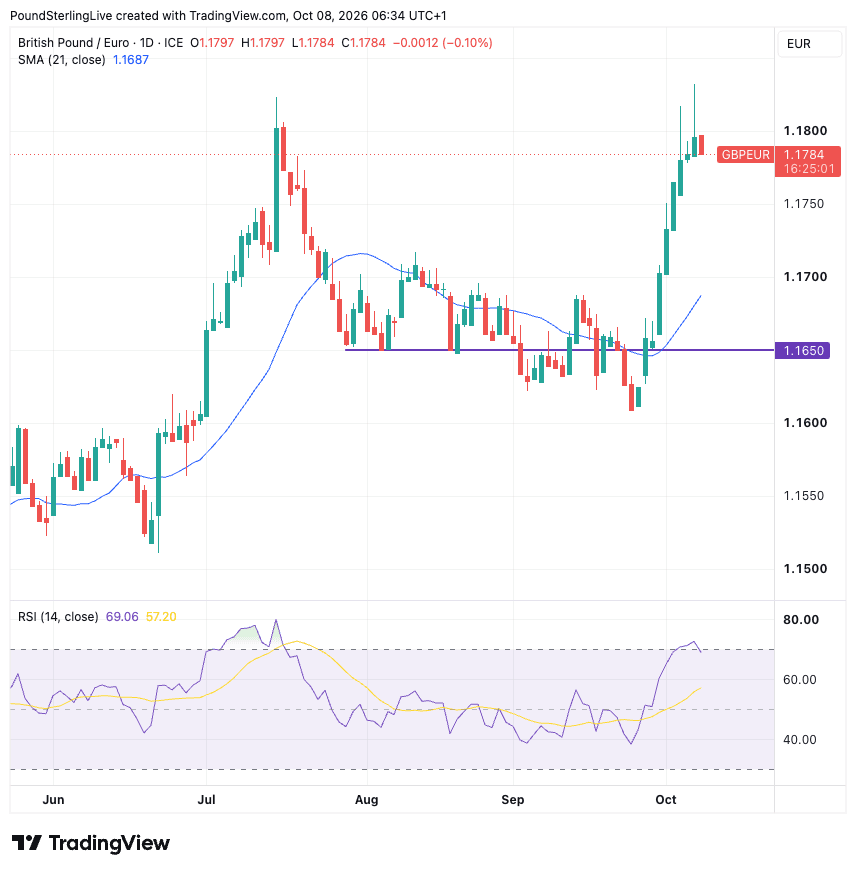
Jeremy Stretch, Chief International Strategist at CIBC, still judges the market "too deterministic" in pricing a November hike, with the Bank likely to listen closely to the Budget before voting.
Berenberg agrees a hike is coming but doubts it is the start of a cycle.
"We expect a solitary 25bp hike in November followed by a return to policy loosening in Q4 2027," says Andrew Wishart, Senior UK Economist at Berenberg.
Markets price around four hikes over the next two years, so any retreat towards a single move would remove some of the rate support behind the pound.
Our house view is that the pound stays capped into the 28 October Budget and recovers afterwards, provided the Budget passes as a non-event.
Bailey's call for fiscal credibility puts the Chancellor on notice that the Bank will be watching the Budget before it moves a week later.
A hawkish Bank of England keeps the 2026 low at 1.3140 protected for the Pound to Dollar rate, with a recovery first needing to clear 1.3274 and then the 30 September peak at 1.3311.
Daniella Arcadipane, Senior Currency Specialist at Indigo
Moving a life-changing sum abroad? You won’t be doing it alone.
One specialist explains every step in plain English and stays with it until the money lands. FCA authorised, FRN 594433.
Talk to a specialist