
Image © Adobe Images
The euro could fall through 1.10 if markets unwind the ECB rate increases they currently price.
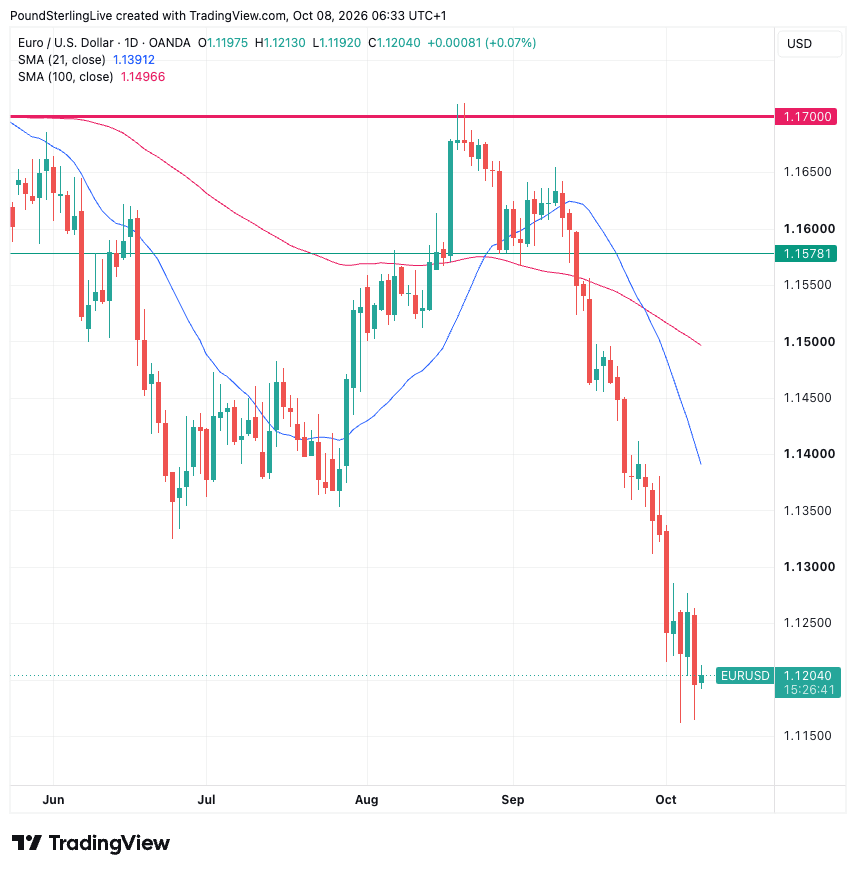
The euro-to-dollar rate slipped briefly below 1.12 on Wednesday and trades at 1.1204 on Thursday, three big figures above the impending low that a major global investment bank now forecasts.
"We expect both EUR/USD and GBP/USD to fall over H1 2027 as interest rate differentials move against the European currencies," says Samara Hammoud, International Economist and Currency Strategist at Commonwealth Bank of Australia.
CBA forecasts the euro-to-dollar rate at 1.09 and the pound-to-dollar rate at 1.24 by mid-2027, before both recover later in the year.
The call rests on rate pricing. Markets price around three additional ECB increases and four from the Bank of England, against CBA's forecast of one apiece, and the bank expects some of that pricing to unwind as underlying inflation pressures ease.
Fiscal and geopolitical risks sit on top of the rate argument, with France's fiscal outlook the particular risk for the euro and limited UK fiscal space weighing on the pound.
CBA expects both currencies to only recover against the dollar from the second half of 2027 as the dollar peaks and the global economy strengthens.
EUR/USD: Rates Doing the Damage Now
Commerzbank's reading of this week complicates the case that rate differentials are doing the damage now.
Wednesday's move below 1.12 was primarily driven by euro weakness, and the expected rate differential between the euro area and the US has actually been somewhat supportive of the euro over the past few days.
The probability of a Fed hike in October is now seen as lower than it was at the end of last week, a view the FOMC minutes reinforced on Wednesday.
Many policymakers continued to favour another increase this year, though the timing remains uncertain, and the minutes referred to a single additional hike rather than the multiple increases markets still price in.
That gap between the Fed's own language and market pricing is the same gap CBA is forecasting against on the European side.
Commerzbank does not read it as markets being wrong.
Elevated energy prices leave inflation risks tilted to the upside and raise the possibility of a more aggressive tightening cycle, with the caution in the minutes pointing to the uncertainty around the path now priced.
"In the near term, however, attention is likely to remain focused on France," says Thu Lan Nguyen, Head of FX and Commodity Research at Commerzbank.
Marine Le Pen's fiscal plans delivered only temporary relief.

Daniella Arcadipane, Senior Currency Specialist at Indigo
Moving a life-changing sum abroad? You won’t be doing it alone.
One specialist explains every step in plain English and stays with it until the money lands. FCA authorised, FRN 594433.
Talk to a specialistShe called on the ECB to intervene to give euro area governments greater fiscal room for manoeuvre at the same time as unveiling them.
"That sounds very much like an attempt to have it both ways," says Nguyen.
France's own central bank governor then downplayed the need for ECB intervention and spoke out against political pressure on the central bank.
"A lasting solution to the issue remains elusive for now. As a result, near-term risks for EUR-USD remain skewed to the downside," says Nguyen.
The ECB publishes the account of its 9 to 10 September meeting at 12:30 BST, the first look at how the Governing Council was weighing these pressures before the French selloff began.
EUR/USD: The Levels
Beneath the market, 1.1162 is Monday's low and the floor of 2026, with 1.1075 the next support and Thursday's 1.1192 low showing the market has not yet retested it.
Sub-1.10 requires both to give way, and nothing in this week's research has it happening on the rate story alone.
Brent crude above $102 after a report that the White House has asked the Pentagon to draw up strike options against Iran keeps the energy risk live on the inflation side.
Above the market, 1.1289 is the level the euro has to reclaim to argue the breakdown has failed, with the falling 21-day moving average at 1.1391 and the 100-day at 1.1497 the tests of the trend.
Both averages are declining and the market has traded beneath them since mid-September, which is the technical picture CBA's 1.09 forecast is extrapolating from.
The ECB account at 12:30 BST and the Bank of England speakers either side of it decide whether the rate pricing CBA expects to unwind starts unwinding this week.
Daniella Arcadipane, Senior Currency Specialist at Indigo
Moving a life-changing sum abroad? You won’t be doing it alone.
One specialist explains every step in plain English and stays with it until the money lands. FCA authorised, FRN 594433.
Talk to a specialist