

Image © Adobe Images
Euro weakness drives sterling to a 16-month best, with resilient UK shoppers keeping November rate hike bets alive.
The Pound to Euro exchange rate hit a new 16-month high on Tuesday as surging energy prices, French fiscal stress and heavy speculative selling drove the euro lower, while UK shoppers showed surprising resilience in the face of rising costs.
The pair reached 1.1844 in early trade, its best level since June 2025, before settling at 1.1831.
Euro weakness is doing the heavy lifting: since 25 September, when GBP/EUR began its 1.7% climb from 1.1628, the Euro to Dollar rate has fallen 1.9% to 1.1179 while the Pound to Dollar rate is little changed at 1.3214.
Sterling's own support comes from the high street, where like-for-like retail sales rose 1% in September, beating forecasts, with total sales up 1.3% year-on-year, according to the British Retail Consortium.
"Shoppers in the UK appear to have thrown more caution to the wind despite the prospect of rising bills, with retail sales rising in a more robust fashion than expected in September," says Susannah Streeter, Chief Investment Strategist at Wealth Club.
She adds that Barclays data backs up the trend, with non-essential spending up 1.8% even in a month when fuel spending jumped 17.3%, and that household financial confidence rose to a seven-month high of 67%.
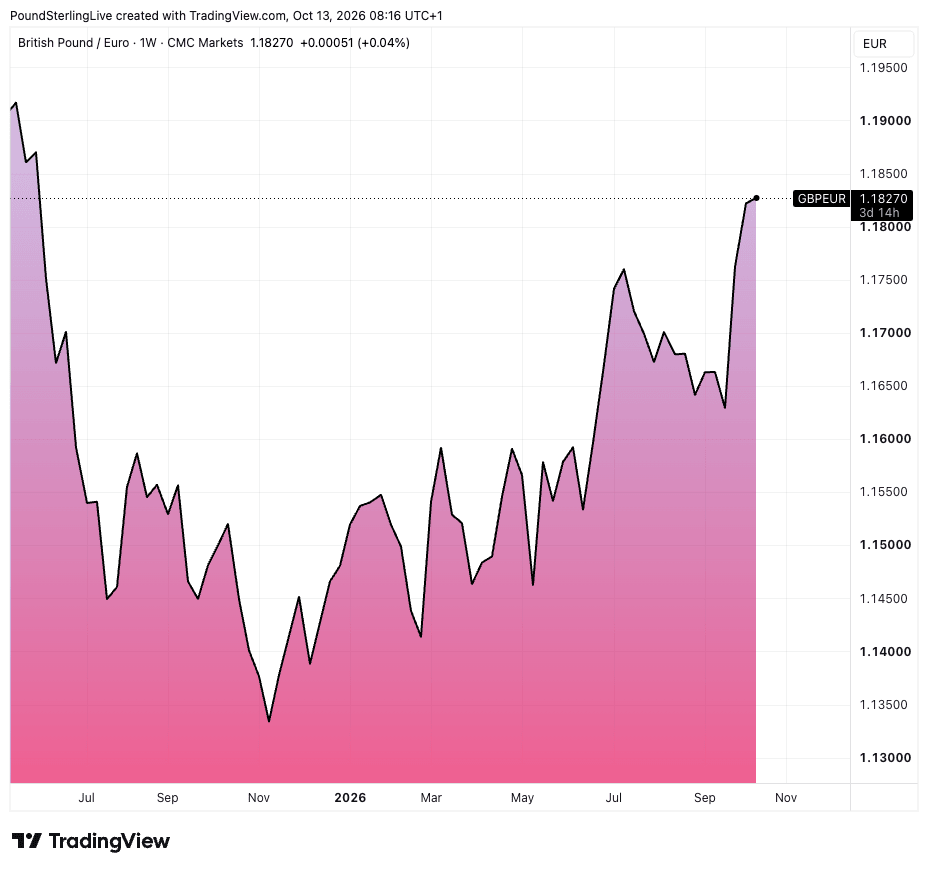
Above: GBP/EUR at weekly intervals, contextualising current levels for euro buyers.
Spending that holds up under this pressure supports market pricing that puts the odds of a 5 November Bank of England rate hike at close to 90%.
It also fits our house view that the UK economy will prove resilient enough to underpin the pound into year-end.
That view is not blind to the headwinds building into 2027: energy bills are set to rise again in January, the Budget is expected to raise taxes, and the BRC itself calls September's figures subdued, with Chief Executive Helen Dickinson saying households are "still cautious with their spending ahead of expected rises in household bills and taxes."
Energy Takes Over From France as the Euro's Burden
A fresh surge in energy prices has joined French fiscal worries as the single currency's main headwind, with Brent crude topping $106 a barrel on Monday and European gas prices retesting multi-year highs on Tuesday (see chart below).
"It's energy that weighed on the euro this time around, taking over from the fiscal narrative that dominated last week," says a morning market release from KBC Bank.
"EUR/USD lost the 1.12 to close at 1.1155, a new year-to-date low. Euro weakness prevailed in EUR/GBP as well with the pair slipping through the 2026 troughs to 0.8446. EUR in both cases suffers from a deteriorating technical picture," adds the Belgian bank.
KBC's EUR/GBP low of 0.8446 is equivalent to 1.1840 in GBP/EUR.
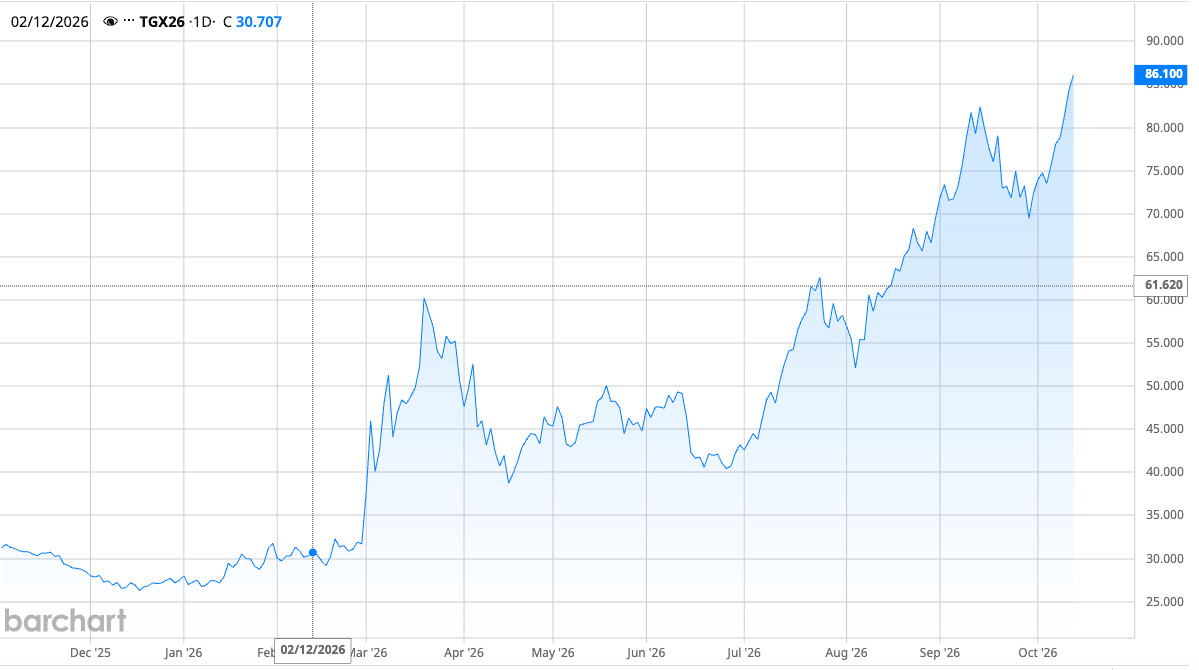
Above: EU gas prices, for November delivery, are at a new high today.

Daniella Arcadipane, Senior Currency Specialist at Indigo
Moving a life-changing sum abroad? You won’t be doing it alone.
One specialist explains every step in plain English and stays with it until the money lands. FCA authorised, FRN 594433.
Talk to a specialistFrench public finance concerns continue to simmer in the background, and speculators are adding to bets against the single currency, with Rabobank linking wider French bond spreads to revived contagion and outflow concerns on top of energy, geopolitical and growth headwinds.
"EUR net shorts have increased further to their highest level since February of 2020, at almost 100,000 contracts," says Rabobank in a weekly review of futures positioning.
"The French government's latest budget plans have failed to restore investor confidence, and there is no clear near-term catalyst to trigger a turnaround in bearish sentiment. It leaves the EUR vulnerable to further weakness in the week ahead," says Lee Hardman, Senior Currency Analyst at MUFG.
MUFG names a deal to end the conflict between the US and Iran as the external catalyst that could ease the risk of a prolonged energy shock and turn the euro around.
ING warns the euro's losses would deepen were French debt to fall further and force the European Central Bank to abandon its rate hikes or restart bond buying.
The bank favours sterling on the other side of the trade.
"Aside from the dollar, we like the pound in the G10 space; it looks like the Bank of England will have to hike after all, and warmer UK-EU relations could see sterling rewarded," says ING.
Overbought GBP/EUR Faces a Pause
Although sterling rises to fresh highs, overbought conditions are a concern. The Relative Strength Index (RSI), a momentum gauge where readings above 70 mark an overbought market, stands at 75 on the GBP/EUR daily, extending the overbought conditions flagged in our week ahead forecast.
Spot also sits about 1% above its 21-day moving average at 1.1716, and PSL's modelling shows that a deviation this size closes through either a pullback or a period of consolidation.
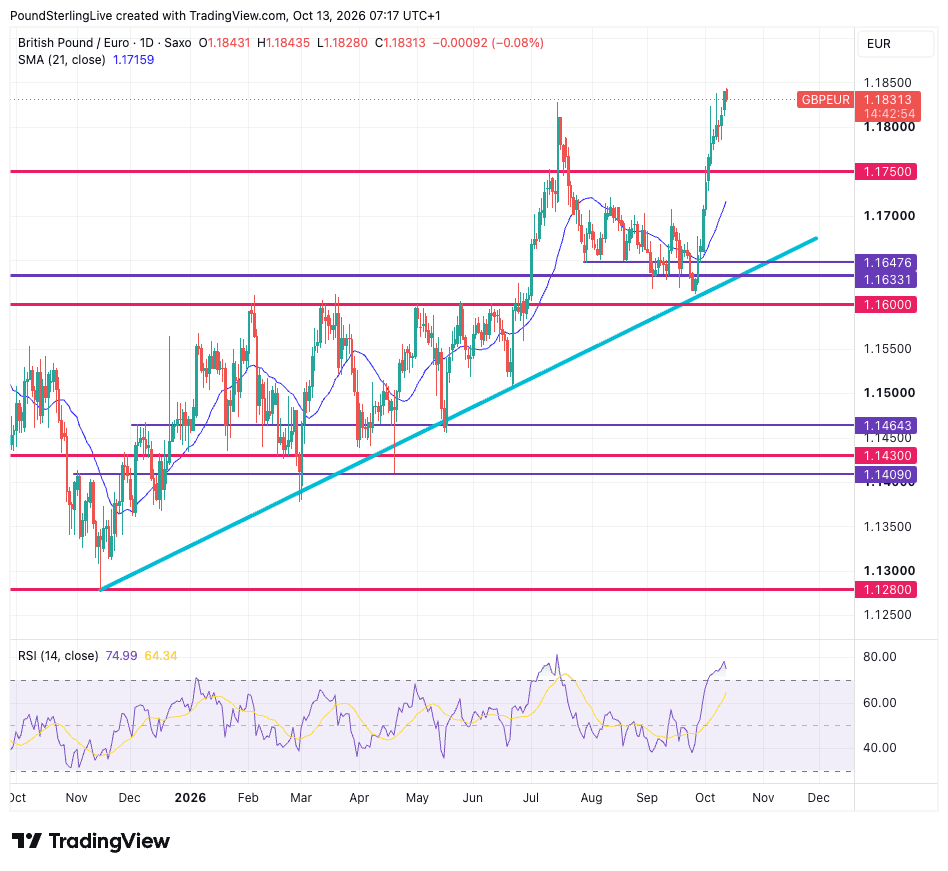
Above: GBP/EUR at daily intervals with the 21-day moving average and the RSI in the lower panel.
The uptrend that began at last November's low near 1.1280 remains intact, with the rising trendline now meeting the former range floor near 1.1650, and the UK's resilience argues any pullback stays shallow.
Crédit Agricole's fair value model judges EUR/GBP modestly undervalued against a fair value of 0.8521, equivalent to 1.1736 in GBP/EUR, below today's spot.
Goldman Sachs forecasts EUR/GBP at 0.88 in 12 months, equivalent to 1.1364 in GBP/EUR.
Rabobank notes that speculators' bets against the pound are at a three-month high ahead of the Budget, a reminder that the 28 October event can still remove sterling from the trade.
GBP Looking Increasingly Relaxed into Budget
The fresh highs in the GBP/EUR exchange rate indicate the key risk event facing sterling - the October 28 budget - is yet to register as a major source of anxiety.
If anything, the direction of the channel is consistent with Pound Sterling Live's view that the Prime Minister Burnham will play it safe in his first budget, avoiding negative market reactions.
Wealth Club's Streeter says today's data showing resilient shoppers puts the Chancellor under more pressure not to rock the boat with big tax changes.
Barclays says expectations of a sharp squeeze on the Chancellor's fiscal headroom may be overstated, as stronger earnings and tax receipts offset higher gilt yields.
UBS says a credible Budget could reduce the fiscal premium attached to UK assets, which would support gilts and potentially sterling.
Options markets lean the same way, with Societe Generale asking whether EUR/GBP three-month risk reversals are about to turn negative, a sign the premium paid for euro upside is vanishing.
The bank identifies a break of 0.8450 in EUR/GBP, equivalent to 1.1834 in GBP/EUR, as the trigger for a move towards 0.8405 and 0.8370, equivalent to 1.1898 and 1.1947.
UK August GDP data on Thursday is the next domestic test, with Pantheon Macroeconomics forecasting a 0.3% monthly contraction after July's surge but third-quarter growth still on track for 0.5%, a resilience it says justifies a November hike.
Any pullback is likely to find first support at 1.1750, ahead of the rising 21-day average at 1.1716, while a daily close above 1.1844 opens the way to 1.1898.