

Image © Adobe Images
Sterling's overbought rally against the euro faces consolidation, with French debt stress deciding whether gains extend.
The Pound to Euro exchange rate starts the week overbought, though French debt stress keeps the door open to further gains.
The pair is at 1.1812, with the Relative Strength Index (RSI) at 73.
It has sat in overbought territory for several days.
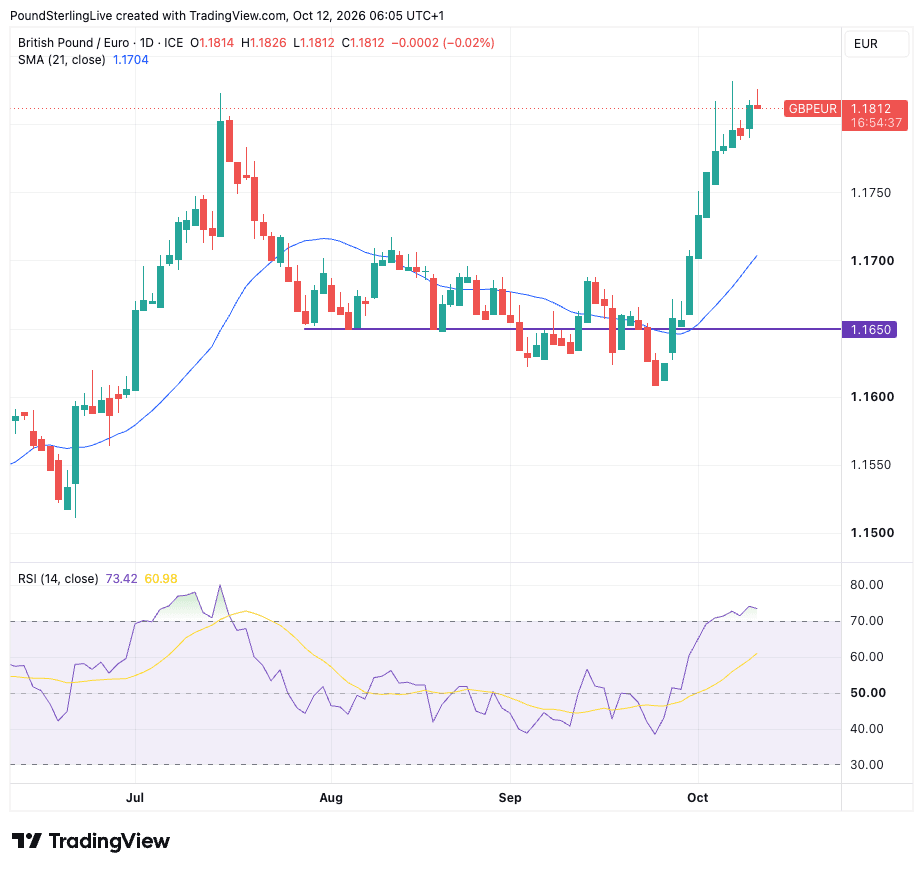
Above: GBP/EUR at daily intervals with the 21-day moving average and the RSI in the lower panel.
The July overbought episode ran for nearly half a month, so the reading does not in itself mark the end of the gains.
Spot is, however, stretched well above its 21-day moving average at 1.1704, and PSL's modelling shows a deviation of this size closes through either a pullback or a period of consolidation.
Any pullback is liable to be shallow, with the rising 21-day average the first area of support and the former range floor at 1.1650 below that.
France is the main disruptor.
Fresh nerves over French debt open the door to further gains, while a calming of those nerves offers the route to a pullback.
The spread between French and German ten-year borrowing costs, the favoured measure of French stress, has nearly doubled since January on doubts over the country's 2027 Budget.
"In an unforgiving bond market, and with a FN that is sending only very loose and unquantified statements of fiscal discipline, the market will continue to translate French woes into expectations of a more dovish ECB reaction function," says Barclays, the investment bank.
A commitment from the European Central Bank to suppress French bond yields would be the most likely trigger for a turn lower in the pair.
ECB President Christine Lagarde says the central bank has the tools to counter disorderly market dynamics, though Governing Council member Emmanuel Moulin says conditions for intervention in French bonds are not met.
Goldman Sachs says ECB support programmes "tend to be positive for the currency", citing the 2012 'Whatever it Takes' speech, but judges them likely only if conditions worsen.
The UK this Week: GDP and the Budget
Lloyds is positive on sterling against the euro in the short term, citing near-90% market pricing for a November Bank of England rate hike alongside French fiscal pressure.
MUFG says UK fiscal concerns "are not as acute as in France currently", adding that a cautious Budget on 28 October "would help to ease downside risks for the pound."
UK August GDP data this week is the domestic test, with Lloyds and Investec both forecasting a 0.1% month-on-month contraction after July's 0.4% surge.
"The strong start to the quarter means Q3 growth could still reach around 0.5% q/q. That would be well above the Bank of England's forecast and point to continued strength in the UK economy through the summer," says Lloyds.
That outperformance underpins our house view that sterling grinds higher into year-end once the Budget passes.
Goldman Sachs forecasts EUR/GBP at 0.88 in 12 months, equivalent to 1.1364 in GBP/EUR, which leaves it well below spot.
A dip back towards 1.1704 is the likely path this week should French spreads stabilise, while renewed French stress opens the 1.1850 area.

Daniella Arcadipane, Senior Currency Specialist at Indigo
Moving a life-changing sum abroad? You won’t be doing it alone.
One specialist explains every step in plain English and stays with it until the money lands. FCA authorised, FRN 594433.
Talk to a specialist