

Image © Adobe Images
French debt stress keeps the euro under pressure, though oversold conditions and positioning argue for a pause.
The Euro to Dollar exchange rate looks oversold heading into a week dominated by US inflation data and French debt stress.
The pair is at 1.1201, with the RSI at 25.
That reading is consistent with a pause in dollar appreciation, and Barclays flags positioning headwinds for the dollar.
Downside remains preferred, though a pause in the selloff is possible this week.
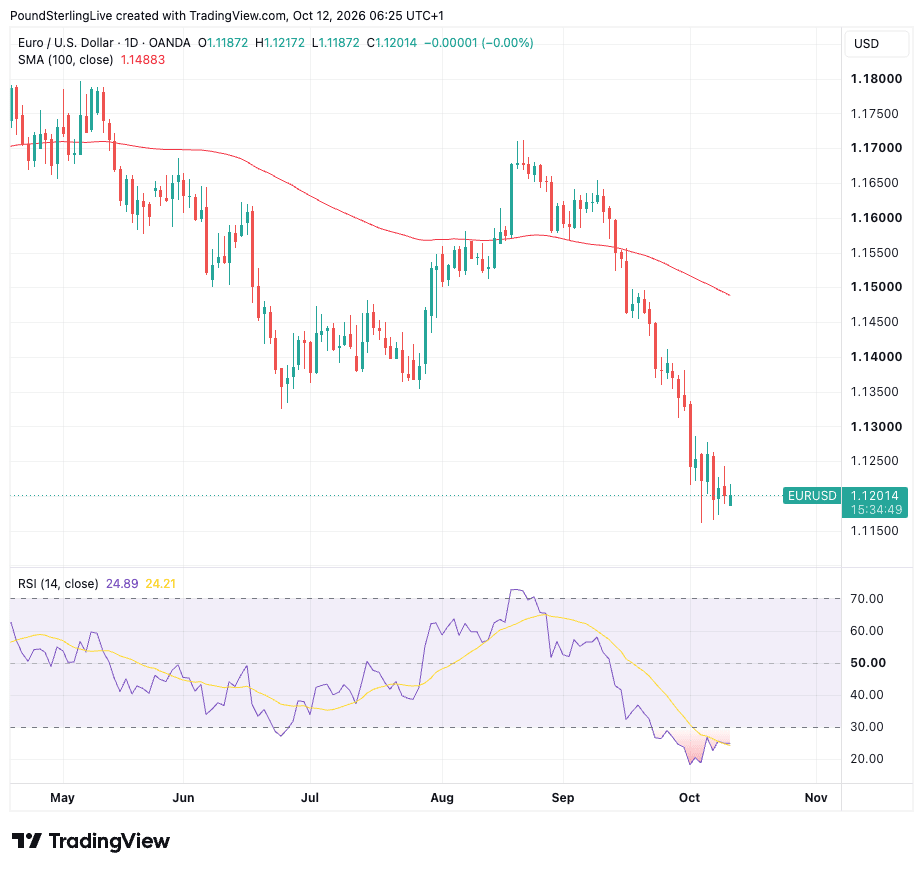
Above: EUR/USD at daily intervals with the 100-day moving average and the RSI in the lower panel.
The 50% retracement of the January 2025 to January 2026 rally sits at 1.1135 and has so far held the decline.
CIBC watches 1.1111, the midpoint of the 2025 trading range, as the next downside level.
Below there, the 61.8% retracement at 1.1090 is the next support.
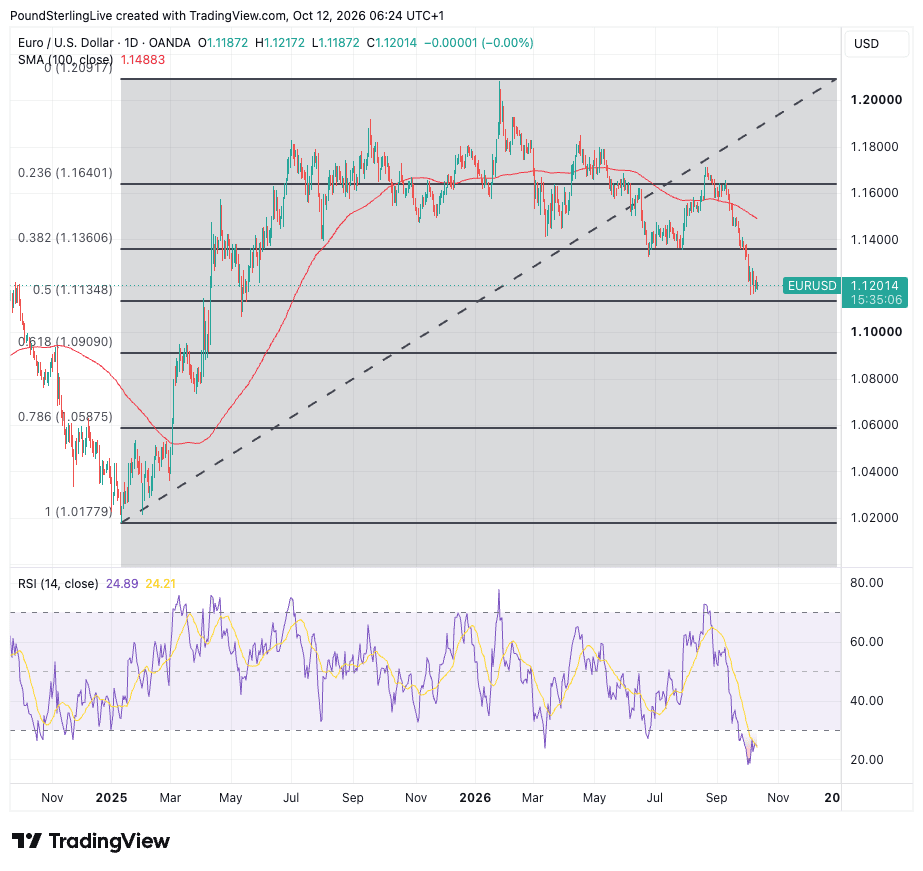
Above: EUR/USD with Fibonacci retracements of the January 2025 to January 2026 rally.
How Much of France Is in the Price
France is the main driver, and how much bad news is already in the price determines the outlook.
The spread between French and German ten-year borrowing costs, the favoured measure of French stress, has nearly doubled since January.
Lloyds argues the market has priced too much.
"If the pace of convergence implicitly assumed proves slower than markets currently anticipate, the balance of risks may become increasingly asymmetric, leaving French assets more vulnerable to positive surprises than additional bad news," says Lloyds.
Commonwealth Bank of Australia says the pair stays vulnerable to further spread widening should French government debt risks escalate.
Goldman Sachs is tactically wary of extrapolating the euro's selloff, forecasting EUR/USD at 1.14 in three months, though it says risks are skewed lower on sustained European fiscal contagion.
Barclays' risk premium model points to a level well below 1.05 over the medium term.
"Our risk premium model still points to a premium of about 3.5% in EURUSD," says Barclays.
Positioning Into US Inflation
The consensus expects US headline CPI inflation to rise to 3.6% year-on-year in September when the figures land on Wednesday.
"Positioning is rarely a good factor on which to make investment decisions, but whenever we have ignored it in favour of macro dynamics, nearly always we have gotten the tactical price action very wrong," says Barclays, noting the market has swung from very short to quite long dollars during this rally.
If the market judges France is now understood, some short-term tactical upside is possible, and positioning does not favour dollar strength into the inflation print.
A recovery would target the 38.2% retracement at 1.1361, while a break below 1.1135 opens 1.1090.