

Image © Adobe Images
Sterling's run against the euro stalled at a fresh high on the US inflation print, with mean reversion now the base case.
The Pound to Euro exchange rate printed a shooting star candle on Wednesday, the first reversal signal of the October rally, after hot US core inflation sparked a spike to 1.1862 that was fully unwound within three hours.
The pair opened at 1.1836, reached 1.1867 and closed at 1.1822, within a few pips of the day's low, and trades at 1.1804 in early Thursday trade.
The 15-minute chart shows the pound initially outperforming the euro on the 13:30 release before sellers took over, with the pair dropping four tenths of a cent from the high into the London close.
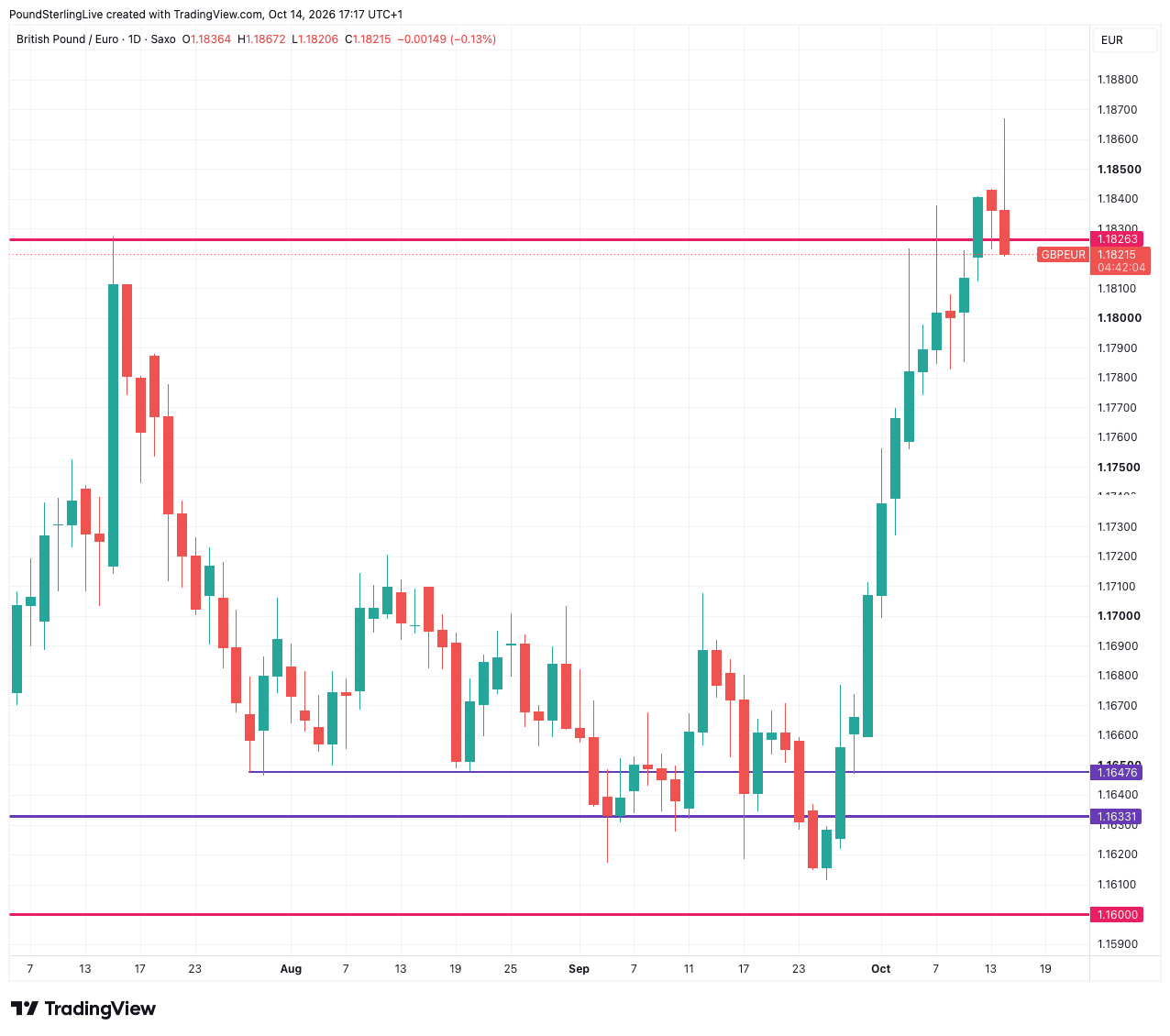
Above: GBP/EUR at 15-minute intervals. The spike to 1.1862 printed on the US inflation release and was sold within the session.
The pattern matters because it shows buyers losing control at the top of a near-vertical run: the long upper wick records a push to new highs that was rejected, and the close below the open confirms sellers had the last word.
It follows a bearish candle on Tuesday that carried its own upper wick, so the market has rejected the 1.1860s twice in two sessions.
The close at 1.1822 also sits beneath the July peak at 1.1826, which puts the breakout above that level in doubt on a closing basis.
A single candle needs confirmation, which requires a daily close below Wednesday's low at 1.1821, and Thursday's early trade below that level puts the signal on course to be confirmed.
The Dollar and Inflation Data Behind the Spike
US core inflation came in hotter than expected, reviving October Fed hike bets and pushing the Pound to Dollar rate down to 1.3149 and the Euro to Dollar rate to 1.1124.
Sterling gave back more than the euro once the initial reaction faded, which is why the cross reversed.
Investment bank analysts expect the dollar to stay firm, which keeps the pound-dollar leg heavy and removes the prop beneath GBP/EUR.
"A clear macro or market catalyst is needed for a reversal, and we do not see one. Fed tightening expectations remain stickier than those for most other central banks, limiting USD downside even if oil prices retreat," says ING in a recent update.
ING adds that net long dollar positioning against the G10 has reached 24% of open interest, with options markets sending the same signal.

Daniella Arcadipane, Senior Currency Specialist at Indigo
Moving a life-changing sum abroad? You won’t be doing it alone.
One specialist explains every step in plain English and stays with it until the money lands. FCA authorised, FRN 594433.
Talk to a specialistWhy a Pullback is Overdue
Spot closed 0.9% above its 21-day moving average at 1.1716, and PSL's modelling shows a deviation of this size closes through either a pullback or a period of consolidation.
The shooting star points to the pullback route.
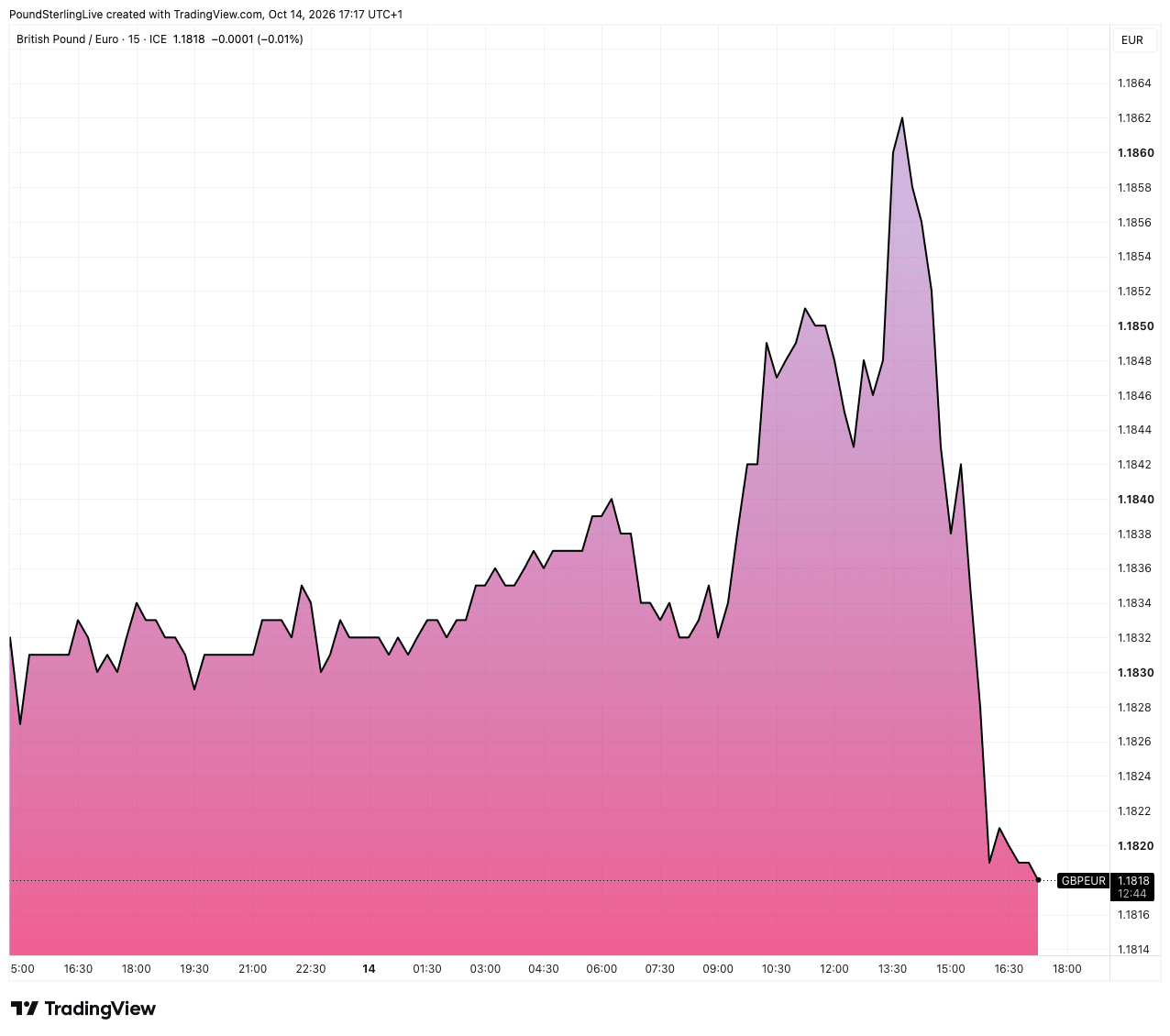
Above: GBP/EUR at daily intervals. Wednesday's candle rejected the 1.1860s and closed back beneath the July peak at 1.1826.
The pound carries two risks of its own into the pullback.
Lloyds argues UK rates markets have priced a degree of Bank of England convergence with the Fed that is hard to justify, with hikes beyond November difficult to reconcile with policy lags, unemployment costs and energy-driven disinflation.
"A resilient currency would afford policymakers greater scope to resist importing Fed tightening and retain optionality after a likely November hike," says Lloyds.
Pantheon Macroeconomics expects the 28 October Budget to cut fiscal headroom to £19bn from £23.9bn and says the plan will lack credibility, with tens of billions of likely commitments deferred to next year's Spending Review.
"Tiny headroom also leaves the forecast highly sensitive to rates: another 30bp rise in gilt yields and Bank Rate would cut it by about £5B. That leaves asymmetric upside risk to gilt yields," says Pantheon.
Why the Pullback Stays Shallow
The euro's problems have not gone away, which argues against a deep retreat in GBP/EUR.
ING has cut its EUR/GBP forecast to a 0.84 to 0.85 range for at least several more months, equivalent to 1.1765 to 1.1905 in GBP/EUR, a range that puts Wednesday's close in its lower half.
"Idiosyncratic risks surrounding the euro are unlikely to fade anytime soon, and the Bank of England has sent a clear enough signal that it is prepared to hike," says ING.
OCBC says France has entered a more dangerous phase, with public debt at 119% of GDP in the second quarter, above the Covid-era peak, and the bond sell-off feeding on itself.
"Higher yields raise borrowing costs and deepen concerns about public finances, which in turn drives more selling and creates a self-reinforcing cycle," says Chester Liaw, G7 Economist at OCBC.
The one development that would turn the euro, a commitment from the European Central Bank to suppress French yields, remains some way off.
Lloyds says the widening in French spreads reflects fundamentals, which is "quite distinctly different from saying there are disorderly unwarranted market conditions," the test the ECB's intervention tool requires.
Convera says Europe's fiscal position makes the UK look good by comparison and favours sterling against the euro on a medium-term basis.
Our house view is that the UK economy proves resilient enough to underpin the pound into year-end, with dips towards the 21-day average likely to be bought once the Budget passes.
The Levels
A daily close below 1.1821 confirms the reversal and marks 1.1867 as the top of this leg.
First support sits at 1.1750, ahead of the rising 21-day average at 1.1716, with the former range floor at 1.1650 and the September support at 1.1633 beneath.
A daily close back above the July peak at 1.1826 keeps the breakout alive, and a close above 1.1844 negates the signal altogether.