
Image © Adobe Images
Official data confirms pound sterling is supported by resilient growth that defies consensus, as we called in the summer.
The UK economy is growing at its fastest annual pace in almost four years, confirming Pound Sterling Live's thematic thesis that the pound stays supported into year-end.
GDP grew 0.1% in August against a consensus for a 0.1% contraction, according to the ONS, the fourth consecutive monthly beat and the sixth upside surprise in eight months this year.
Thursday's figure was disappointing on a month-on-month basis, but the cumulative growth cycle cannot be ignored.
As Simon French at Panmure Liberum notes today, this is the fastest rate of UK economic growth for almost four years at 2.1% y/y and a sprightly 0.7% q/q to the end of August.
"Following three years over which growth has averaged 1.1%, the acceleration through the 2% threshold gives the data some wow factor," says Andrew Wishart, Senior UK Economist at Berenberg.
Lloyds Bank calculates that flat GDP in September would still leave third-quarter growth at around 0.7%, against the Bank of England's July projection of 0.1% and its September upgrade to 0.4%.
The data shows services, manufacturing, investment and trade all carrying decent third-quarter momentum, with manufacturing output up 1.2% in August and wholesale trade rising on strong purchases of IT equipment.
AI in the Official Numbers
AI investment continues to show up in the figures: the official data now confirms the narrative that the UK economy is particularly exposed to benefit from AI investment diffusing out of the US.
"The sector breakdown suggests that AI is behind much of the upswing," says Wishart, who calculates that information and communication output is up 7.1% on the year, contributing 0.5 percentage points to annual growth.
Professional, scientific and technical activities added a further 0.8 percentage points, with output up 9% on the year.
Pantheon Macroeconomics sees the same signal in the 'big three' professional services sectors.
"It's hard to be sure of the drivers, but these industries are among the most likely to be using AI tools or working in that area," says Rob Wood, Chief UK Economist at Pantheon Macroeconomics.
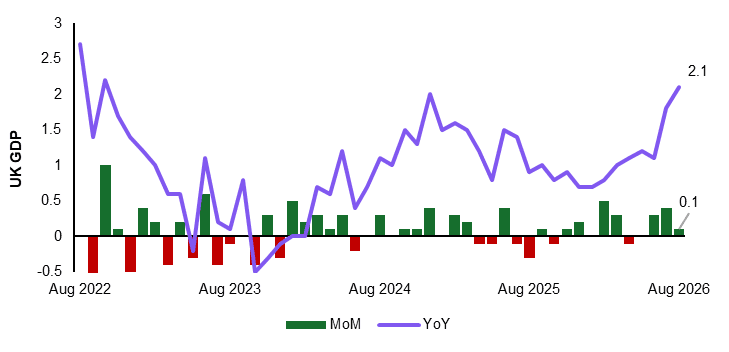
Above: UK GDP, monthly and annual growth. Image courtesy of Panmure Liberum.
Where We Were Wrong
We underappreciated the strength of the cycle and expected growth to cool in the second half as energy costs reached households.
Instead, the economy has accelerated.
"We have to shift from describing UK growth this year as resilient to calling it strong," says Wood, who estimates underlying growth has averaged 2.8% annualised this year.
Pantheon notes the economy is expanding well above any estimate of UK potential growth, leaving the Bank of England with no trade-off between inflation and growth and reinforcing its call for hikes in November and February.
What It Means for the Pound
The pound-to-euro rate trades at 1.1818, close to the 16-month high set this week, and the pound-to-dollar rate at 1.3259.
"As other markets crash and burn, the pound is the top performing G7 currency this week, and the Gilt market is the best performer amongst its peers on Thursday," says Kathleen Brooks, Research Director at XTB.
Brooks adds that AI investment cannot be turned on and off like a tap, and could have a big impact on GDP in the coming months.
Susannah Streeter, Chief Investment Strategist at Wealth Club, says growth looks set to beat the IMF's upgraded 1.3% forecast for 2026 even if the economy flatlines from here.

Daniella Arcadipane, Senior Currency Specialist at Indigo
Moving a life-changing sum abroad? You won’t be doing it alone.
One specialist explains every step in plain English and stays with it until the money lands. FCA authorised, FRN 594433.
Talk to a specialistThe Pushback
The slowdown warnings have not gone away.
"The expansion was only very modest and owed entirely to a 0.8% monthly rise in industrial production," says Ellie Henderson, Economist at Investec, who flags consumer-facing services as an early warning sign after a second consecutive monthly fall.
Berenberg expects consumer spending to lose momentum after September's step-up in energy prices and interest rates, and notes the rest of the economy outside the AI-linked sectors is "decidedly sluggish."
"Higher energy costs risk becoming more embedded in the economy and force interest rates higher, putting the brakes on growth more sharply next year," says Streeter.
Pantheon cannot rule out downward revisions to data that "seems too good to be true" given depressed business sentiment.
Those are the risks to a growth story that has, so far, beaten every forecast put against it, and the next test is the 28 October Budget, where a Chancellor aiming for a "beige" statement would leave the pound's economic support intact.