
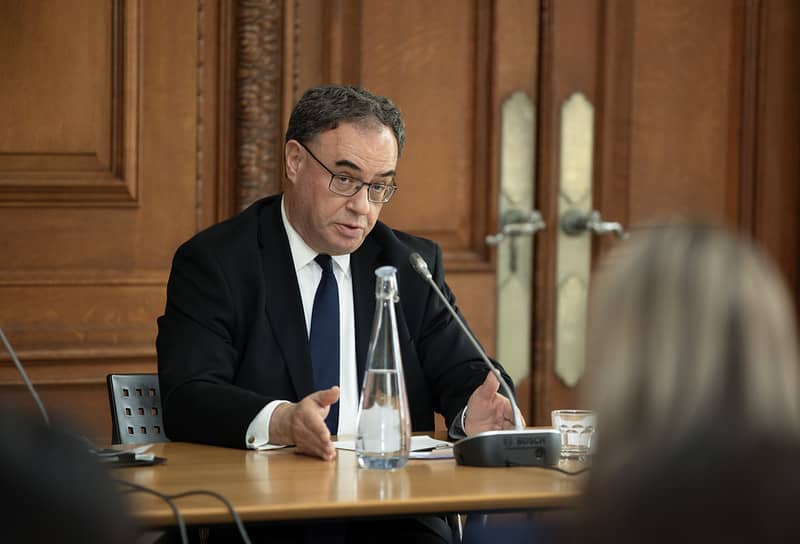
IImage copyright: Bank of England
Bailey says the neutral rate has risen and the economy is resilient, leaving the pound an outperformer on the day.
Pound sterling is outperforming on Friday after Bank of England Governor Andrew Bailey said there are signs the UK's neutral interest rate has risen, which means policy is less restrictive than previously thought.
The pound-to-euro rate is at 1.1847, within reach of this week's 16-month high, and the pound-to-dollar rate at 1.3308, its strongest level in a month.
A higher neutral rate matters because it means Bank Rate at 3.75% is doing less to restrain the economy than the Bank assumed, which lowers the bar for a hike and raises the ceiling on where rates eventually settle.
The comments helped the pound outperform the majority of G10 currencies ahead of the weekend:
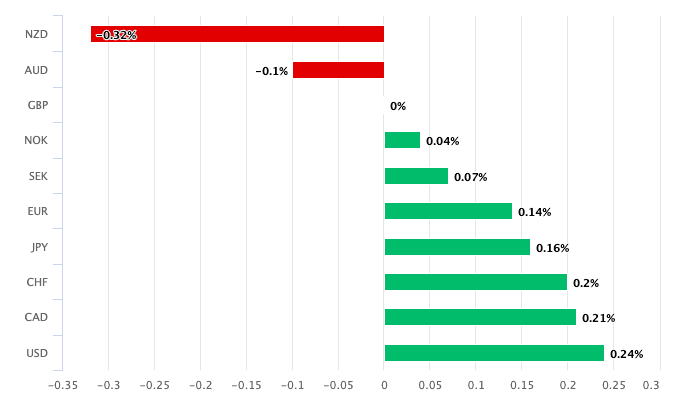
Above: GBP performance against G10 currencies.
That reading lifts sterling through yield support, with UK money markets pricing a 91% probability of a hike at the 5 November meeting.
Speaking at the Institute of International Finance meeting in Bangkok, on the sidelines of the IMF and World Bank annual meetings, Bailey said the UK economy "is actually turning out to be more resilient than we expected it to be."
The resilience was confirmed by Thursday's GDP data, which showed the economy growing at 2.1% year-on-year, its fastest pace in almost four years.
Second-Round Effects Still Subdued
Bailey tempered the hawkish read by saying signs of second-round effects from the energy price shock remain limited so far.
"I think it's too early, but to the extent we've seen evidence, so far it's been quite subdued," he said, adding that businesses are emphasising cost-cutting over price rises.
He also called above-target inflation "enormously frustrating".
The subdued second-round reading is no obstacle to a November hike, according to Lloyds Bank.
"He reiterated that it is too early to see second round effects in inflation as a result of the energy shock, but the September MPC minutes implied that wasn't a precondition for a rate hike anyway, given the lengthening period of the first round effect," says Sam Hill, Head of Market Insights at Lloyds Bank.
DNB Carnegie says it would take significant surprises in next week's inflation and labour market data to materially change the pricing for a November move.

Daniella Arcadipane, Senior Currency Specialist at Indigo
Moving a life-changing sum abroad? You won’t be doing it alone.
One specialist explains every step in plain English and stays with it until the money lands. FCA authorised, FRN 594433.
Talk to a specialistOne Hike or a Series?
The debate among analysts has moved from whether the Bank hikes to how far it goes.
Markets price a series of increases, and the neutral rate signal gives that view room to run.
"We agree with current pricing for a high chance of a BoE interest rate increase at its next meeting in November. However unlike the market we don't expect a series of interest rate hikes," says Kristina Clifton, Senior Economist at Commonwealth Bank of Australia.
The gap between a single hike and the series priced by markets is the main risk to the pound's yield support: if the Bank stops at one, part of that support unwinds.
The Fed Side
The pound's gains against the dollar owe as much to Federal Reserve Chair Kevin Warsh as to Bailey.
Warsh, appearing in Bangkok alongside Bailey, said "I don't prejudge meetings" and offered no guidance on the 28 October decision, despite hot US producer price data this week.
Markets cut the probability of an October Fed hike to below 15%, and the dollar fell around 0.2% during his remarks.
That leaves a Bank of England moving towards a hike against a Fed on hold, a combination that favours the pound-to-dollar rate in the near term.
The Euro Side
Against the euro, the pound keeps the upper hand as French fiscal stress stays in the background.
"Sterling keeps the other hands against the euro. EUR/GBP swapped gains for losses yesterday. The pair grinds further lower this morning. Closing below 0.8455 on a weekly basis would be an important technical signal," says a daily note from KBC, the Belgian bank.
A weekly close below 0.8455 equates to a pound-to-euro rate above 1.1827, and the pair trades at 1.1847 as the week's close approaches.
KBC describes the 28 October Budget as Prime Minister Burnham's "litmus test" for sterling.
Our in-house modelling holds that the pound stays capped into the Budget and recovers in its wake, and Bailey's resilience message adds a Bank of England that is unlikely to stand in its way.
A weekly close above 1.1827 in the pound-to-euro rate would confirm the breakout KBC is watching for, with next week's inflation and labour market data the final hurdles before the November meeting.