
Image © Adobe Images
Pound Sterling recovery against Euro advances on July's high, challenges arise from a heavy UK data week ahead.
The pound-to-euro exchange rate starts the week on a soft tone but weakness should stay limited with buyers back in control and a good portion of the late July decline already recovered.
That retreat found its floor in the first week of August without ever reaching the levels that would have materially eroded the uptrend; price is above the 50-day moving average which has climbed steeply beneath the market throughout, the signature of an uptrend in good health rather than one under repair.
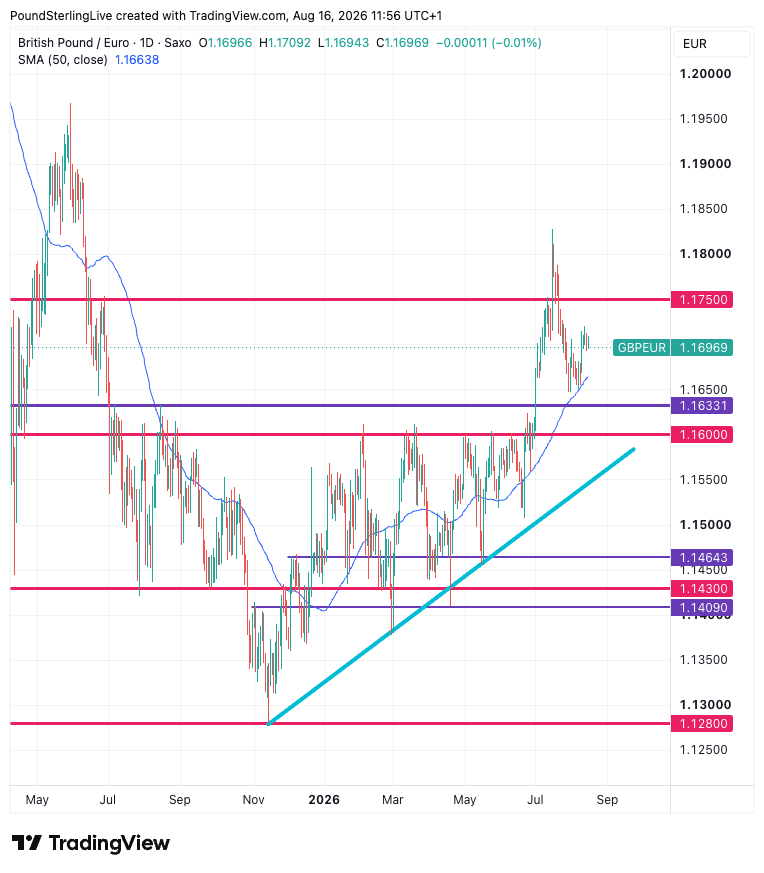
Above: GBP/EUR daily chart. Image © Pound Sterling Live, chart created with TradingView.
From a tactical perspective, the recovery is now advancing on the level that turned it back in late July, and it does so into a calendar heavy enough to offer an uptick in near-term volatility: labour market figures on Tuesday, inflation on Wednesday and the flash purchasing managers' surveys on Friday.
Spot at 1.1687 sits above a rising 50-day moving average at 1.16638, and it printed a high of 1.17092 earlier in Friday's session.
The pullback from July's 1.1810 peak bottomed out in the 1.1640 area, held comfortably above the 1.16331 support and has since recovered a meaningful share of the ground lost.
The slope of the moving average is the most informative feature of this chart, because an average rising this steeply tells us the July correction interrupted the trend without denting it.
From here, the upside obstacle is 1.17500, the level that rejected the pair on the way down in late July, and clearing it puts the July high at 1.1810 back within reach.
Support starts at the moving average at 1.16638, then 1.16331, and beneath both is the more consequential 1.16.
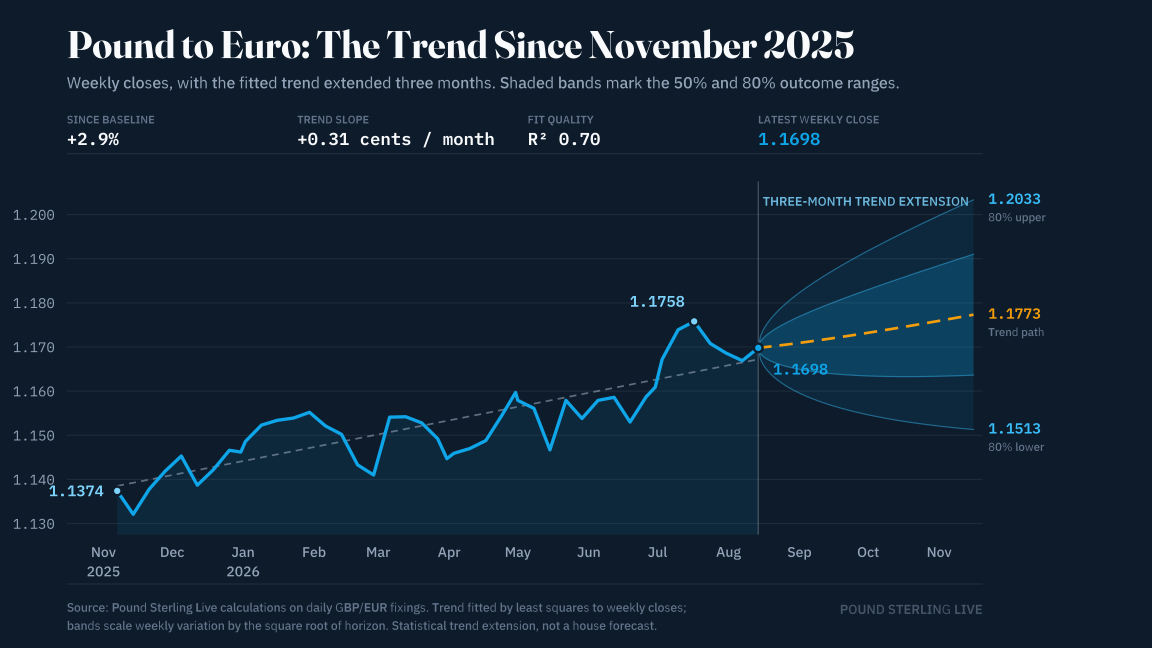
The rising trendline drawn from November's 1.12800 low now runs through the 1.1590 region and is converging on that horizontal support, which gives the 1.1600 area two separate claims to significance and makes it the level that would need to break before the medium-term picture changed.
Our Pound to Euro forecast for the week ahead is for a test of 1.17500 during the coming week, with the inflation release on Wednesday the most likely trigger.
The medium-term uptrend is constructive: the correction stopped above the moving average, the recovery has held every level it needed to, and the structure of higher lows dating back to November is intact.
Jobs Data Sets the Tone on Tuesday
The first test of the week comes on Tuesday with the labour market figures, and the question is whether the market continues to firm after a multi-month retrenchment.
That matters to the Bank of England because signs of a turnaround would point to firmer wage growth ahead, consistent with a more robust inflation profile.
Better than expected numbers would therefore firm rate hike bets, and the Pound with them.
The numbers to watch are an unemployment rate falling to 4.8% from 4.9% and average earnings holding steady at 3.4%.
To be sure, the bigger picture is one of cooling wages, which will encourage some Monetary Policy Committee members to lean against higher rates, suggesting the bar to a 'hawkish' surprise is elevated.
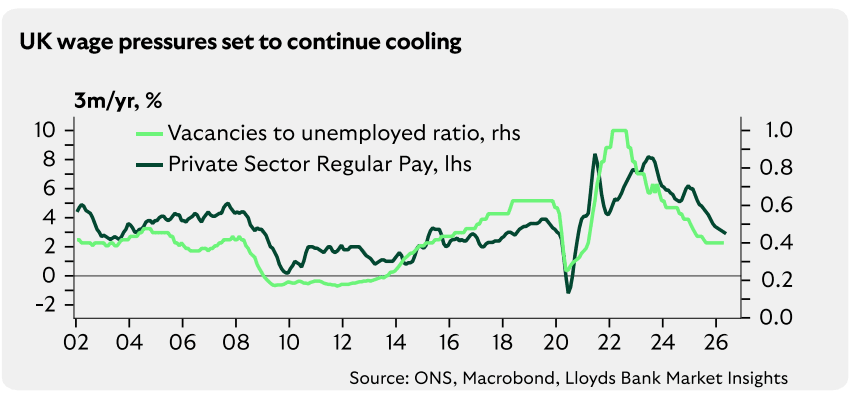
Above: UK wage growth continues to cool. Image courtesy of Lloyds Bank.
Will Inflation Force the Bank of England's Hand?
Wednesday's consumer price index release is the calendar event of the week and should move expectations for a September move at the Bank of England.
The rise is largely mechanical, with a lift in energy prices being the driver.
"The impact of previous energy price increases is still feeding through to inflation and will become more evident in next week's UK July CPI report, which will reflect a 13% increase in the Ofgem energy price cap," says Lloyds Bank in a weekly economics briefing.
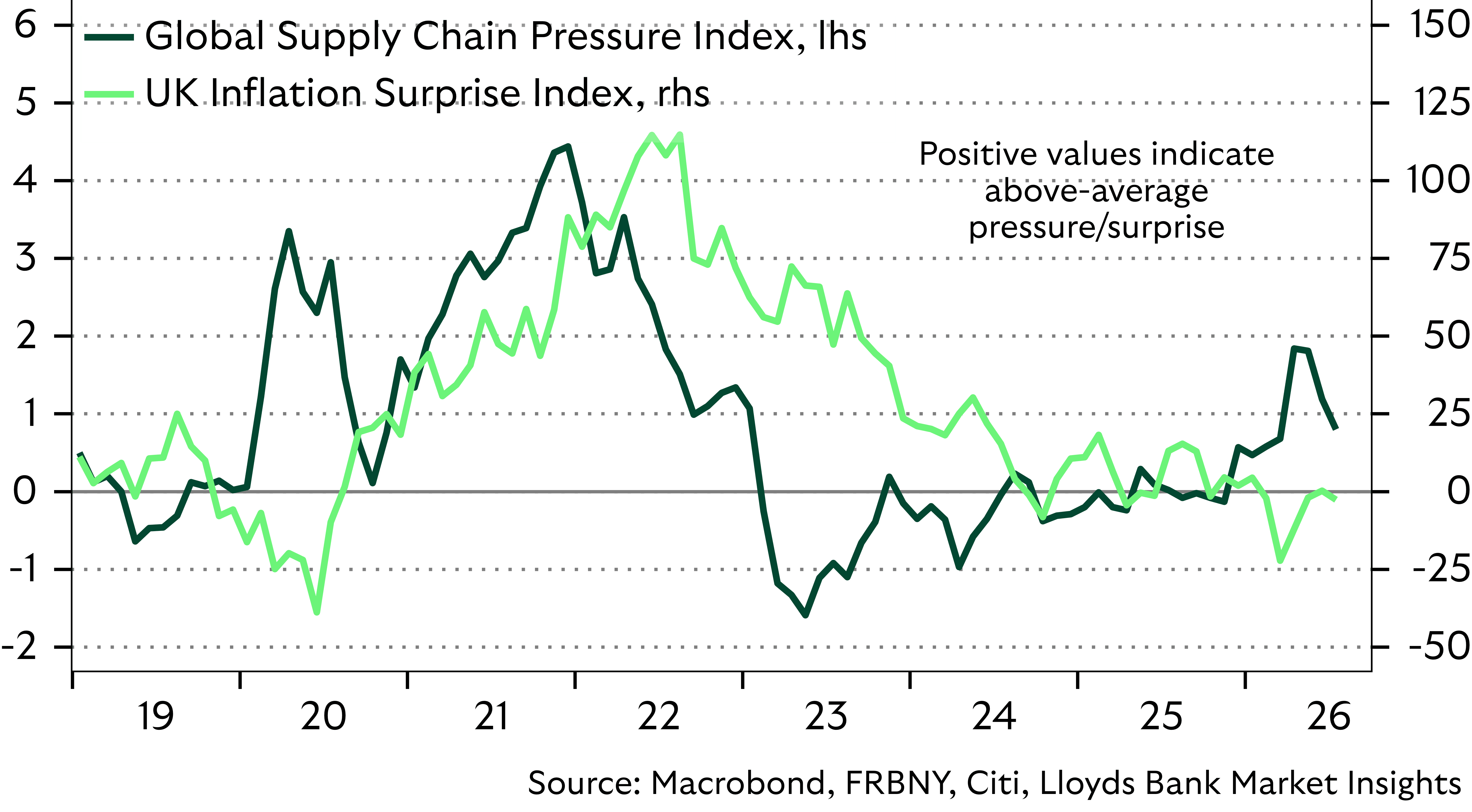
Above: UK inflation is expected to rise in July. Image courtesy of Lloyds Bank.
June's reading was the lowest of the year, which sets a low bar for July.
"After a series of good news on the inflation front, where June CPI sank to its lowest rate all year, we expect a summer bounce to kick things off in July," says Sanjay Raja, an economist at Deutsche Bank.
Consensus looks for a 0.4% monthly increase and an annual rate of 2.9%.
Lloyds is looking for a beat, expecting the annual figure to land at 3.0%.
That would be consistent with a firmer Pound exchange rate strip on the day, as markets sniff higher odds of a September rate increase at the Bank.
"The data would be consistent with the Bank of England's view that inflation is likely to move higher during the second half of the year," says the high street lender.
PMIs and the Case for Continued Outperformance
Friday rounds the week off with the August purchasing managers' surveys, a release that often moves the foreign exchange market.
Consensus looks for the flash composite PMI to drift lower to 51.5 from 52.2, with anything more severe leaving the Pound under pressure into the weekend.
Anything stronger and the currency firms.
Our house view is that the UK economy can continue outperforming expectations in the coming months, defying the consensus that it will decelerate sharply.
Further positive data surprises can bolster the Pound and help it close the year higher than current levels.
Last week's second-quarter GDP release supports that reading.
"The UK economy remains on a solid footing: It was a story of resilience for the UK economy in Q2 with GDP growth of 0.4% Q/Q. Fixed investment was the largest contributor to growth, with ICT and hardware apparently robust," says Deutsche Bank's Raja.
The composition matters as much as the headline, because growth led by fixed investment is more durable than growth led by consumption, and it is the kind of profile that keeps the Bank of England's tightening bias intact.
The Euro side of the pair has little to offer by comparison, with the eurozone flash PMIs on Friday the only release of comparable weight.
That asymmetry is why the week's direction is a Sterling story: the Pound has three chances to move the pair and the Euro has one.
For Euro buyers, the medium-term Pound to Euro forecast points higher into the autumn on our house view, and the immediate task is 1.17500, with three UK releases in four days offering the market the excuses it needs to get there.