
Image: Dave Collier, sourced: Flickr, licensing: CC 2.0.
The British pound should remain supported near-term after the UK economy expanded 0.4% in the second quarter.
That means this week's main UK calendar release met expectations for a 0.4% q/q expansion, making for another robust performance following the 0.6% growth recorded in the first quarter.
However, it was the June GDP rate that really impressed with an increase of 0.3% m/m, which defied expectations for a flat 0%, and suggests the country's economy hasn't lost the momentum that many economists were expecting to have been the case by this point in the year.
Indeed, the annual growth rate sits at an admirable 1.2% y/y, which was stronger than traders had expected.
These are constructive figures from a currency markets perspective and the the pound should benefit as a result.
That being said, there were no sparks in the wake of the release: the pound-to-euro exchange rate rose to 1.1710 in the wake of the numbers and the pound-to-dollar rate to 1.3497.
A strong print is bullish for the UK currency in that it massages expectations for a rate hike at the Bank of England later in the year.
Although sterling put in an unremarkable reaction, we think the data further solidifies the floor under the currency's near-term constructive setup.
The strong GDP print follows recent official labour market data prints that reveal the jobs market dip of the past two years has stabilised, which points to the potential for robust pay settlements in the coming months.
"Recent UK labour market data have hinted at signs of stability. On the margin, this implies a little more risk of second order inflation effects then there may have been earlier in the year," says Foley.
The trajectory of UK interest rates matters in a foreign exchange market that takes its cue from global interest rate differentials, with currencies belonging to higher interest rate countries being favoured.
Just the Right Stuff
What is particularly constructive for UK assets is that the underlying details in Thursday's data release are all the more encouraging as it shows the private sector economy is leading the charge.
"Market sector GDP outpaced overall GDP where it has often struggled to do so in recent times," says Sam Hill, Head of Market Insights at Lloyds Bank.
"Expenditure contributions were encouraging with private consumption and investment accounting for essentially all of that expansion," he explains.
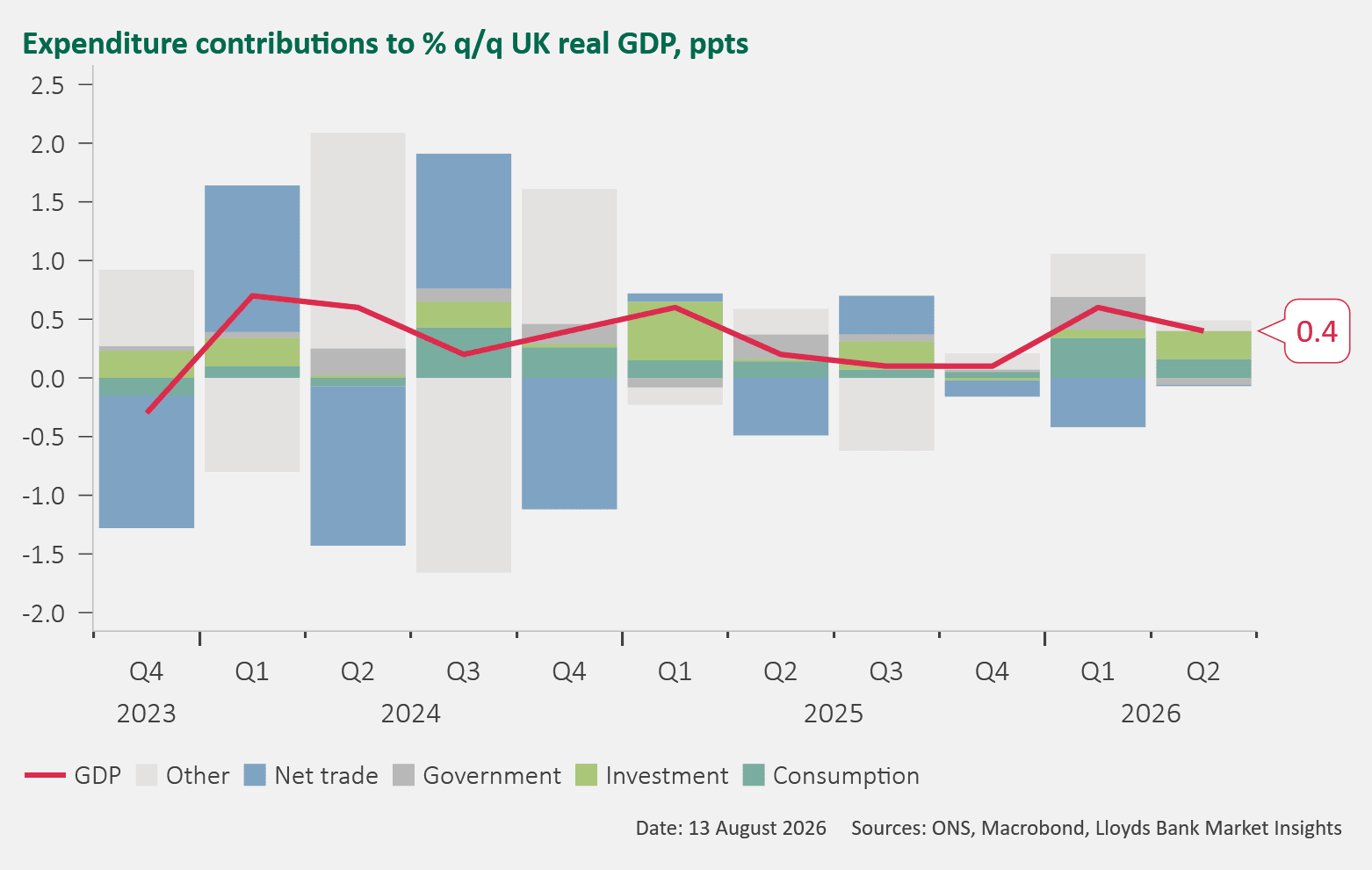
Looking ahead, it looks as though the economy will avoid the slowdowns that have reliably plagued H2s in recent years.
Lloyds researchers forecast that even if monthly output is flat at the June level throughout Q3, the Q3 overall growth rate would be 0.2% q/q, slightly higher than the 0.1% q/q July Bank of England forecast in its last forecasting round.
"In other words, the hurdle for outperforming BoE projections is low," says Hill.
Limited GBP Gains
Nevertheless, the data shows the pound's yield spread advantage over the likes of the dollar and euro hasn't materially shifted in recent weeks and we are aware that the rate advantage story could therefore be waning.
That will come against a backdrop of heightened anxiety over government spending plans during the Autumn.
"We would favour looking to sell GBP rallies vs. the EUR if UK GDP does print a strong figure," says Jane Foley, Senior FX Strategist at Rabobank. "Heading into the autumn, worries about the October 28 budget could also weigh on the pound."
Window for Gains Won't Stay Open for Long
Sterling's rally against the euro and dollar resumed this week, and the summer calm leaves room for further gains before September's tensions.
When parliament returns in September, attention will immediately turn to the October Budget, and for the pound, headwinds could start to blow as fiscal risk is the channel through which Sterling has been repeatedly damaged over the past two years
"Uncertainty about the budget could keep the UK market nervous into the autumn and we would look to buy EUR/GBP on dips," says Foley.
We reported Tuesday that UK Treasury officials fear Burnham's fiscal 'flexibility' plans could destabilise markets, risking the British pound's ascent against the euro and dollar.

The Bank Consensus, Without the Terminal
The median, mean, highest and lowest from the October survey update, plus named point forecasts out to 2027.
Free information pack, issued by World Wide Currencies.
Under the plans the PM would look to shift some elements of spending into the investment bracket, thereby hoping that the market wouldn't mind if the government borrowed more to fund these items.
However, whichever way you want to classify it, more spending means more debt issuance in a world where issuance is increasingly significant, with both governments and AI hyperscalers asking for more and more funds.
The cost of borrowing for the UK government will therefore be set to remain dangerously high and any unlucky developments or missteps by Burnham could quickly precipitate a crisis for GBP assets.