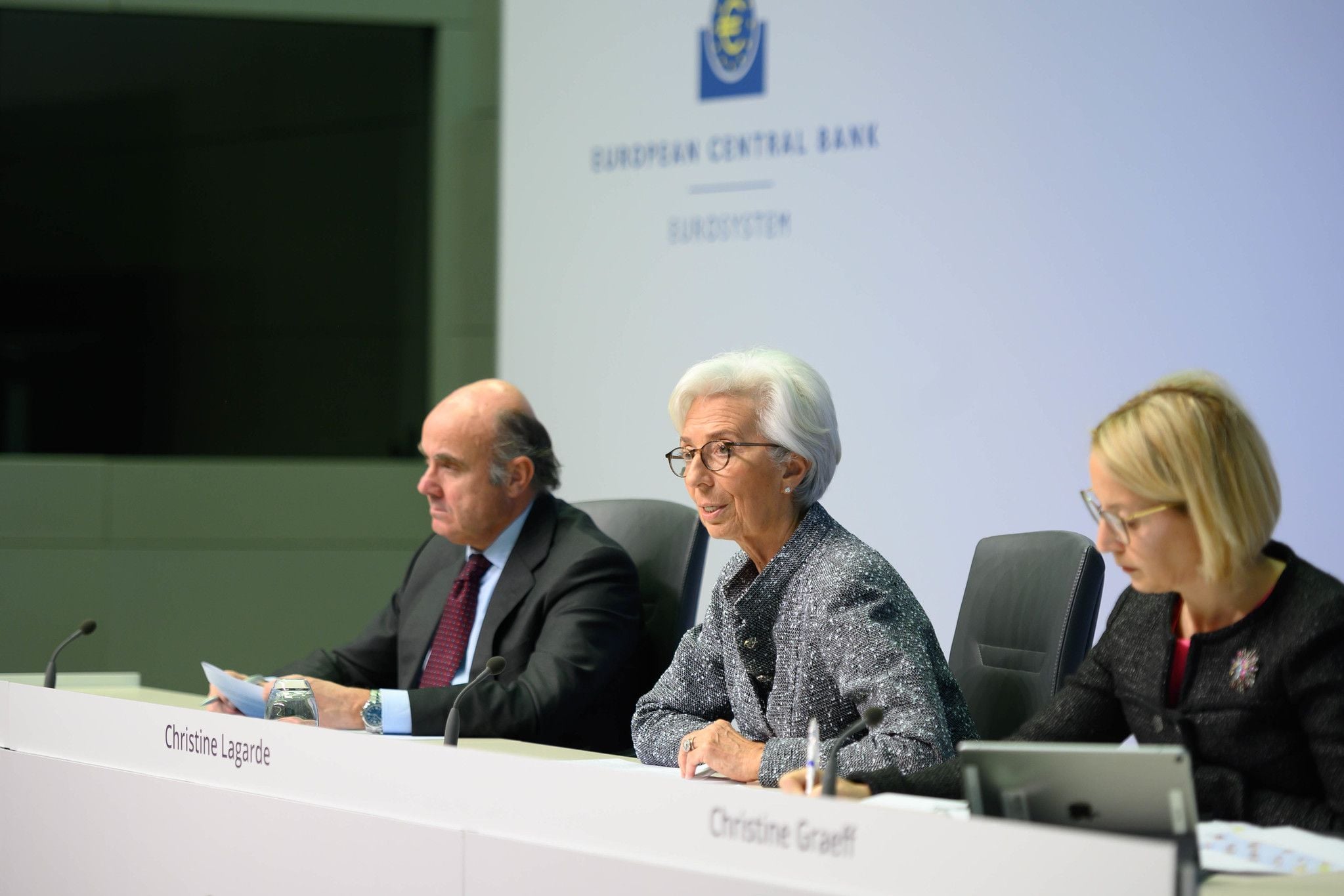
ECB Vice President Luis de Guindos, ECB President Christine Lagarde, and Director General of Communications Christine Graeff. Photo by Dirk Claus/European Central Bank
Lagarde's dovish tilt exposes the euro to its June low, though softer US data could trigger a rebound.
The euro-to-dollar exchange rate is 0.2% lower at 1.1346 on Tuesday, slipping beneath 1.1360 support after ECB President Christine Lagarde leaned against market bets for an October rate hike.
Lagarde told the European Parliament's economic committee on Monday that the energy shock has yet to reach wages and a "measured response" remains appropriate.
"Her remarks confirm our suspicion that if one central bank hikes in October, it will be the Fed, and not the ECB," says Francesco Pesole, FX Strategist at ING.
Markets price 17bp of Fed tightening in October against just 9bp from the ECB, according to ING.
That gap shows up in the SOFR-ESTR two-year swap spread, which measures the difference between US and Eurozone rate expectations.
The spread has widened beyond 155 basis points, close to the 163bp maximum reached in early July, when the euro-to-dollar rate was carving out its summer lows.
"Any hint of strong US data could prompt a test of the 1.1320-30 summer lows, with Lagarde's comments lifting some support off the euro," says Pesole.
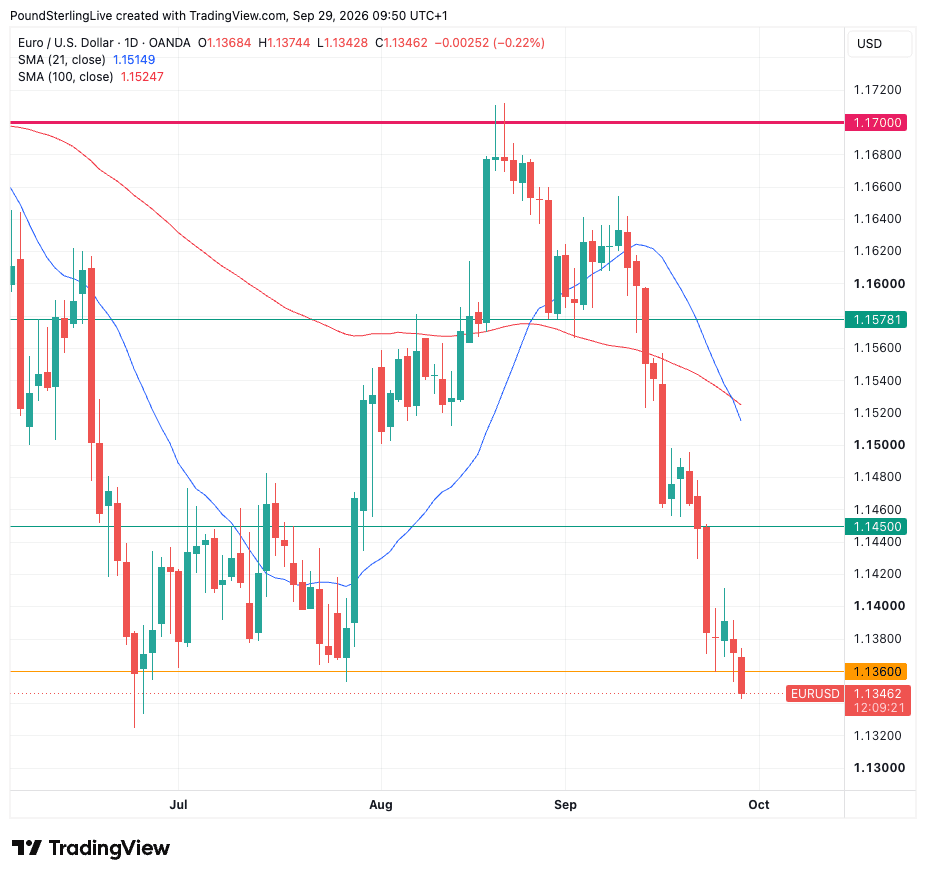
The euro-to-dollar rate has fallen close to 2.5% since mid-September's high near 1.1650, leaving it on course for its worst month since June.
Tuesday's move takes out 1.1360, the floor that held the late-July lows.
The next support is the June low at 1.1325, the 2026 low, with 1.1300 beyond.
The 21-day moving average at 1.1515 has crossed beneath the 100-day at 1.1525, and both averages point lower.
Any rebound faces resistance at 1.1360, then 1.1450, the support that gave way last week.
The Dollar's Rate Advantage
The US side of the spread continues to build.
Ten-year Treasury yields closed at 5.24% on Monday, not far from the 2007 closing peak of 5.29%, according to Deutsche Bank.
Rising oil prices, with Brent above $107 a barrel, are feeding expectations that the Federal Reserve will keep tightening, and markets now price 93bp of Fed hikes by June 2027.
The steady march towards Fed hikes as been the engine behind the dollar's September advance, and there still appears some fuel left in the tank.

Daniella Arcadipane, Senior Currency Specialist at Indigo
Moving a life-changing sum abroad? You won’t be doing it alone.
One specialist explains every step in plain English and stays with it until the money lands. FCA authorised, FRN 594433.
Talk to a specialistThe Building Case for a Short-term Rebound
However, some analysts think the dollar's run is maturing and look for a setback. ING's baseline still points to a higher euro-to-dollar rate by year-end, with its macro team expecting both the Fed and the ECB to hold until December.
CIBC meanwhile looks for a short-term reversal in recent dollar strength this week, citing downside risks to US payrolls and month-end dollar selling.
CIBC expects Friday's non-farm payrolls at 80,000, below the 90,000 consensus, as covered in our week ahead forecast.
A daily close back above 1.1360 through Friday's jobs report would keep ING's year-end recovery view intact.
Eurozone flash inflation for September lands on Friday alongside payrolls, and a hot print would test Lagarde's message and put October back on the table.
Before that, US JOLTS job openings and Conference Board consumer confidence are due this afternoon, the first tests of whether US data can push the euro-to-dollar rate through the 1.1325 June low.