
Image © Adobe Images
The euro looks set to steady against the dollar in the days ahead, and firm eurozone inflation figures at the end of the week could turn that into a modest rebound.
The Euro to Dollar exchange rate has fallen to the graphical support that halted July's selloff, and with the pair stretched after a steep September decline, we expect the dollar's advance to stall this week.
Yet the forces behind the dollar's rally remain in place, with U.S. growth outpacing Europe's and U.S. bond yields holding near their highs, so any euro rebound should be tepid.
Buyers must defend graphical horizontal support - the orange line in the below chart - if a rebound is to develop:
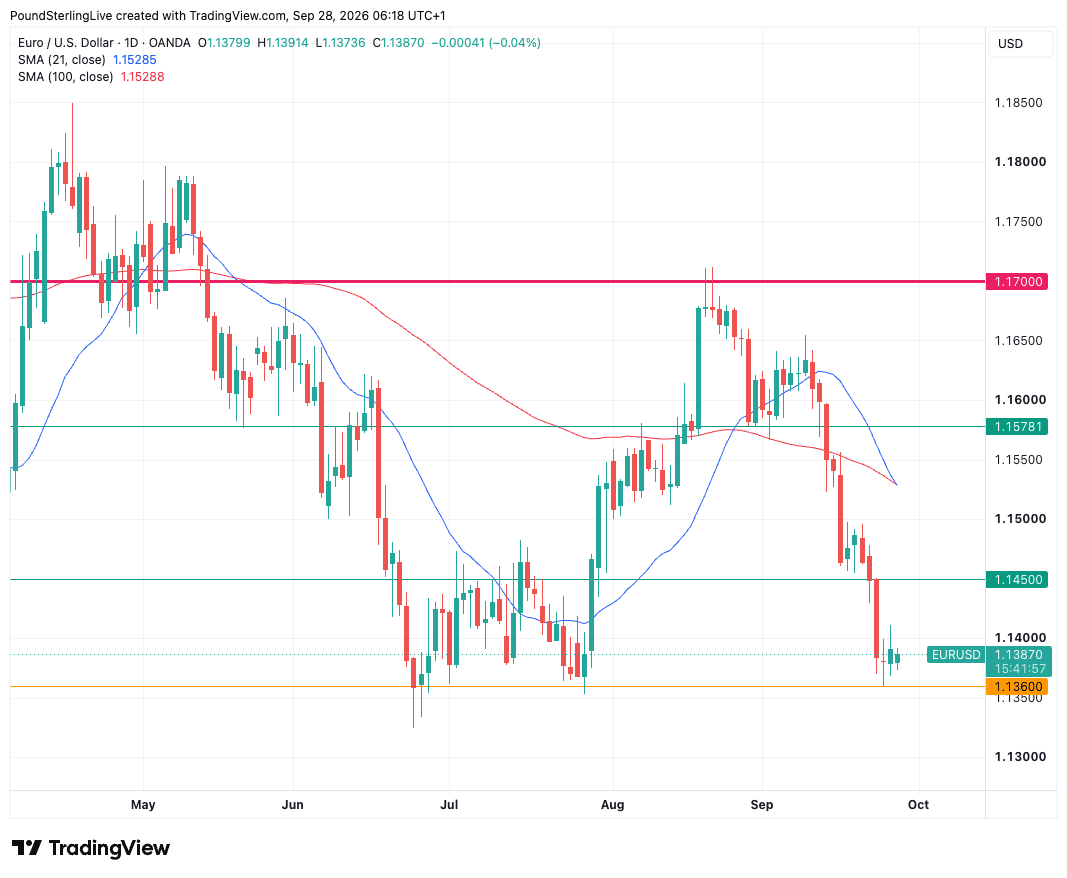
EUR/USD daily chart. Image © Pound Sterling Live, chart created with TradingView.
EUR/USD trades at 1.1387 at the start of the new week, just above graphical horizontal support at 1.1360, the level where July's selloff found its floor and where last Thursday's decline stopped.
That leaves the pair 1.2% beneath its 21-day moving average - the blue line - a deviation that looks extended. Exchange rates tend to mean-revert to the 21-day after a run of that length, and with the average falling steeply the gap can narrow through a stretch of sideways trade as readily as through a bounce.
Graphical horizontal resistance at 1.1450 is the first hurdle for a rebound. It held as a floor through mid-September before giving way last week, and old support tends to resist on the way back up. The 21-day at 1.1529 marks the outer limit of any mean-reverting move, so this is by no means a bullish call for the euro.
The 100-day moving average - the red line - has pointed lower since May, and the falling 21-day is crossing beneath it now. With price below the pair of them, the broader trend remains down and any rebound runs against it.
Beneath 1.1360 the next support is June's low at 1.1325, visible as the long lower wick on the chart, which Brown Brothers Harriman identifies as the level that must hold if rising ECB rate expectations are to keep limiting the euro's downside.
We expect EUR/USD to hold above 1.1360 and drift back towards 1.1450 this week. A daily close beneath 1.1360 would open the way to 1.1325 and undermine our Euro to Dollar forecast.
We got last week wrong. We judged that EUR/USD had found a fragile floor near 1.1450, and that floor failed on Wednesday as a strong U.S. PMI report extended the dollar's rally to two-month lows.

Daniella Arcadipane, Senior Currency Specialist at Indigo
Moving a life-changing sum abroad? You won’t be doing it alone.
One specialist explains every step in plain English and stays with it until the money lands. FCA authorised, FRN 594433.
Talk to a specialistECB Pricing Offers the Euro a Cushion
Friday's flash eurozone CPI report is the week's calendar highlight for EUR/USD. Economists expect energy costs to push headline inflation up to 3.7% from 3.2%, with core inflation seen at 2.5% against 2.4% in August.
A print above those numbers would signal more ECB tightening ahead, lifting eurozone yields and the euro with them. A soft reading would weigh on the single currency.
The swaps curve already implies nearly 100 basis points of ECB tightening to 3.50% over the next twelve months, according to Brown Brothers Harriman, which would take the policy rate above the central bank's own estimate of neutral. That pricing is a cushion under the euro while the dollar is strong.
U.S. Data Tests the Dollar's Momentum
Friday also brings the U.S. jobs report, likely to be the FX market's event of the week.
The consensus expectation for this week’s US Non-Farm Payrolls (NFP) report, scheduled for release on Friday, October 2, 2026, points to a moderation in job growth, with forecasts ranging between 90K and 100K jobs added for the month of September.
This represents a slowdown from the stronger-than-expected 162K jobs created in August.
An above-consensus outcome would lift U.S. yields and the dollar and push EUR/USD lower, while misses to the downside let the euro recover.
Morgan Stanley reversed its call for a weaker dollar last week, and David Adams, G10 FX strategist at the bank, writes in a note of 25 September: "We now forecast USD strength through year-end and into 2027." The bank sees EUR/USD at 1.10 by mid-2027, a medium-term view that sits comfortably alongside a near-term pause.
In the week in front of us, a firm eurozone print and a softer payrolls number landing on the same Friday would be the combination most likely to lift the euro off support, and on balance that is consistent with our Euro to Dollar forecast of stabilisation above 1.1360.