
Image: Adobe Images
The Australian Dollar is the week's worst G10 performer as carry trades unwind, says Societe Generale.
The Australian Dollar has fallen against every G10 currency this week, making it the worst performer among the major currencies.
The losses have come while Australia's economy is still creating jobs and the Reserve Bank of Australia is preparing to raise interest rates, so the causes lie beyond domestic fundamentals.
A selloff in global bond markets has lifted currency volatility, and investors have taken profits on carry trades - borrowing in low-yielding currencies to invest in higher-yielding ones - where the Australian Dollar is a favoured target.
"Losses in G10 were concentrated in AUD," says a daily strategy note from Societe Generale.
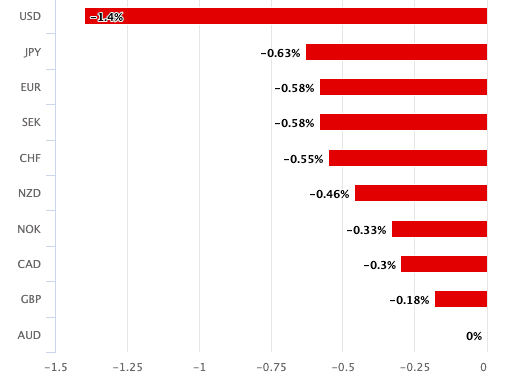
Above: Australian Dollar performance against G10 currencies this week.
Australian Jobs Data Gives Mixed Signal
This week's labour market figures pulled in two directions for the currency.
The economy added 39,500 jobs, well ahead of the consensus forecast of 20,000. That is supportive for the Australian Dollar.
However, the unemployment rate rose to 4.6% from 4.5% in July, its highest level since late 2021.
Markets also expect the RBA to raise interest rates. ING expects a 25 basis point hike on 29 September, and markets have almost fully priced that move.
Domestic fundamentals therefore offer the currency some support. They do not explain why it has fallen so broadly.
Bond Market Turmoil Triggers Carry Trade Unwind
The explanation lies in global markets.
"Bond storm rages on," says Societe Generale. "The rebound in FX volatility, albeit from historically low levels, prompted profit taking in the carry trade."
As a high-yielding currency, the Australian Dollar is among the first to suffer when volatility rises, as volatility is the enemy of the 'carry' trade.
"Another tumultuous week in the global bond markets was driven by rising term premia, volatile oil prices, strong US macro data, weak demand for US auctions and technicals. The sell off ratcheted up pressure on bloated government balance sheets, debt interest burdens and raised questions over the amplitude of future monetary tightening to prevent the build-up of second round inflation effects," says the French bank.
Term premia refers to the extra yield investors demand for holding longer-dated bonds.
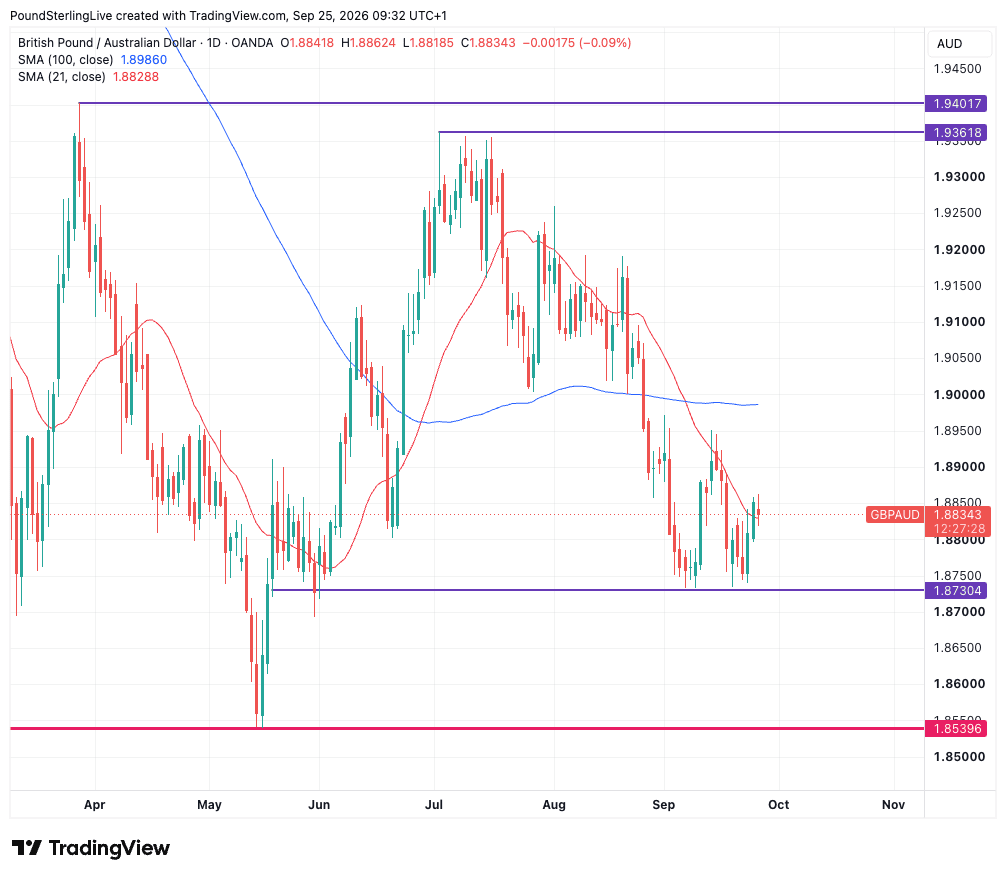
GBP/AUD Selloff Shows Signs of Easing
The Pound to Australian Dollar exchange rate (GBP/AUD) has been falling since July, but the chart shows that decline is losing momentum and a rebound is starting to gain some traction as FX volatility disadvantages the Aussie.
A move back towards the flat 100-day moving average looks increasingly likely with the 100-day acting as a magnet when the pair pushes too far in either direction. In short, it's acting as a fulcrum and its gravitational pull denies any meaningful trend higher or lower.
For the rest of 2026, we can expect the range that's built around this fulcrum to continue, and we would expect a reversion higher as the Australian Dollar underperforms while volatility picks up and the US Dollar stays strong.
The next test is the RBA decision on 29 September. After that, watch whether volatility in global bond markets settles.

Daniella Arcadipane, Senior Currency Specialist at Indigo
Moving a life-changing sum abroad? You won’t be doing it alone.
One specialist explains every step in plain English and stays with it until the money lands. FCA authorised, FRN 594433.
Talk to a specialist