Image © Adobe Images
The bank expects the pound to underperform, which puts the euro cross in play as well as the dollar.
HSBC looks for the pound to underperform during coming months, particularly against the dollar.
"We choose to play USD upside against GBP which looks exposed over the next month," says Daragh Maher, Senior FX Strategist at HSBC.
Pound sterling underperformance is a theme that would extend to beyond the GBP/USD pair. HSBC expects the dollar to rise against most major currencies, and sterling is the one it judges most exposed, which implies the pound falls further against the dollar than the euro does.
That puts downside into GBP/EUR, currently at 1.1632, as well as GBP/USD at 1.3243.
The call appears in the bank's FX Tactician, a regular publication in which HSBC sets out its near-term positioning views across the major currencies, separate from its longer-run forecasts.
This edition, titled "Freeing the USD from debasement", argues the September Federal Reserve meeting removed the narrative that had been holding the dollar back.
Three Pressures on the Pound
HSBC identifies three reasons sterling is the exposed currency:
1. Markets are already priced for hikes from a Bank of England that "still sounds somewhat unconvinced."
2. Labour demand is weak.
3. Another real income squeeze follows if energy prices stay elevated.
The first two showed up in Wednesday's business surveys.
UK activity undershot expectations in September, with the composite PMI falling to a three-month low of 51.7 while the Eurozone reached a three-year high.
UK data has beaten expectations through most of this year, which makes the September surveys the first meaningful downside surprise of the run.
Pantheon Macroeconomics reads the survey as consistent with payrolls falling by 4,000 in September, and Berenberg notes it extends a two-year decline in UK employment.
Markets nevertheless price around 100 basis points of Bank of England tightening over the next twelve months, taking Bank Rate to 4.75%.

Daniella Arcadipane, Senior Currency Specialist at Indigo
Moving a life-changing sum abroad? You won’t be doing it alone.
One specialist explains every step in plain English and stays with it until the money lands. FCA authorised, FRN 594433.
Talk to a specialistDeutsche Bank Is Selling Sterling Too
Deutsche Bank recommended selling the pound this week, against a basket of the euro, dollar, franc and yen.
"We have turned bearish on sterling as the risk premium around UK fiscal policy has largely disappeared, leaving the pound more exposed to a softer domestic and external backdrop," says a strategy note from Deutsche Bank.
The bank expects the UK data pulse to fade into year-end, with elevated energy costs, a deteriorating trade balance and eroding fiscal headroom supplying the headwinds.
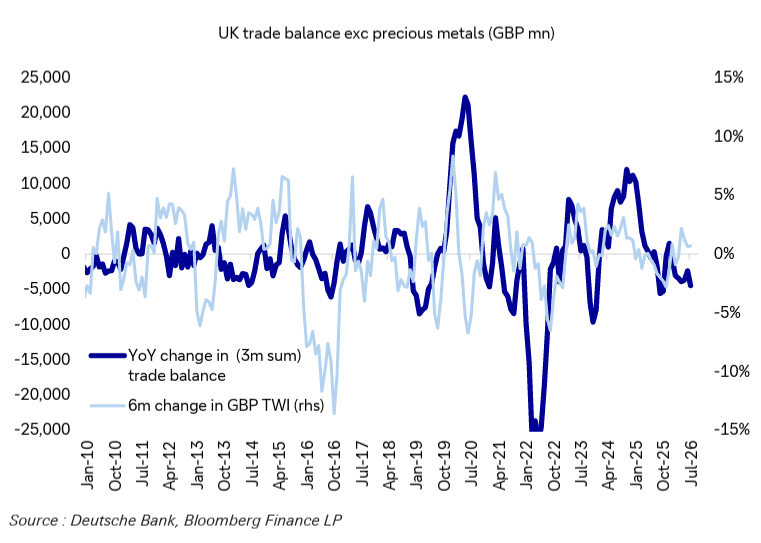
It also doubts the Bank of England delivers what markets price, and questions whether hikes would help the pound in any case.
"If tightening does materialise, the lesson from the last cycle is to expect 'dovish hikes' accompanied by currency weakness," says Deutsche Bank.
The trade is cheap to hold because sterling volatility is unusually low.
Implied volatility has never been this low ahead of a UK budget, and the skew towards sterling puts remains far from its extremes, leaving Deutsche Bank to conclude the currency is "already priced for a quiet Budget" on 28 October.
Two banks reaching the same position in the same week arrive by different routes: HSBC through the dollar and the Fed, Deutsche Bank through UK fiscal policy and the Budget.
The Dollar Side
"The USD has been freed from debasement, a narrative which had gained traction amid rising US Treasury yields, ill-received communication by the Fed's new Chair, and a soft patch of US economic data," says Maher.
Each of those drivers is now either positive for the dollar or no longer a headwind, according to the note.
A rebound in US employment and retail sales alongside higher-than-expected inflation has renewed hawkishness at the Federal Reserve and in the market.
"The tone of the Fed may not quite validate the multiple sequence of hikes the market is priced for, but it has not forced the market into a dovish repricing," says Maher.
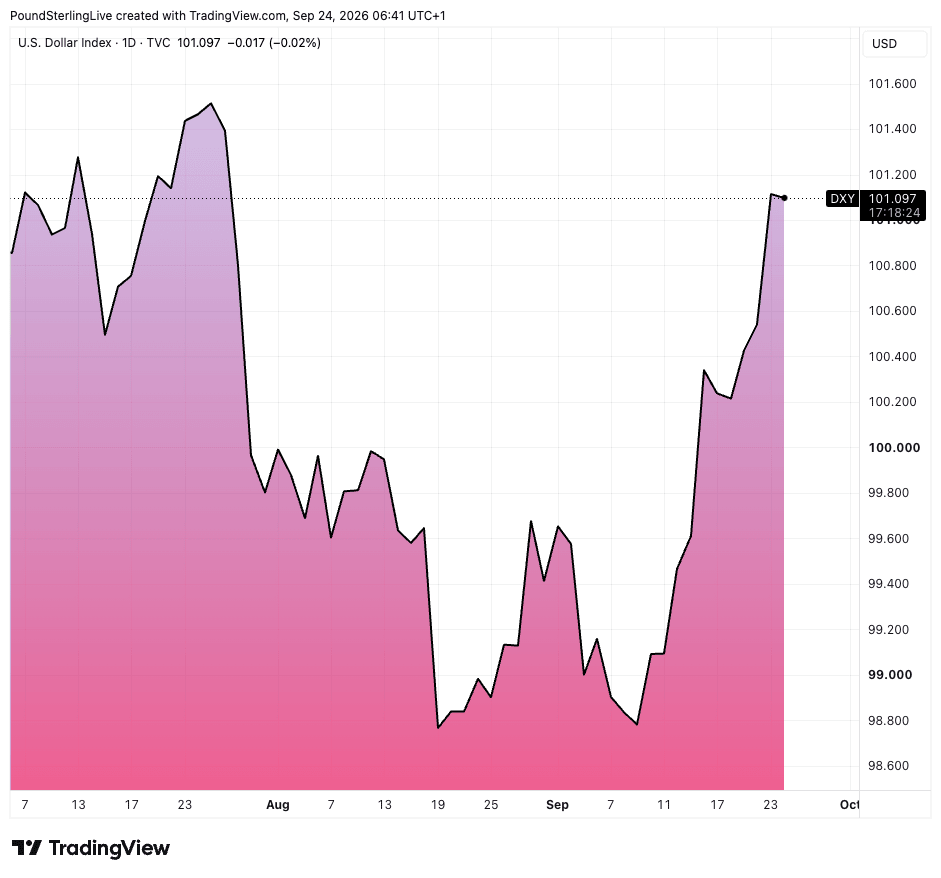
Above: The dollar index, a measure of USD performance.
That reading was reinforced on Wednesday, when the US composite PMI jumped to 58.4, its highest since July 2021, and markets moved to price more than a 50% chance of an October hike.
Long-end US bond yields remain elevated, though HSBC argues high yields are not solely a dollar problem, and that with Fed credibility recovering the market will look increasingly at vulnerabilities elsewhere.
Dollar Benefits from Rising Energy Costs
"Energy prices are reasserting their grip on the FX market; if they remain elevated, the EUR, GBP and JPY are vulnerable," says Maher.
Brent crude has steadied near $100 a barrel after five sessions of declines, with Saudi Arabia restarting its East-West pipeline and US crude inventories building.
Cheaper energy would ease the real income squeeze HSBC identifies, while also removing the price pressure that supports a November Bank of England hike.
The euro faces its own version of the problem, with energy inventories low ahead of October and rising French bond yields a growing concern, which is what keeps the euro cross a question of degree.
Core PCE inflation data next week is the next test of the hawkish Fed pricing HSBC's call rests on, with GBP/USD now trading below its 1.3250 support.