The euro's slide is nearing a level that held through July, which could slow the dollar's advance.
The Euro to Dollar exchange rate is at 1.1386 and closing on the support band that arrested its last decline.
Wednesday's fall took the pair through 1.1450, a level that capped the downside through late July and again in mid-September.
That leaves 1.1360 as the next line, with the late July lows and the 1.1353 marker that formins a band immediately below the market.
A hold there would ease the downside pressure that has built since 19 August, when EUR/USD topped out near 1.1700, but a break through it opens 1.1325, the June low, with no obvious support until then.
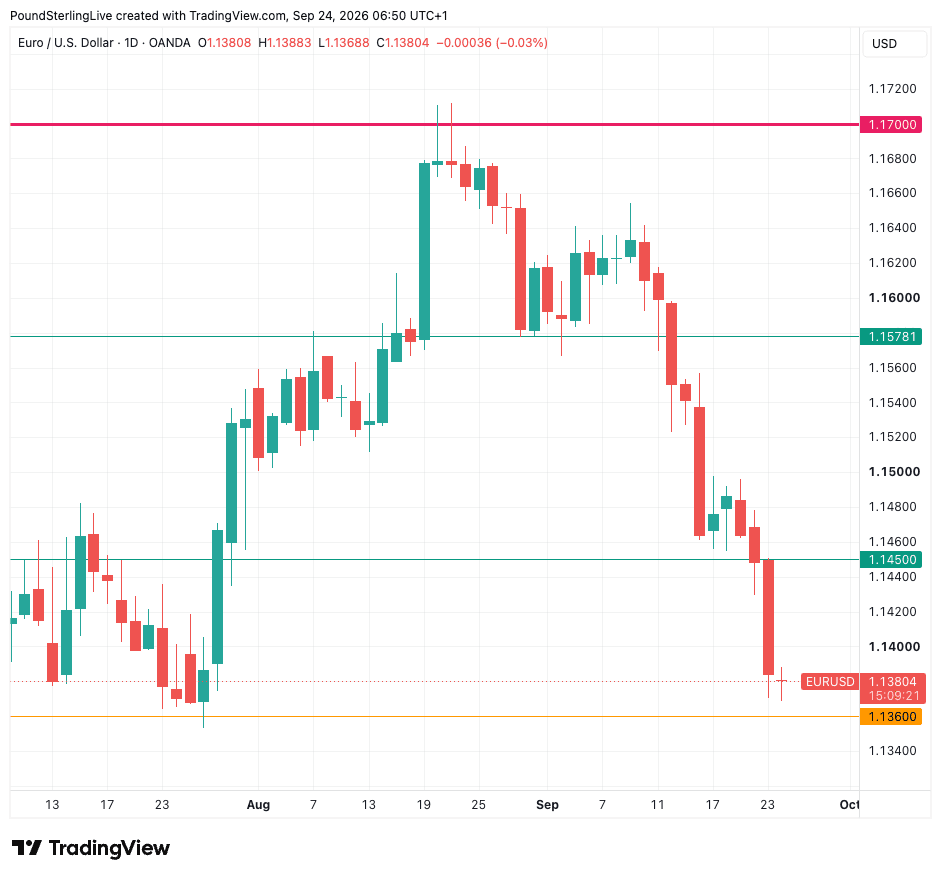
Chart created with TradingView
On any recovery, 1.1450 becomes the first barrier, with the September pivot at 1.1578 the level that would signal the September downtrend had ended.
The move is a dollar story, with the September composite PMI at 58.4 sending US yields higher.
"Strong US growth is becoming a double-edged sword," says a market outlook from OCBC, the Singaporean bank.
"Robust PMI data lifted yields, supported the USD and reinforced the risk that the Fed may need to tighten policy further," it adds.
The 10-year US Treasury yield rose more than 15 basis points over 24 hours, the largest daily increase in more than a year, according to DNB Carnegie, taking it to its highest level since 2007.
Markets price more than a 50% chance of a Federal Reserve hike in October, with three moves priced by next June.
New York Fed President John Williams speaks at 9:10am London time, and Commonwealth Bank of Australia notes he has been among the less hawkish members while still voting for last week's increase.

Daniella Arcadipane, Senior Currency Specialist at Indigo
Moving a life-changing sum abroad? You won’t be doing it alone.
One specialist explains every step in plain English and stays with it until the money lands. FCA authorised, FRN 594433.
Talk to a specialistThe ECB Side Offers EUR Little Help
Despite the euro's recent weakness, expectations for further ECB rate hikes can help shore up the euro. Markets price around a 50% chance of an ECB hike at the October meeting, while a December increase is more than fully priced.
ECB board member Isabel Schnabel and Chief Economist Philip Lane speak on Thursday, and both should shore up these expectations.
The ECB can afford to raise rates, judging that the economy remains resilient and inflationary risks are building: Eurozone activity reached a three-year high in September according to PMI data.
Political risk meanwhile continues to weigh on the euro, with the 10-year French-German bond spread at its widest since July 2012.