Image © Adobe Images
The euro looks set to steady against the dollar, but German power prices and politics leave any recovery vulnerable.
The Euro to Dollar exchange rate looks to be finding its feet after the selloff that followed the Federal Reserve's 16 September rate hike, although the Euro looks vulnerable and its resilience could prove short-lived this week.
To be sure, the selling pressure that built through the Fed week now looks to be unwinding, and the pair may well have found a floor for the time being.
That floor is graphical horizontal support sitting just beneath the market, and buyers will be tested there if the headlines out of Germany keep coming:
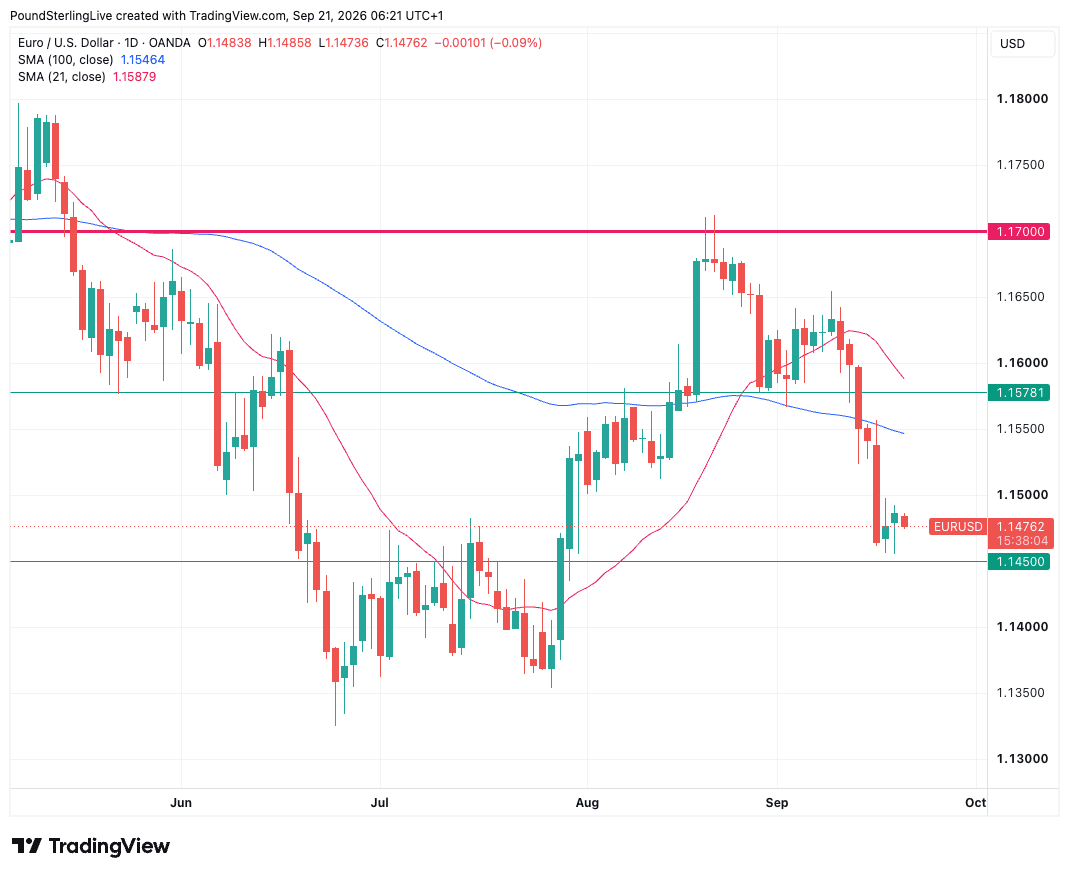
Above: EUR/USD daily chart. Image © Pound Sterling Live, chart created with TradingView.
EUR/USD trades at 1.1475 on Monday morning, putting it just above graphical horizontal support at 1.1450.
"EUR-USD has stabilized at levels just below 1.15, suggesting that the pair may have found a floor following last week's hawkish Fed meeting," says Thu Lan Nguyen, Head of FX and Commodity Research at Commerzbank [VENUE AND DATE TO CONFIRM]. We concur, and we think the pair is unwinding the selling pressure of the previous week.
A week ago we looked for a down week in euro-dollar, with the gas story in charge and the Federal Reserve able to add to Monday's move, and the call held: the pair fell from 1.1539 to below 1.15 as the Fed hiked and signalled more to come.
The early-August consolidation around 1.1500 gave way in the process and now sits overhead as the first cap on a recovery, while beneath 1.1450 the chart offers little until the July low near 1.1320.
That makes for a defensive Euro to Dollar forecast: we expect 1.1450 to hold in the early part of the week, but any Euro-positive price action looks tepid, and a daily close beneath 1.1450 would open the way to further losses.
German Power Prices and Politics Weigh on the Euro
The Euro's domestic backdrop gives it little to build on, with soaring German wholesale power prices and political uncertainty in France and Germany both working to temper European Central Bank hike expectations.
Non-traditional parties did very well in Sunday's state elections in Mecklenburg-Western Pomerania and Berlin, adding a German layer to the uncertainty already surrounding France.
Why do German power prices matter for the Euro? Expensive electricity raises costs for the bloc's largest manufacturing economy and squeezes growth, and a weaker growth outlook makes it harder for the ECB to keep raising interest rates, eroding the higher returns that attract buyers to a currency, a pattern already seen with gas.
ING now expects a further ECB hike after this month's hawkish decisions, which puts Wednesday's flash PMI surveys, the top-tier release on the Euro's calendar, at the centre of its week.
UniCredit forecasts the eurozone composite PMI easing to 51.5 from 52.0 as higher energy costs take some shine off new orders. Under the FX rule of thumb, a reading above expectations would support the Euro by keeping further ECB hikes in play, while a miss would add to the weight of the power market.
Germany's Ifo survey, Tuesday's revision to Italy's 2025 deficit and Moody's review of Italy on Friday are second-tier events that put eurozone fiscal risk back in view.
Softer oil is the Euro's best hope of a sustained recovery, since the eurozone imports most of its energy while the U.S. is a net exporter.
Consensus projections for the next four quarters, compiled from leading investment banks.
Access the full forecast →
"Diplomatic efforts to end the US-Iran conflict ease supply fears, weighing on oil for a fourth consecutive session," says a morning note from Julius Baer on Monday.
The Dollar side of the pair still leans the other way, with the Fed's dot plot signalling a further hike in the fourth quarter.
"We believe that strong underlying US growth momentum, the Fed's continuing tightening cycle and persistently elevated energy prices will maintain EUR/USD on a declining trend, targeting 1.12 in 12M," says Danske Bank in its FX Forecast Update of 18 September.
The Danish lender's 12-month view sits well beyond this week, but it describes the same forces we see capping the Euro now, and German power prices add a domestic weight on top of them. On balance, the floor looks in place for the time being, but the Euro has little reason to build on it, which keeps our Euro to Dollar forecast defensive.