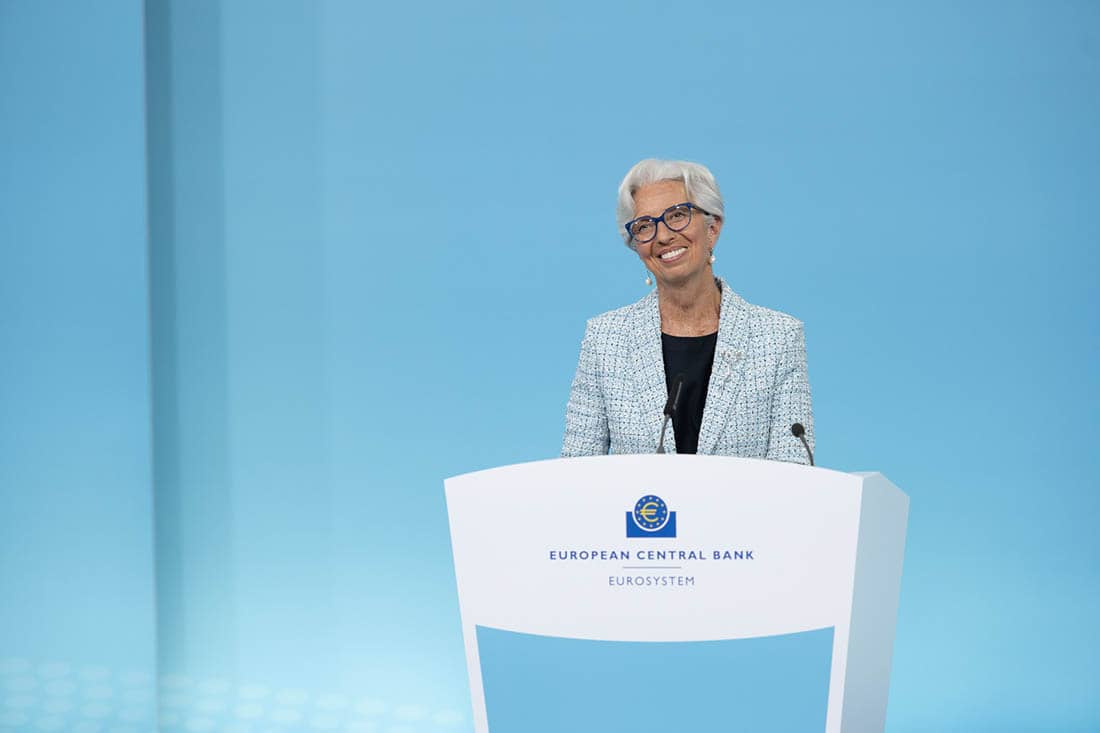
File image: ECB President Christine Lagarde. Image: Andreas Reeg/ECB.
The euro could extend gains if energy prices push the ECB to out-hike the Federal Reserve and Bank of England into year-end.
Investment bank analysts now expect the European Central Bank (ECB) to keep raising interest rates after Thursday's hike to 2.50%, a forecast upgrade that points to further interest rate support for the euro.
"We now expect two additional 25bp rate hikes at the next meetings in October and December, taking the deposit rate to 3.00% by year-end," say Henry Cook and Lee Hardman, analysts at MUFG.
Danske Bank has made the same change, saying the new projections came as a very hawkish surprise and revealed a reaction function firmly focused on energy prices.
Nomura expects the hikes to come in December and March, reaching 3.00% by March 2027.
"We think the Iran war has lasted sufficiently long, keeping energy prices elevated for long enough, to make a December rate hike more likely than not," says Nomura.
UniCredit, Deutsche Bank, UBS and ANZ look for one further hike in December, which would take the deposit rate to 2.75%.
Barclays, which had expected Thursday's move to be the last, now also forecasts a December hike and sees risks skewed towards more tightening should the energy outlook fail to improve.
"Unless energy prices fall rapidly and significantly from current levels, the ECB is likely to continue its tightening campaign at the December meeting," says Marco Valli, Chief European Economist at UniCredit.
The ECB's staff projections are conditioned on a three-month Euribor rate of 3.0% in 2027 and 2028, which implies two more hikes, and they still show core inflation at 2.3% in the final quarter of 2028, says Lottie Gosling, an economist at Investec.
In other words, the ECB's own forecasts require two more hikes and still leave core inflation above target.
A Bloomberg report published after the press conference said officials expect to raise rates further, with a move possible as soon as October.
Money markets now almost fully discount 25 basis point hikes in both October and December, and see up to two more over the course of 2027, according to KBC.
Nomura keeps its trade idea to buy the euro against the dollar and forecasts the euro-to-dollar rate at 1.20 by year-end.
"We think that a more stringent approach to inflation should enhance EUR's structural position relative to the USD," says Nomura.
"We remain constructive on EUR assets: favor a stronger EUR, attractive carry opportunities in fixed income and credit," says Dean Turner, Chief Eurozone and UK Economist at UBS Global Wealth Management.
ING's FX strategists say the hawkish ECB reduces the euro's downside risks against the dollar for the time being.
MUFG sees that support as temporary. "While higher ECB rate expectations offer near-term support for the EUR especially if the Fed stays on hold, we continue to believe that an intensifying energy price shock will ultimately favour the USD over the EUR," say Cook and Hardman.
The market is yet to reward the hawkish turn: the euro-to-dollar rate trades at 1.1601 on Friday, below Thursday's 1.1633 open, with Brent crude near $108 a barrel and Fed hike bets underpinning the dollar.
The pound-to-euro rate trades at 1.1645 after Thursday's low of 1.1627 held a pip above the 100-day moving average near 1.1626.
The pair closed Thursday almost unchanged because UK two-year yields rose 17.4 basis points, keeping pace with a 17 basis point rise in eurozone two-year yields, according to KBC.
That leaves the two-year rate differential between the UK and the eurozone broadly where it stood before the ECB meeting.
Our call ahead of the meeting was that any currency reaction to the ECB would be faded, and the pound-to-euro rate's recovery from 1.1627 fits that call.
The ECB's hawkish turn pressures the pound-to-euro rate only if eurozone rate expectations rise faster than UK expectations.
Next week's Bank of England decision is therefore the test of 1.1626: a failure to endorse market pricing would move the differential in the euro's favour and expose 1.1600.
GBP/EUR: Pound Holds the 100-Day
"We also expect EUR to outperform GBP, where tightening appears to be less likely and where fiscal risks are more acute," says Nomura.
ABN AMRO expects the euro-to-pound rate to rise modestly and holds its end-2026 forecast at 0.87, equivalent to 1.1494 in pound-to-euro terms.
TS Lombard went into the meeting recommending buying the euro against the pound, arguing the ECB has more room to raise rates than the Bank of England.
KBC puts first resistance in the euro-to-pound rate at 0.86, now under test, which inverts to 1.1628 and sits alongside the 100-day average on the pound-to-euro chart.
The Bank Consensus, Without the Terminal
The median, mean, highest and lowest from the October survey update, plus named point forecasts out to 2027.
Free information pack, issued by World Wide Currencies.
The pound has a domestic counterweight in July GDP growth of 0.4%, which beat a consensus forecast for no growth.
"Stronger growth helps justify the market's relatively hawkish Bank of England expectations and offers near-term support to the pound," says George Vessey, Lead FX and Macro Strategist at Convera.
UK money markets discount up to four Bank of England hikes between November and June, according to KBC, although Governor Andrew Bailey pushed back on Tuesday against the idea of a preset tightening path.
BofA Global Research expects the Bank to hold next week on a 6-3 vote, with a more hawkish tone than in July.
"A hawkish BoE hold could support sterling," say Constantin Bolz and Teck Leng Tan, Strategists at UBS Global Wealth Management.
Our medium-term view is that the pound-to-euro uptrend from November 2025's low holds and the current weakness is corrective, with a recovery through the 21-day average at 1.1675 opening 1.1750.
Lagarde speaks at 15:00 BST today and Chief Economist Philip Lane at 18:00 BST, and Nomura expects post-meeting commentary to lean hawkish; any firm signal for October would put the pound-to-euro rate back onto its 100-day support at 1.1626.
EUR/USD: Hike Pricing Faces Pushback
"The impact on EURUSD was overshadowed by inflation figures and the outlook for the Fed's monetary policy, which the market prefers to price in first and foremost," says Alex Kuptsikevich, Chief Market Analyst at FxPro.
Markets price a roughly 70% chance of a Fed hike on 16 September, and today's August CPI release at 13:30 BST is the last major input before that decision.
"We still think the ECB could be done after Sept, but it's getting a very close call," says a BofA Global Research report published Friday.
BofA's economists add that more than one further hike remains unlikely and that implied hike pricing is now too hawkish.
"In our view, the ECB has already made a policy error, and raising interest rates again would make it worse," says Berenberg.
Berenberg does not expect the ECB to deliver the two or three further hikes investors now price.
Carsten Brzeski, Global Head of Macro at ING, says the meeting leaves a mildly hawkish impression but he doubts the ECB is willing to tighten further.
"But the onus is now on the data to weaken quickly to stop the ECB hiking again," says Mark Wall, Chief European Economist at Deutsche Bank.
Lloyds Bank says pricing for two or three more hikes into early next summer lines up with the more pessimistic outcomes, and it doubts the economy would hold up if those came to pass.
A retreat in that pricing would remove the support MUFG and Nomura see for the euro.
Our own week-ahead forecast for the euro-to-dollar rate was that the dollar's dominance caps post-ECB gains, that remains the case.
We look for 1.1578 support to hold, with the falling 100-day average at 1.1562 beneath it and 1.1700 the ceiling, into the Fed's 16 September decision.