
 Image © Adobe Images
The euro looks like it wants to go higher against the dollar, but Fed rate hike expectations and worrying gas prices are keeping a lid on it.
The euro-to-dollar exchange rate has held its ground through a difficult fortnight in which the market moved towards expecting a Federal Reserve interest rate rise in September.
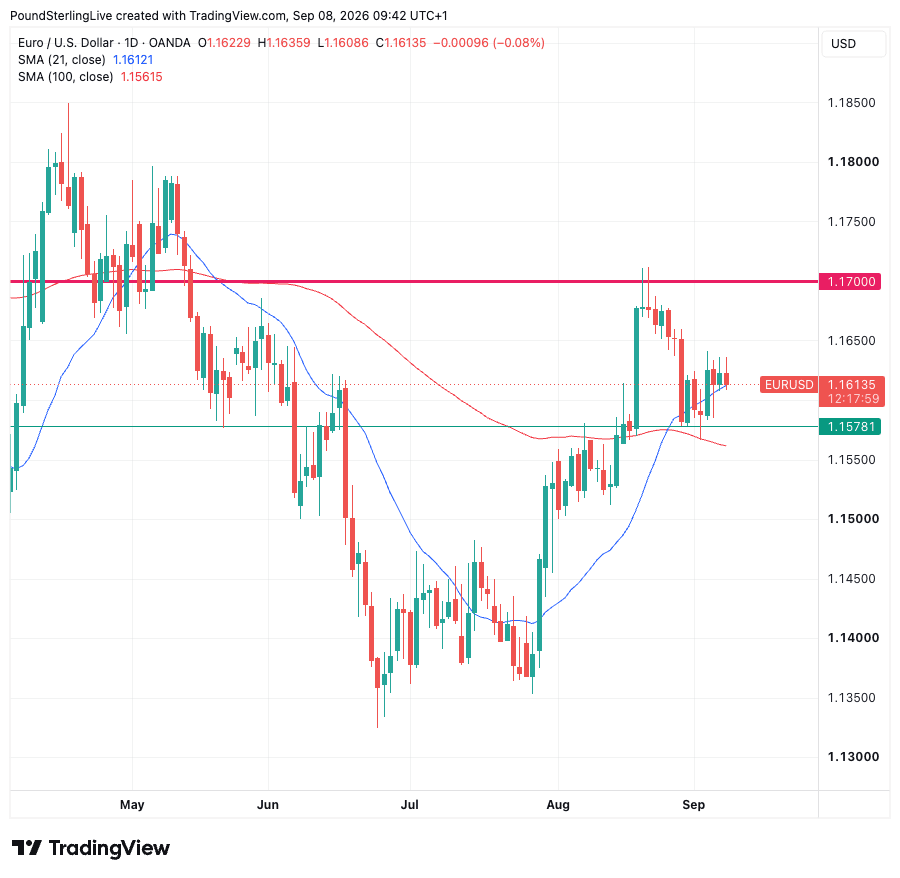
That resilience sees EUR/USD trade at 1.1613 on Tuesday, a matter of pips above the 21-day moving average at 1.1612, a level that has offered a floor for the past fortnight.
The rising 21-day MA has completed its cross above a falling 100-day, which is likely the most constructive development this chart has produced since July:
Above: EUR/USD daily chart. Image © Pound Sterling Live, chart created with TradingView.
What does that crossover denote? It reads as a shift in short-term momentum relative to the longer trend, and it is the signal that turns a recovery into something with a structure behind it. Yet, the quality of this one is mixed, because the 100-day at 1.1562 is still pointing lower, so the exchange rate is reflecting a market recovering inside a medium-term decline that has not itself turned.
Every pullback since the middle of August has stopped on or just beneath the 21-day, and the average has risen through each of them, which leaves the euro defending a line that keeps moving up to meet it. That is the constructive half of the chart and it is holding by a very small margin.
1.1700 was the floor of the May range and has worked as the ceiling since June, turning back the late-August advance on the day it was tested. It sits far enough above the market to be out of reach of anything on this week's calendar.
Beneath, the 1.1578 graphical horizontal support caught the early-September low, with the falling 100-day at 1.1562 immediately under it, so the two form a narrow band and a daily close through it would take the constructive reading away.
A week ago we looked for the 1.1573 to 1.1578 band to hold, with any recovery capped at the 21-day and then at 1.1700.
The band held, and the euro then cleared the 21-day we had named as the cap and spent the fortnight since using it as support. That is the more constructive of the two outcomes and the reason this week starts with the chart pointing up.
For now we look for the euro to hold the 21-day and the 1.1578 support beneath it, with 1.1700 the ceiling. Our Euro to Dollar forecast has the range holding into the Federal Reserve's 16 September decision, which is the event carrying the power to break it.
Fade ECB Rate Hike Reaction
The European Central Bank is expected to raise interest rates this week, and the market is well positioned for it.
The FX rule of thumb is that a central bank delivering more than expected lifts bond yields and draws buyers to its currency, while an outcome that undershoots does the reverse. Neither applies cleanly to an outcome the market has already bought, and the euro has been unwilling to rally on hawkish ECB news for some time now.
However, we think post-ECB moves are a fade largely due to the dollar's dominance. Market-priced odds of a Federal Reserve hike on 16 September rose from 54% to 61% after Friday's payrolls report, continuing a steady repricing that favours USD.
A market more than half convinced the Fed moves next week is a market that keeps buying dollars on dips, and that repricing is the reason a chart which looks like it wants to go higher has not been able to.
Europe's Energy Bill Is the Other Weight on the Euro
Meanwhile, domestic fundamentals are also capping euro-dollar upside ambitions.
The eurozone's vulnerability to elevated gas prices and low storage levels intensifies the longer the stalemate in the Strait of Hormuz persists.
"European power prices remain elevated, with front-month contracts around €130 to €150/MWh across most markets as surging gas costs outweigh the temporary relief from stronger renewable generation," say economists at Rabobank in a new note.
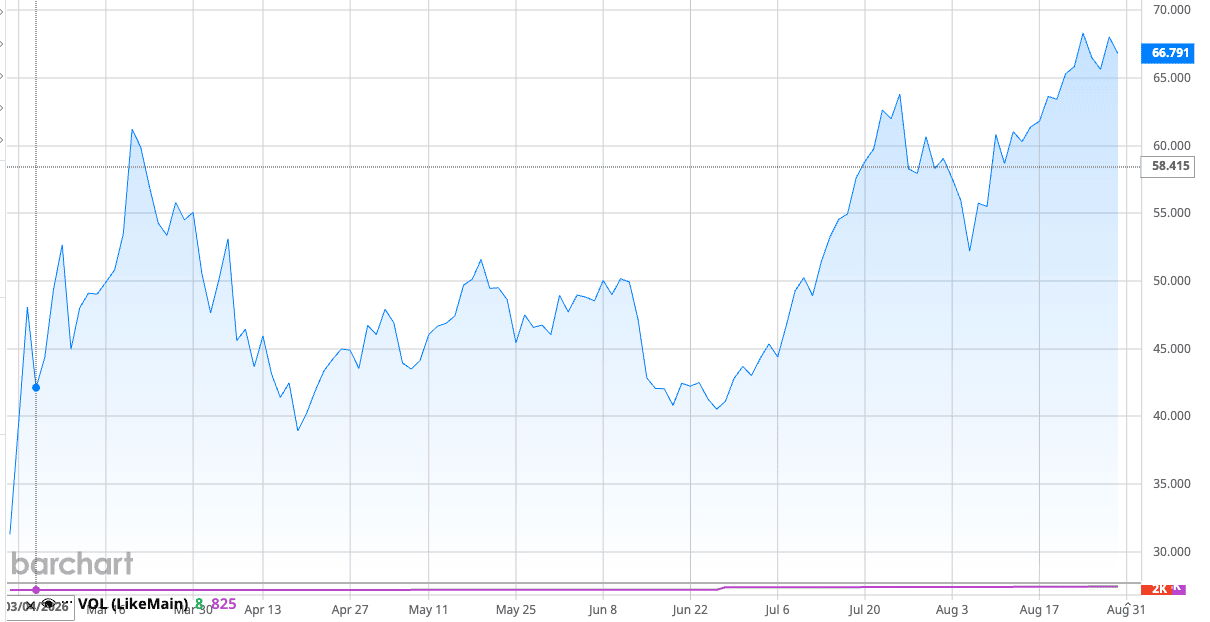
Above: European gas for next month delivery.
Wind is amplifying day-ahead volatility without lowering the forward curve, according to the same research: prices fall sharply when output rises, particularly in Germany, and rebound quickly when generation fades.
Rabobank expect gas to keep power prices high into 2027, with low storage and disrupted Gulf LNG flows supporting the near-term outlook, and name further damage to Qatari or other LNG infrastructure as the main risk to a slower normalisation next year.
An economy paying more for energy than its trading partners runs a persistent drag on growth and on its terms of trade, which is a reason to sell the currency that has nothing to do with interest rates.
Our Euro to Dollar forecast sees the euro supported, but with upside being capped. The chart has turned constructive, yet the two things weighing on it - a Federal Reserve that the market expects to move and an energy bill that will not come down - are both still in place as the ECB finishes this week.

The Bank Consensus, Without the Terminal
The median, mean, highest and lowest from the October survey update, plus named point forecasts out to 2027.
Free information pack, issued by World Wide Currencies.