
Image © Adobe Images
The British pound is starting to labour under the strains of the looming budget - Barclays.
Analysts warn the pound sterling is beginning to exhibit signs of caution, most likely due to rising global borrowing costs and uncertainty ahead of the Budget.
"The pound showed some signs of strain last week, under pressure from higher global yields and a gradual - albeit preliminary - shift of focus towards the October Budget," says a weekly strategy note from Barclays.
The observation comes as the cost of some tenors of UK debt rose to the highest level since 2007, slashing the space Chancellor John Healey has to manoeuvre with his spending and tax plans next month.
"Political risk now seems to be grossly underappreciated ahead of the Autumn Budget. We see it as inevitable that the Autumn Budget will bring with it a combination of higher ancillary tax rates and an increase in debt issuance in order to fund Burnham’s spending ambitions," says Matthew Ryan, Head of Market Strategy at Ebury.
The pound-to-euro rate fell through a key near-term support level to a low of 1.1622 amidst another jump in bond yields, consistent with the idea that the UK's elevated yield relative to other developed economies was no longer providing support.
The pound-to-dollar conversion dipped to 1.3474.
Our reading is that sterling is still in a short-term pullback within the confines of a broader uptrend, but the risk is that the selloff becomes more pronounced on any ongoing rise in bond yields and a deterioration in the British fiscal matrix.
"Overall, the August lull is giving way to a period of increased scrutiny on UK policies and fundamentals, shifting the risk-reward modestly to the downside for the pound," says Barclays.
Economists at the bank reckon the rise in gilt yields has eroded the Chancellor's headroom from over £23BN at the OBR's March outlook to £10-15BN, while other economists think the headroom has effectively been halved.
Chancellor Healey has pledged to build a fiscal buffer against uncertainty at the 28 October Budget, which means he must likely raise taxes and issue more debt.
"We know that Burnham favours a heavier burden on assets and a lighter one on labour, so we could see changes to stamp duty and council tax, an introduction of a mansion tax and tighter pension and ISA relief," says Ryan.
Rising taxes and debt pressures meet a market that is becoming increasingly cautious about taking on more debt issuance owing to generous debt supply from other developed nations and AI hyperscalers.
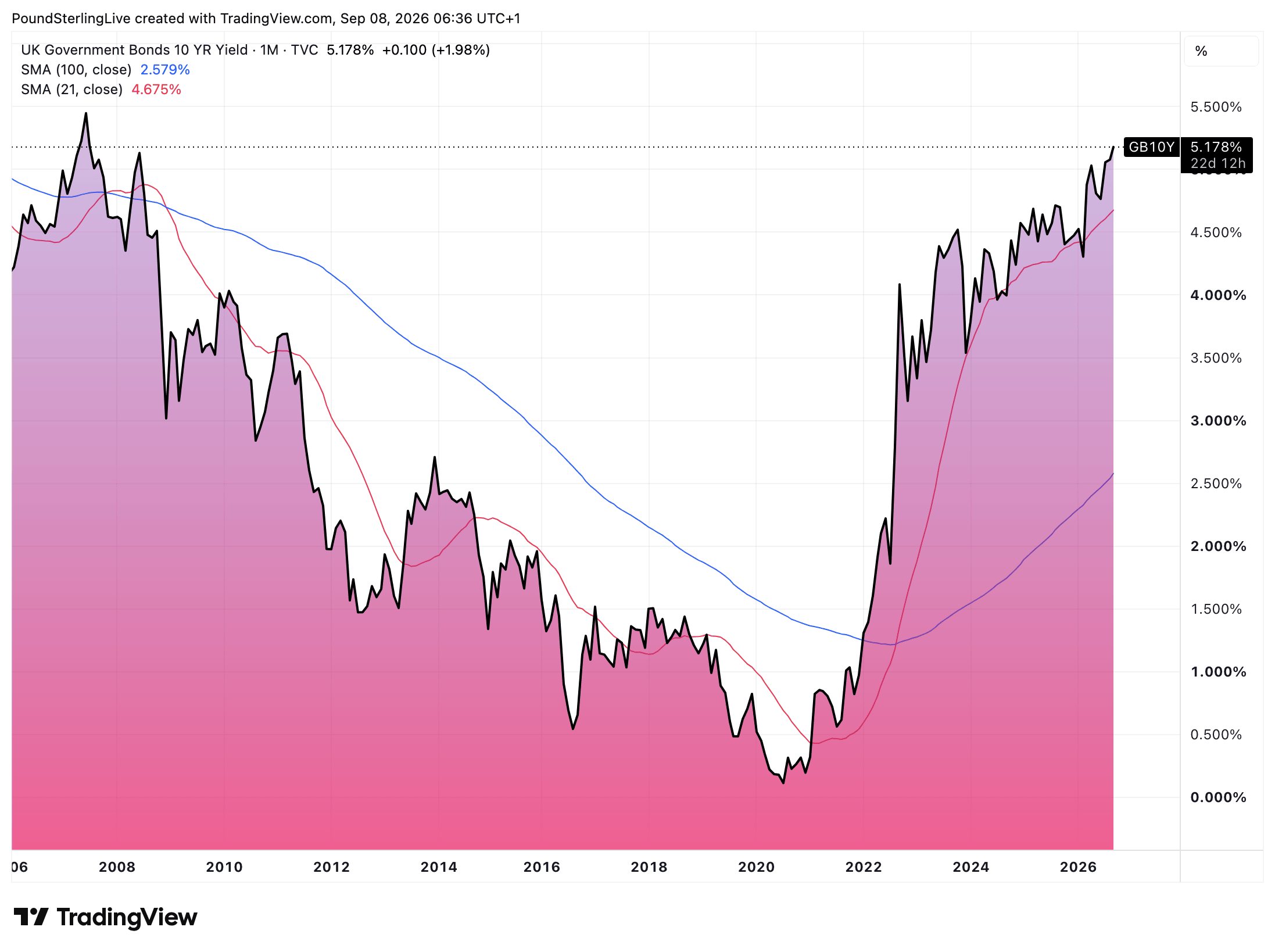
Above: UK ten-year bond yield
Rising oil and gas prices are also playing a decisive role as global yields firmed at the start of the week and were higher across the yield curve, supported by higher oil prices and the payrolls-related boost to U.S. Treasury yields on the previous Friday.
European 10Y sovereign yields were 4-6bp higher, with the UK rising to 5.18% and Germany's to 3.39% on Monday.
No fresh U.S. or Iranian strikes were reported overnight, although Iran has accused the U.S. of causing disruptions to shipping through the Strait of Hormuz.
Iran has threatened to establish an “exclusion zone” outside the Strait of Hormuz aimed at vessels it believes are attempting to transit the waterway.
Reported traffic volumes through the Strait of Hormuz fell to their lowest since May.
The issue won't fade anytime soon, and that implies a protracted period of higher oil and gas prices as well as sovereign debt yields.
Thet's a difficult backdrop for Burnham's government and a risky one for the pound.
Constructive News from Key Jobs Report
The run into the Autumn Budget was always going to be a pain point for the pound, as uncertainty as to its contents is enough to freeze upside progress.
However, provided the government does as little as possible, confidence should return quickly and refocus attention to Britain's improving fundamentals.
"We received an encouraging August KPMG/REC report on jobs on Monday," says Sam Hill, an analyst at Lloyds Bank. "The survey recording its first increase in permanent hirings since September 2022."
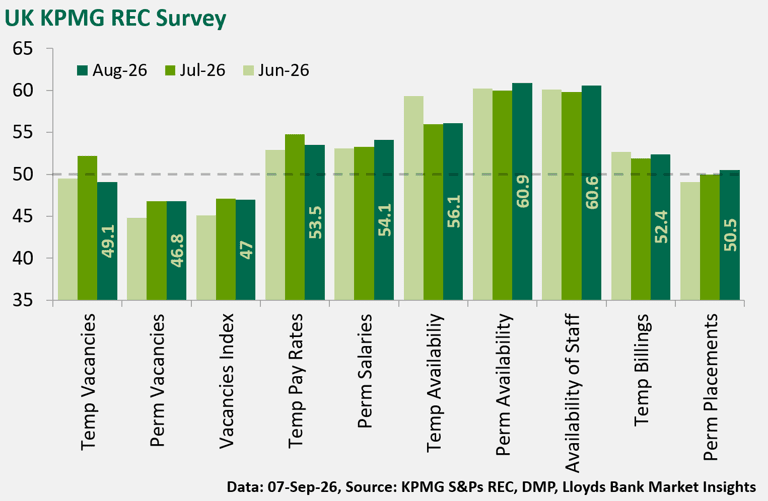
The headline index rose to 50.5 from 50.0 in July, while temporary recruitment also picked up some additional pace (52.4 from 51.9).
"That mirrors some aspects of the labour market data (the PAYE figures look softer than the Labour Force Survey) and the improved hiring responses recorded in the PMI surveys," says Hill.
The Bank of England will register the firming labour market in future decisions, and that could prove decisive in determining whether rates rise in the coming weeks.
The textbook says higher rates will underpin the pound. However, it must be noted rates are set to rise in most developed markets before year end, meaning a Bank of England hike might be the minimum requirement to keep the pound's rate support intact.
A higher Bank Rate underpins higher short-dated tenors of bonds, but will ultimately raise yields across the curve.
This might seem contradictory in light of what we said earlier in this piece about rising bond yields being a concern. The source of the rise is important: is it a robust economy and strong demand? Or is it spending largesse and the sense the budget is out of control?
For the pound, the former is clearly the supportive driver.

The Bank Consensus, Without the Terminal
The median, mean, highest and lowest from the October survey update, plus named point forecasts out to 2027.
Free information pack, issued by World Wide Currencies.