Image © Adobe Images
The British pound looks on course to fall a further 200 pips against the dollar as markets adjust to a September rate rise at the Federal Reserve.
The pound-to-dollar rate continues its near-term pullback, cracking through a graphical support zone at 1.3506 over the past 24 hours, suggesting there's not much interest layered at this region, or at least not enough to resist the selling pressure.
The RSI sits at 46 and is pointed lower, confirming to us that momentum is consistent with lower levels.
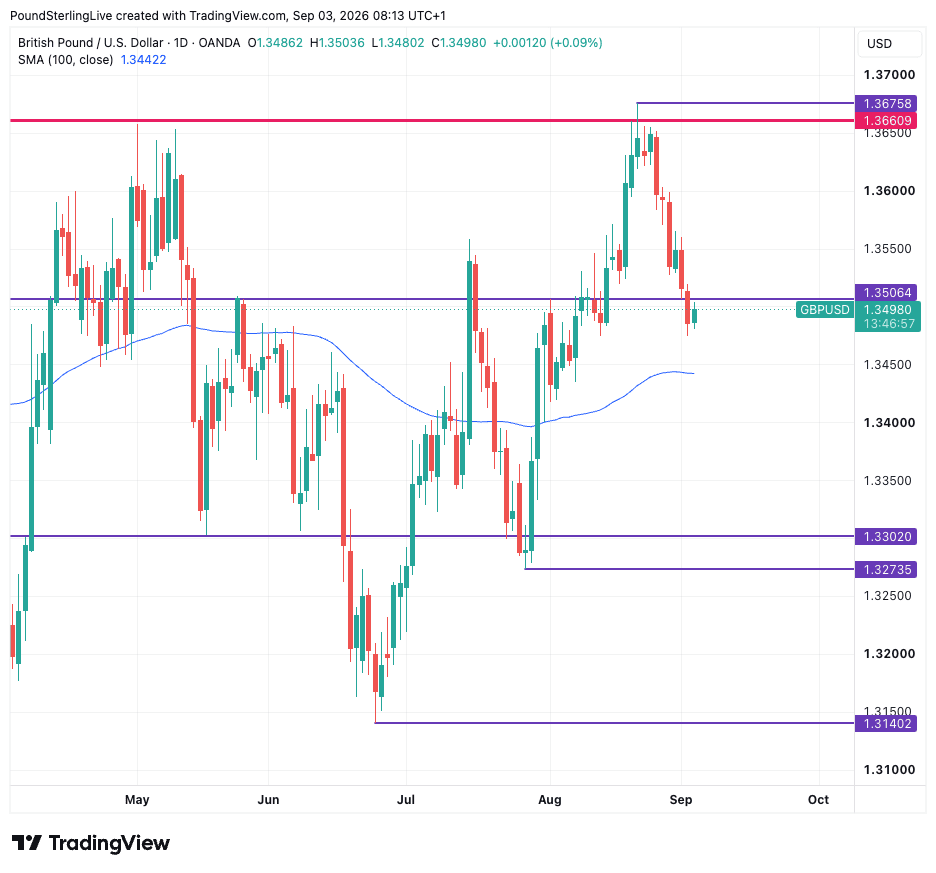
The moving averages aren't of much use: nothing is signalling the potential for support or resistance at this point, and our reading is that they are merely confirming one thing: this is a range-bound pair and periods of strength and weakness are an oscillation within a range.
Another way of approaching the analysis is that the pair is oscillating around the 100-day moving average, currently at 1.3442, and therefore the current pullback will meet that level and likely break below it.
The 100-day is flat, consistent with a meandering sideways range, where 1.3660 is the top and 1.3300 the bottom. Of course, you can choose your own levels, but they all approximate in a similar place.
That range-bound assessment is not an attempt to make light of current weakness: we're looking at a big range with notable cost implications for those with GBP into USD transfers, and vice versa.
Our reading of the situation also tells us that we're oscillating lower and that there is the potential for a further 200 pips of losses before real support sets in.
Fundamentally, we're in a new period of USD appreciation, driven by the rise in expectations that the Federal Reserve will raise interest rates this month.
Just two weeks ago, a September hike was off the table, but the Fed's assessment of inflation dynamics has prompted a rethink.
According to analyst Nick Kennedy at Lloyds Bank, the Fed is likely to gloss over soft headline jobs data, absent a clearer deteriorating trend. Federal Reserve Chairman Kevin Warsh's Jackson Hole appearance showed he is likely more concerned about inflation persistence, being "hard pressed to see financial conditions as restrictive".
"Which is why a September hike is now odds on," says Kennedy.
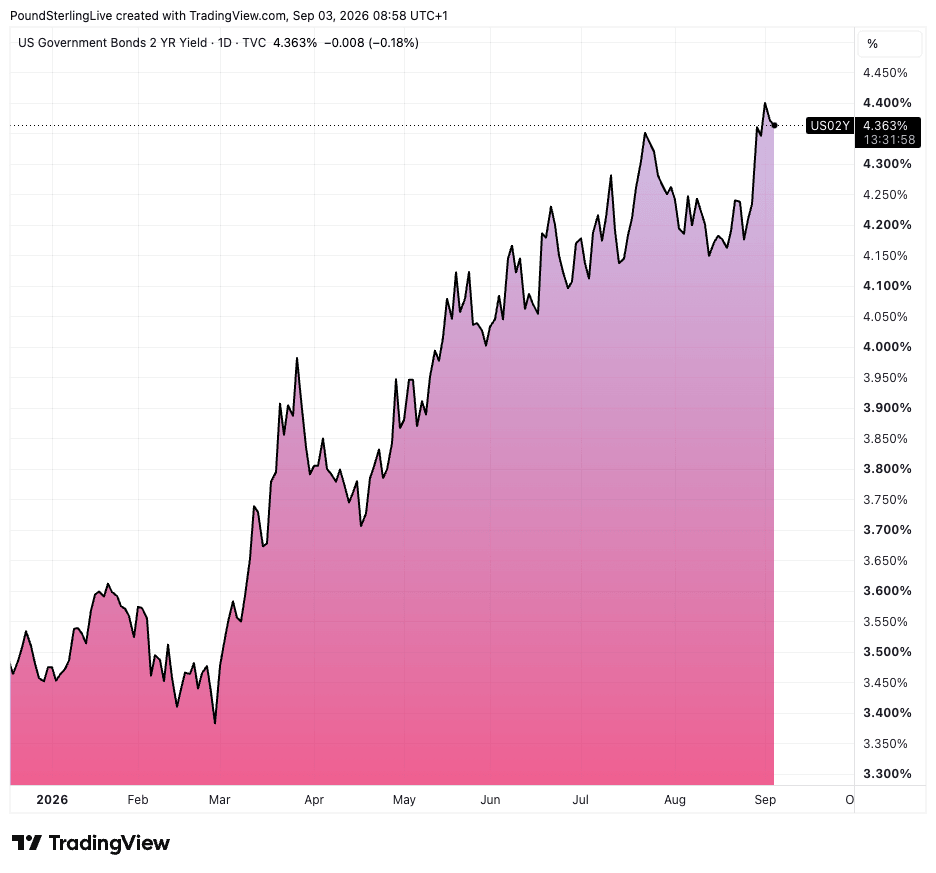
Above: The US 2-year bond yield has risen sharply. It is particularly sensitive to bets on future Fed interest rate levels.
The dollar is proving reflexive to that shift in market odds, which has driven U.S. bond yields notably higher.
With U.S. yields now relatively more attractive than equivalent yields elsewhere, the flow into U.S. bonds is strengthening the dollar, precipitating a decline to the lower end of the GBP/USD range at 1.33.
Warsh told the central bank conference in Wyoming that 2.0% was the target for Core PCE, reaffirming that this figure remains the Fed’s preferred inflation measure.
Last week, PCE core inflation came in as expected at +3.3% year-on-year.
That reading and Warsh's reaffirmation of the 2.0% core PCE target is the market reading the economy: higher rates are needed.
For U.S. bond yields, that implies upside, which should translate into further near-term dollar strength.
The Bank Consensus, Without the Terminal
The median, mean, highest and lowest from the October survey update, plus named point forecasts out to 2027.
Free information pack, issued by World Wide Currencies.