Image © Adobe Images
Last week's recovery died before it got back to the 21-day, and Friday's jobs blowout confirmed the downside skew.
The British pound looks liable to further losses against the dollar in the coming week.
The pound-to-dollar exchange rate spent last week trying to recover from a two-week low and could not get back to its own short-term trend before Friday's U.S. employment report ended the attempt.
From a technical perspective, the market sits a handful of pips above the shelf that launched August's advance, with a flat 100-day moving average sitting some seventy pips beneath it:
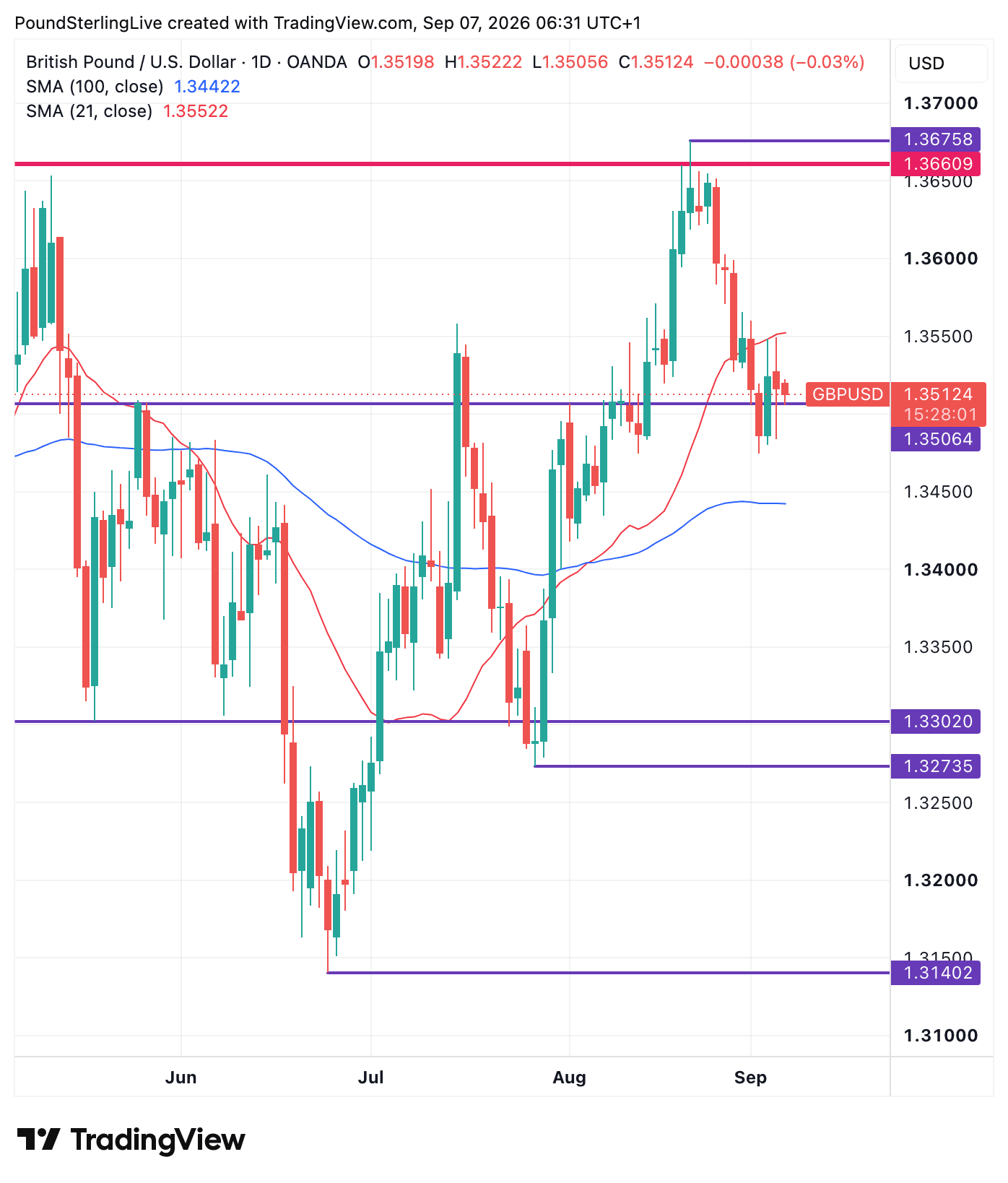
Above: GBP/USD daily chart. Image © Pound Sterling Live, chart created with TradingView.
The market trades at 1.3512 at the start of the new week, putting it on a graphical horizontal support zone at 1.3506, which is acting more as a pivot than a line in the sand.
GBP/USD hit a two-week low at 1.3485 on Thursday, recovered to 1.3535 by Friday morning, before the payrolls report took it straight back to 1.3487.
The pair looks heavy and a fall to the 100-day moving average looks like an attractive call.
The 100-day moving average is flat, reflecting four months of rangebound GBP/USD trading; it's the centre of gravity.
The 1.3506 shelf is where August's advance began, and the market is now retesting it from above. Losing it unwinds that advance and leaves the 100-day as the next thing drawn on the chart.
Set against that, the market still trades above a 100-day that has not fallen, so this is a retreat towards the middle of a four-month range, with the bottom of that range still some way off. The year's low at 1.3140 sits a long way from here.
The Jobs Blowout Puts the Fed Back in Play
The dollar jumped ahead of the weekend after August payrolls came in at 162,000 against a consensus of 56,000, above the top of a forecast range that ran from minus 25,000 to plus 121,000.
July's reported decline of 23,000 was revised to a gain of 21,000 in the same release, a swing of 44,000 that takes the summer's weakest month off the record. Unemployment held at 4.1% and average hourly earnings rose 0.3% on the month for 3.1% on the year.
A payrolls print above expectations tells the Federal Reserve the economy can carry higher interest rates, which lifts U.S. bond yields and draws buyers to the dollar, pushing this pair lower. Friday delivered exactly that inside twenty minutes, with the pound falling from 1.3535 to 1.3487 before steadying at 1.3510.
The strong labour market report pushed the market-priced probability of a Fed interest rate hike on 16 September up from 54% before the job figures were released to 61% afterwards, says Felix Schmidt at Berenberg.
That leaves the decision a week away with the market more than half convinced the Fed moves, and it puts this week's American data in the position of being the last chance to shift those odds before the meeting.
The U.S. This Week
A political risk that is new this week as President Trump has publicly called on the Fed to lower interest rates, while also threatening to halt trade with countries running surpluses with the U.S. if it fails to do so.
This is the first time he has publicly pressured the Fed during Warsh's term as Chair, and flag it as a potential barrier to FOMC hikes.
Looking at the calendar, the New York Fed consumer survey lands on Tuesday and the University of Michigan survey on Friday. Both are second tier but should continue to show anchored longer-term inflation expectations.
Watch the three-month annualised CPI change and the trimmed, sticky, median and supercore measures on Friday for whether the underlying improvement is stalling.

The Bank Consensus, Without the Terminal
The median, mean, highest and lowest from the October survey update, plus named point forecasts out to 2027.
Free information pack, issued by World Wide Currencies.