Image © Adobe Images
The Reserve Bank will not chase inflation with faster hikes, diminishing the NZD's rate support.
The hawkish rate story that carried the NZ dollar through much of 2026 has died a sudden death following the Reserve Bank of New Zealand's (RBNZ) latest interest rate hike and policy update.
Markets had expected the hike but had been pricing an official cash rate of 3.50% by the middle of 2027; however, the projections published alongside Wednesday's 25 basis point hike - which took the OCR to 2.75% - put it lower at 3.1%.
That gap of roughly 40 basis points sits at exactly the point on the curve where the Kiwi's carry advantage was being built, and it is the reason the currency fell on a rate rise:
The pound-to-New Zealand dollar exchange rate jumps 1.25% on the day to hit 2.32. The New Zealand dollar-U.S. dollar conversion slips 1.40% to 0.5809.
The RBNZ's new forecast profile shows the OCR will track to 2.8% in December, 3.0% by March 2027 and 3.2% only by the end of that year: that's a pace that implies just one further move across the next three quarters.
Economists at ING say that the market's existing pricing of "95bp by June 2027 looks way too hawkish" against forecasts the Reserve Bank declined to revise higher.
The Committee said a recent appreciation of the exchange rate had contributed to the tightening in domestic financial conditions in New Zealand, alongside higher wholesale rates and dearer mortgage and business lending.

The Bank Consensus, Without the Terminal
The median, mean, highest and lowest from the October survey update, plus named point forecasts out to 2027.
Free information pack, issued by World Wide Currencies.
Currency strength is therefore doing what additional rate rises could have done, thereby limiting the need for further hikes.
Four of the six members of the Committee still see inflation risks skewed to the upside, so the tightening bias survives, and the new guidance should therefore act as a cap to market expectations as opposed to the trigger to a reversal.
Westpac reads the statement as balanced and keeps a hold in October with a hike in December, judging that the Committee wants more evidence on the durability of the recovery before committing further.
GBP/NZD: A Trend Change?
The pound-to-New Zealand dollar exchange rate fell amidst the broader NZD selloff, potentially shifting near-term momentum in Sterling's favour.
On Monday, we looked for the compression between the 21-day average at 2.2917 and the 2.27951 shelf to break higher, and we expected the 200-day at 2.2985 to cap it.
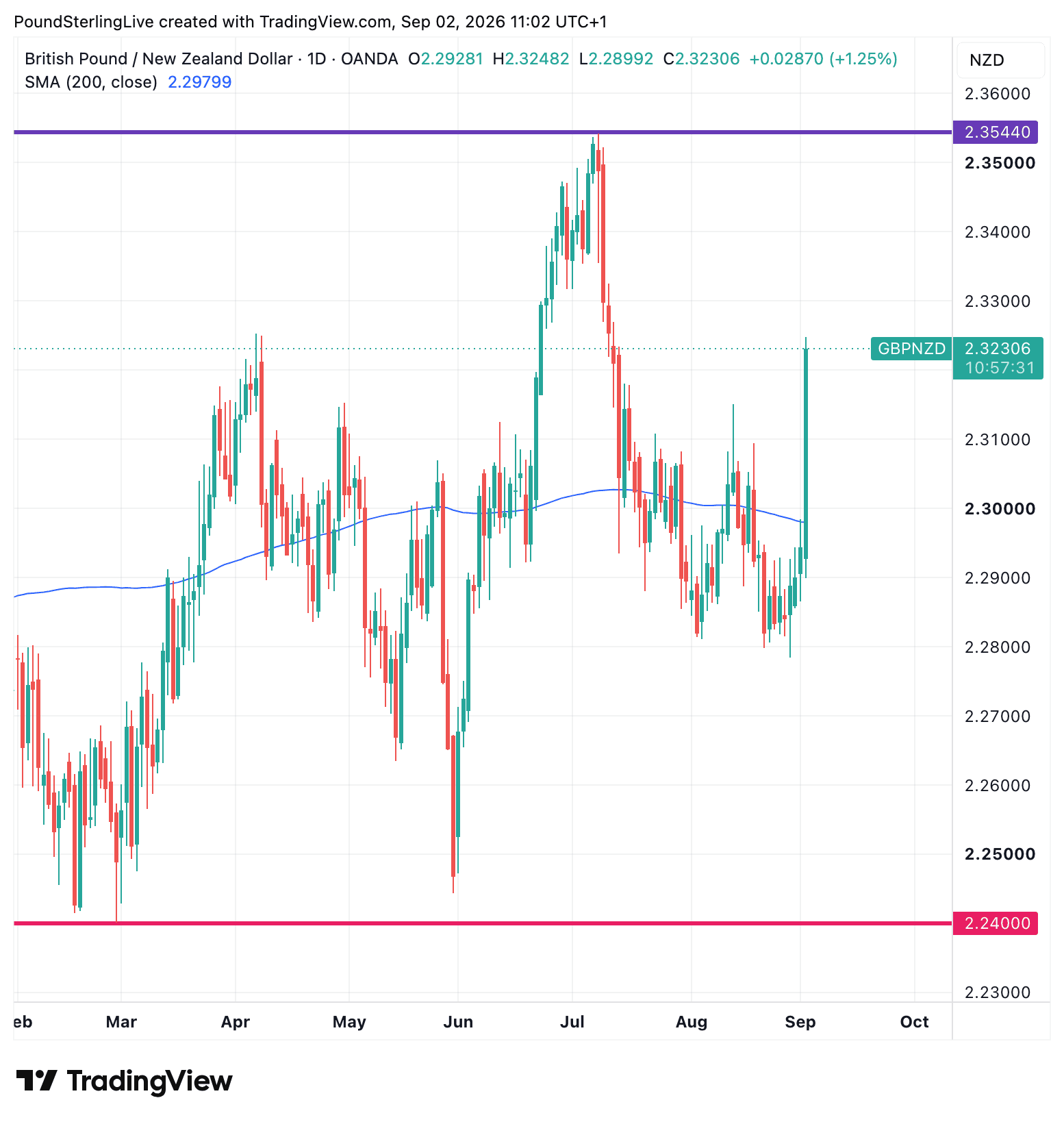 The break came higher and the 200-day did not hold, which is the more consequential half of that call.
Clearing a long-term average on a central bank decision carries different structural content to clearing it on a dollar move, and it puts the July peak at 2.3518 back in view.