
Image © Adobe Images
The pound is pinned between its short-term average and support against the Kiwi, the RBNZ decision and USD direction could prove pivotal this week.
The pound-to-New Zealand dollar exchange rate has been squeezed into a narrowing space between its 21-day moving average above and the shelf that has caught every decline this month below, with Friday's session dipping beneath that shelf before recovering to close higher.
From a technical perspective, a market compressed like this resolves with a break, and the position of the 200-day says which way it ought to go:
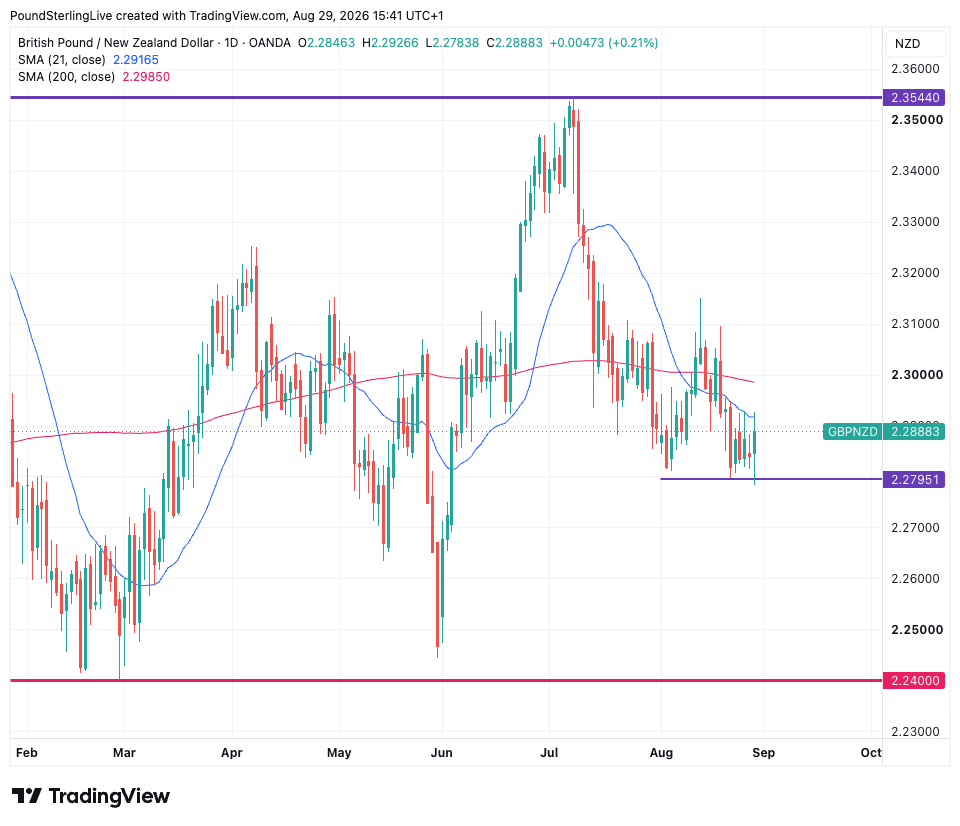
Above: GBP/NZD daily chart. Image © Pound Sterling Live, chart created with TradingView.
Spot at 2.2888 sits 28 pips beneath the 21-day moving average at 2.2917 and 93 pips above the 2.27951 shelf, with the 200-day at 2.2985 above both.
The 21-day has been falling since the middle of July while the shelf has not moved, so the space between them narrows by a few pips each session.
The general rule is that a market trading below its 200-day moving average sits in a broader downtrend, and on that reading the break should come lower.
Yet, two things argue the other way: Friday's low at 2.2784 dipped beneath the 2.27951 shelf and then closed nearly a cent above it, which leaves the sellers with nothing to show for the attempt.
And a falling average above a market holding its ground can be cleared without any rally at all, simply by the average coming down to meet price.
Dollar in Control
Our analysis of GBP/NZD has for some time now relied heavily on broader USD action:
GBP/NZD is GBP/USD divided by NZD/USD, so both legs move when the dollar moves and the cross follows whichever leg moves further.
However, the Kiwi has the greater sensitivity of the two, owing to its commodity linkages, its exposure to global risk appetite and its relative illiquidity.
It has a higher beta to the dollar.
A rising dollar therefore knocks NZD/USD by more than it knocks GBP/USD, and this exchange rate rises as a result, which was solidly confirmed by Friday's USD surge.
A week ago we called for the decline to extend towards 2.2600 and then 2.24000, with a daily close back above the 200-day as what the August recovery needed.
The decline did not extend.

The Bank Consensus, Without the Terminal
The median, mean, highest and lowest from the October survey update, plus named point forecasts out to 2027.
Free information pack, issued by World Wide Currencies.
The market made a marginal new low at 2.2784 and finished the week higher than it started.
Although the forecast was off, the mechanism held up: we wrote that a falling dollar pushes this cross lower, and the dollar rose instead.
The framework was right and the input assumption was wrong, which is the more useful half to know going into a week that turns on the same arithmetic.
For now we look for the break to come higher, through the 21-day at 2.2917 and towards the 200-day at 2.2985, which we would expect to cap it. A daily close beneath 2.27951 changes that and opens a stretch of chart with nothing drawn on it until 2.24000.
RBNZ Seen Hiking on Wednesday
The Reserve Bank of New Zealand announces on Wednesday and a 25bp increase to 2.75% is fully priced, which leaves the decision itself as a formality and guidance as the key determinant of NZD direction.
Should the RBNZ hint towards further hikes, the NZD can push GBP/NZD lower.
Should the RBNZ push back against further hikes, the NZD can come under pressure.
Beyond September, the market expects another increase by year-end, and the overnight index swap curve implies a further 50bp taking the official cash rate to 3.50% by the middle of 2027.
Therefore, the RBNZ must verify those bets for NZD to just stay still, any erring would send the currecny lower.
ING expect the hike and expects the Bank to keep a tightening bias, but argues the bar to match expectations that hawkish is set high, and that the new projections carry dovish risks capable of weighing on the New Zealand dollar.
Westpac read it the other way, expecting two more 25bp increases this year to take the cash rate to 3%, and further tightening through 2027 towards 4%.
Their judgement is that policy is not yet restrictive by historical standards and would not be even at 3%.
They expect the committee to stay equivocal on whether the next move lands in October or December.
The Bank Consensus, Without the Terminal
The median, mean, highest and lowest from the October survey update, plus named point forecasts out to 2027.
Free information pack, issued by World Wide Currencies.