File image of Kevin Warsh. Sérgio Garcia/Your Image for ECB. Copyright: European Central Bank 2026.
Pound sterling's pullback against the Euro has stalled at a short-term support line, further USD weakness could bolster the pair.
The pound-to-euro exchange rate continues to consolidate above 1.1650 support and Friday's 0.20% gain to 1.1680 helps shore up the near-term setup.
GBP/EUR's Friday gain looks to be a symptom of Federal Reserve Chair Kevin Warsh's speech: both European currencies fell against a hawkish-Warsh dollar, but GBP/USD lagged EUR/USD on the way down, mechanically raising the GBP/EUR cross.
From a technical perspective, buyers must now hold the recovery above the 21-day moving average - the blue line in the below chart - which has capped every attempt since the first week of August:
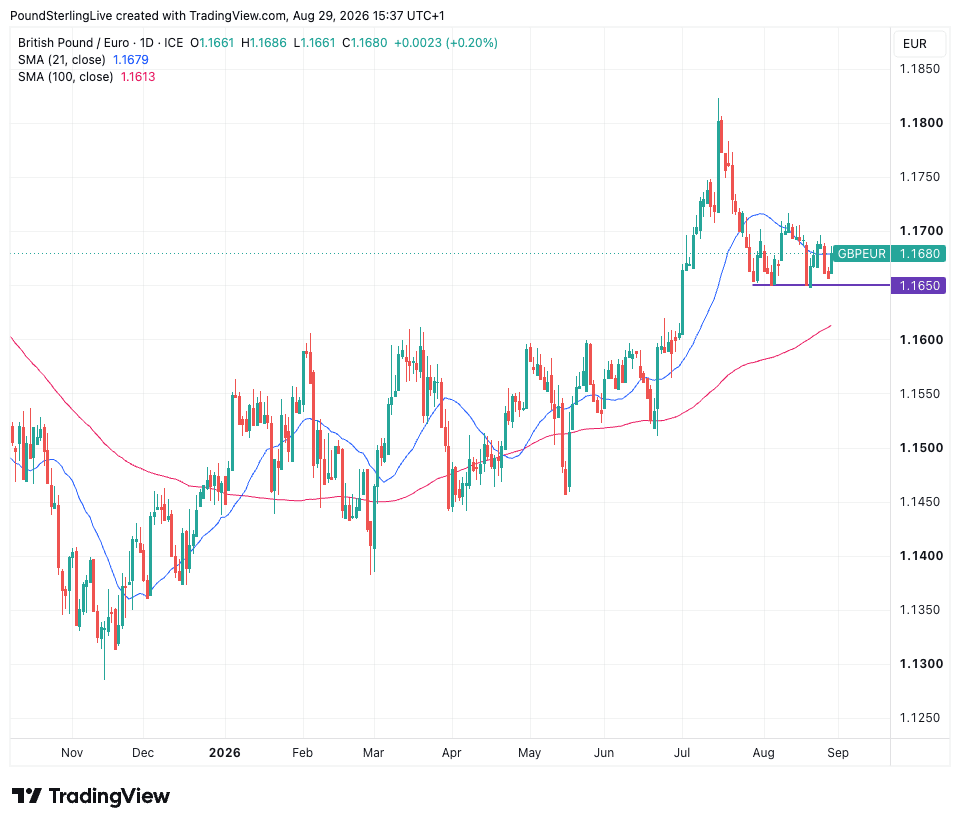
Above: GBP/EUR daily chart. Image © Pound Sterling Live, chart created with TradingView.
The 21-day sits at 1.1679 and the pair closed Friday at 1.1680, which puts price and average on the same line.
That average has been falling since the final week of July, when the pair peaked above 1.1800, and it has flattened over the past fortnight. Beneath it, support approximates around the 1.1650 shelf, which has now halted four separate declines in August.
The 100-day moving average - the red line - is at 1.1613 and rising steadily, so the medium-term support beneath this market climbs towards the current price while the short-term resistance above it falls. What does that convergence tell us?
A falling short-term average means the ceiling comes down a little each session, so the pair can clear it without rallying at all, simply by holding its ground.
A rising long-term average means the floor comes up to meet price at the same time. Squeeze the two together and a market runs out of room to sit still. We would expect this one to resolve in weeks.
A week ago we said the correction had further to run and that the downside would be shallow, a call that came good.
For now we think 1.1650 holds and that this week is spent between that shelf and the 21-day average. A daily close below 1.1650 would change our mind and bring a fall back to the 100-day into view.

The Bank Consensus, Without the Terminal
The median, mean, highest and lowest from the October survey update, plus named point forecasts out to 2027.
Free information pack, issued by World Wide Currencies.
Dollar Direction Could Prove Decisive for Sterling-Euro
Friday's price action is instructive: we saw EUR/USD's weakness outpace that of GBP/USD in response to Kevin Warsh's Jackson Hole appearance, which tells us that any follow-through USD strength could encourage further GBP/EUR gains.
"Warsh’s speech was deemed to be quite a bit on the hawkish side and the dollar reacted by bouncing back across the board," says Fawad Razaqzada, Market Analyst at FOREX.com.
Warsh cited solid consumer and business investment spending as indicative of a resilient economy, while acknowledging slower hiring.
He said the Fed should be more disciplined, less predictable, and more focused on restoring price stability, while allowing markets to infer policy direction from economic data rather than Fed signalling.
"To that end, he avoided indicating what the Fed will do at the September meeting but was clear that he’s not convinced underlying inflation is moving sustainably back to the Fed's 2% target," says Jay Hawkins, Senior Economist at PNC Bank.
The jump in the dollar all but confirms the market's verdict that Warsh is minded to oversee a rate hike in September.
That strength has helped GBP/EUR, and for that reason we think that follow-through USD action will be the decisive driver for sterling crosses in a week devoid of major UK and Eurozone calendar events.
The Bank Consensus, Without the Terminal
The median, mean, highest and lowest from the October survey update, plus named point forecasts out to 2027.
Free information pack, issued by World Wide Currencies.
Front-line Data: Eurozone Inflation
Eurozone Inflation Carries an Upside Skew
Tuesday's euro area flash inflation reading is the week's main event for this pair, and the risk into it is skewed against Sterling.
Barclays track the release at 3.39% year-on-year headline and 2.45% core, while UniCredit are at 3.4% and 2.5%, both against a Bloomberg consensus of 3.2%. Those two houses have already incorporated Friday's national releases from France and Spain, which make up roughly 30% of the basket, so their gap to consensus rests on data the rest of the market has also seen.
Germany's own August inflation figures land on Monday while UK markets are shut for the bank holiday, which hands the euro a full session to price them before London can respond.
Pipeline pressure is building underneath the headline: Spanish producer prices accelerated to 9.2% year-on-year in July from 7.0%, with industrial electricity prices up 16.6% on the month on heatwave demand, while French producer prices rose to 4.3% and German to 3.0%. Barclays stress the pass-through is not yet reaching consumer goods, and euro area producer prices follow on Thursday.
Economists at Barclays expect a final 25bp hike from the European Central Bank in September to a terminal deposit rate of 2.5%, while Lloyds notes that of the ECB, Federal Reserve and Bank of England all reporting over the coming fortnight, only the ECB is expected to move.
On balance, we think that could be supportive of euro crosses, particularly if the hike is accompanied by guidance that suggests more could follow.
Isabel Schnabel, the 'hawkish' ECB Governing Council member, has argued rates may need to rise further and said markets "seem to understand our reaction function very well".
A hawkish ECB setup can certainly limit GBP/EUR's upside ambitions this September.