
Image © Adobe Images
Pound sterling's pullback against the Euro has further to run, with its short-term average now rolling over.
The Pound to Euro exchange rate has spent seven weeks handing back the gains of its early-July surge, and the short-term moving averages are now turning down towards the longer ones, an alignment that argues this correction still has legs.
To be sure, the pair has now recorded three successive days of declines which suggest that downside is ultimately likely to be shallow, with enough buying interest being attracted into weakness to limit the extent of any spell of weakness.
From a technical perspective, buyers must defend the rising 50-day moving average - the red line in the below chart - if the uptrend is to be kept alive::
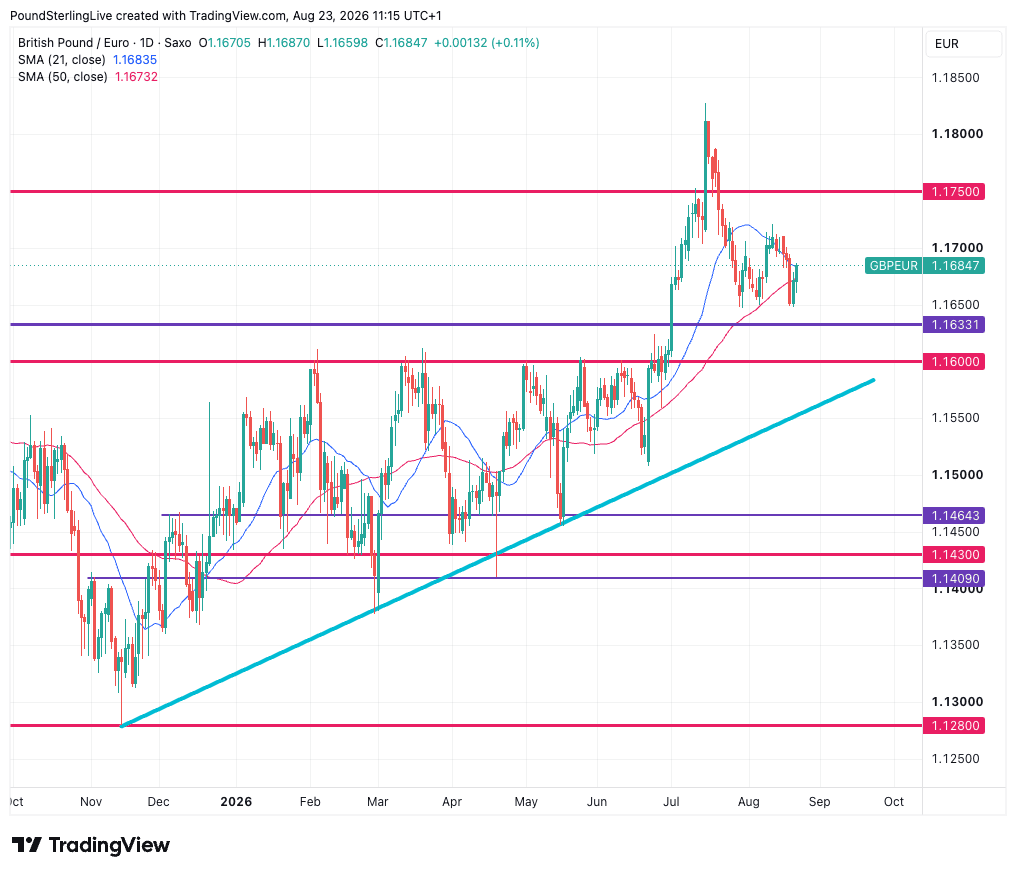
Above: GBP/EUR daily chart. Image © Pound Sterling Live, chart created with TradingView.
The other moving average on the chart - the 21-day - has meanwhile been falling since the final week of July where the peak at 1.18 was hit, while the 50-day is still rising, so the two are converging and a crossover is a risk.
What would the crossover of the 21-day below the 50-day denote? It would signal a potential shift in short-term momentum relative to the longer-term trend. Specifically, it reads as a bearish signal that suggests recent price action has weakened enough that the short-term trend is now trailing the longer-term trend, the start of a possible downtrend.
Although near-term risks are to the downside, if we step back a bit, we still see the medium-term uptrend that began at November 2025's low of 1.1280 still manages to survive all of this, with the trendline drawn from that low rising through the 1.1580 area and converging on 1.1600 through September.
That convergence is what makes 1.1600 the level that separates a correction from a reversal, because a break there takes out the horizontal and the trendline together, and until it happens the past seven weeks read as an orderly retracement inside a rising market.
For now, we don't think that's likely and that the medium-term uptrend stays intact.
UK Economy Provides a Fundamental Source of GBP Support
While the short-term is consistent with further weakness, the medium-term is more constructive on account of a robust economic pulse.
With that in mind, the UK offers two second-tier surveys this week that should reinforce the notion that the UK economy continues to do well, and that's a fundamental source of assurance for those wanting a stronger pound. Watch the CBI retail sales survey on Wednesday at 11:00 following July's reading of -26, and the Lloyds Business Barometer for August arrives on Friday at 00:01 after a previous month at 49.
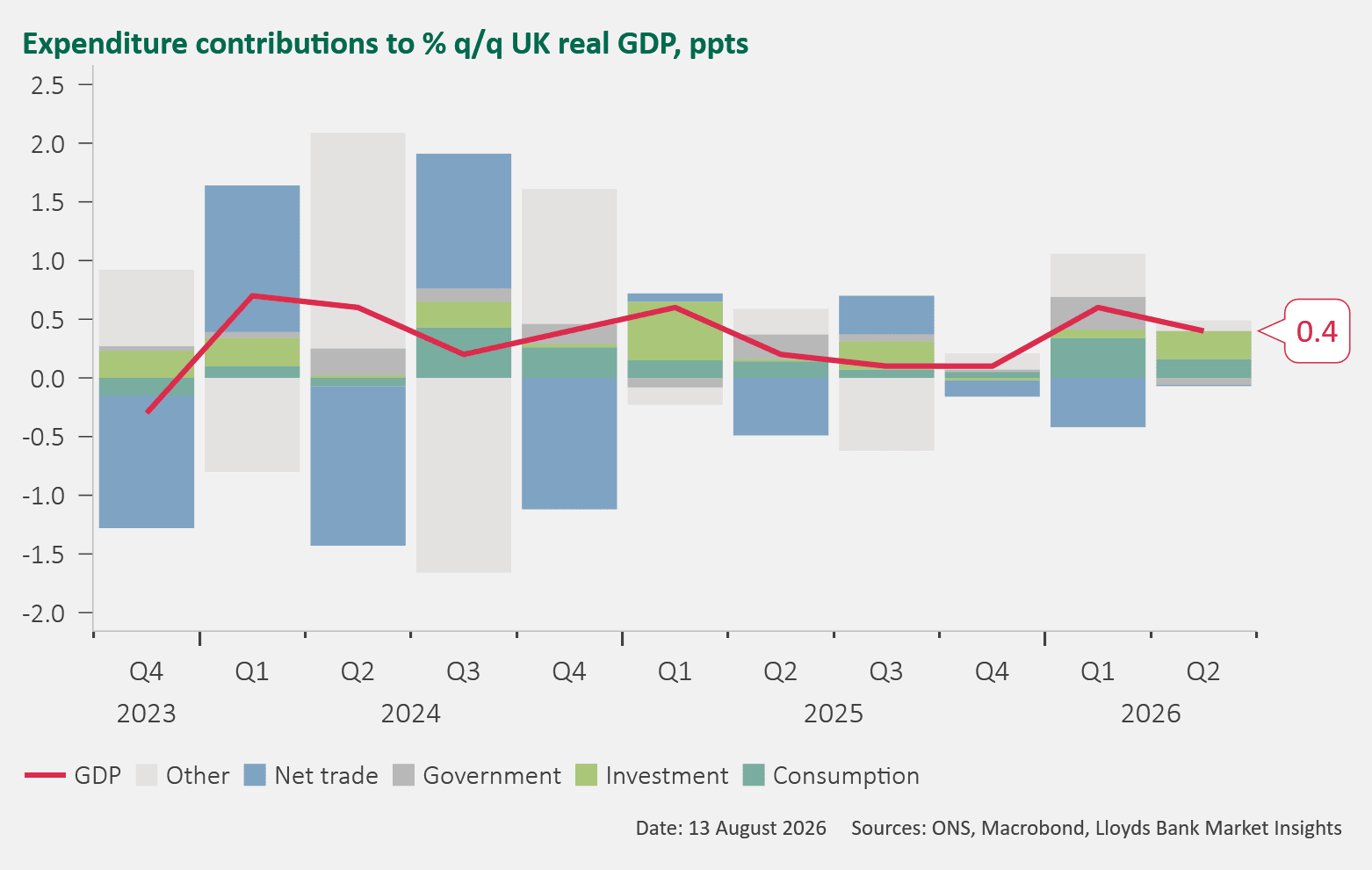
Above: UK economy settles into a constructive rhythm.
Neither carries the weight to move Bank of England pricing, which leaves the Pound where it has spent all of August, taking direction from gilts, UK government bonds, and from the inflation picture sitting behind them.
July's consumer price index met expectations at 2.9% year-on-year, with the core measure delivering a firmer 0.2% monthly reading against estimates of 0.1%, and there was nothing in it to prompt a strategy rethink in Threadneedle Street.
That is why the release failed to arrest the Pound's slide against the Euro in the days that followed.

The Bank Consensus, Without the Terminal
The median, mean, highest and lowest from the October survey update, plus named point forecasts out to 2027.
Free information pack, issued by World Wide Currencies.
The medium-term consequence points the other way, because inflation is stuck above the 2.0% target and will stay there for some time, which supports UK bond yields and preserves a residual carry advantage for Sterling.
Expectations for the Bank to hold in September survived the past week intact, according to research from Lloyds Bank, which points to core inflation unchanged at 2.6% and moderate wage growth as evidence of limited second-round pressure.
The risk to Sterling is that the market still expects too much from the Bank of England as the swaps curve shows 50 basis points of Bank of England hikes (that's two hikes) over the next twelve months, which is too aggressive given the UK's negative output gap, says Elias Haddad, Global Head of Markets Strategy at Brown Brothers Harriman.
Eurozone Focus Falls on Inflation Readings
Image © Adobe Stock
Germany's IFO business climate survey opens on Tuesday at 09:00, with consensus at 87.2 after 86.6 in July, and the European Central Bank publishes the account of its July meeting on Thursday at 12:30 alongside M3 money supply data.
Spain's flash harmonised inflation reading for August is expected at 4.6% year-on-year on Friday at 08:00, up sharply from 3.9%, while Deutsche Bank Research looks for 4.42%.
France's flash print follows at 07:45, expected at 2.6% year-on-year, with the German lender forecasting 2.85%.
A September rate hike from the ECB is already fully discounted so the prints will set the scale of repricing beyond September rather than decide the September meeting.
The Spanish number is the likelier source of a surprise given the size of the jump already in consensus, and an upside reading starts pricing in further hikes in the future. On balance that would be consistent with the GBP/EUR's current spell of softness.