
Image © Adobe Images
Falling inflation expectations trim September hike bets, but economists still expect the RBNZ to tighten.
The NZD bullish thesis took a hit Thursday after the Reserve Bank of New Zealand's quarterly Survey of Expectations, released overnight, showed inflation expectations falling back sharply at the short end.
Expectations for inflation one year ahead fell to 2.60%, down from 3.41% in the previous quarter, a drop of 81 basis points.
The two-year measure, which the RBNZ watches most closely, eased to 2.34% from 2.53%.
That's a relief for the inflation-fighting central bank, and households and businesses will welcome the associated retreat in domestic interest rates that will follow a slackening in New Zealand money markets:
Short-term borrowing as measured by the two-year NZ sovereign bond fell dropped by more than a per cent on the day to 3.53%.
That's translating into NZD weakness: The Pound-to-New Zealand Dollar exchange rate is quoted at 2.2983 at the time of writing, up 0.27% on the day, having found a floor in the 2.29 support zone that has been approaching for three weeks.
NZD/USD is trading below 0.5860, probing the lower bound of a nine-day range.
The New Zealand Dollar's advance this year has been built almost entirely on the market's conviction that the RBNZ has further to tighten.
This is the first data point to put a dent in that conviction.
Why the Inflation Survey Matters
Expectations for inflation one year ahead fell to 2.60% said the RBNZ's survey, down from 3.41% in the previous quarter, a drop of 81 basis points.
The two-year measure, which the RBNZ watches most closely, eased to 2.34% from 2.53%.
Longer horizons moved the other way marginally, with five-year expectations at 2.31% from 2.22% and the ten-year measure effectively unchanged at 2.20%.
That combination is the one the RBNZ would have wanted.
Near-term expectations have come down without the long-term anchor drifting, which is the definition of a central bank retaining credibility through an inflation overshoot.
Annual inflation in New Zealand ran at 4.1% in the second quarter.
"Recent moves in short-term inflation expectations from the RBNZ look to have been heavily influenced by NZ fuel price movements," says Mark Smith, Senior Economist at ASB.

The Bank Consensus, Without the Terminal
The median, mean, highest and lowest from the October survey update, plus named point forecasts out to 2027.
Free information pack, issued by World Wide Currencies.
The spike in retail fuel prices in April was followed by a jump in short-term expectations; the retreat from those mid-April peaks has now pulled them back down.
That matters for the currency because it means the improvement is imported rather than a domestic story - the kind the RBNZ can influence via rates - meaning the pressure can reverse just as quickly if the Strait of Hormuz situation deteriorates again.
Westpac reaches the same conclusion from the other direction.
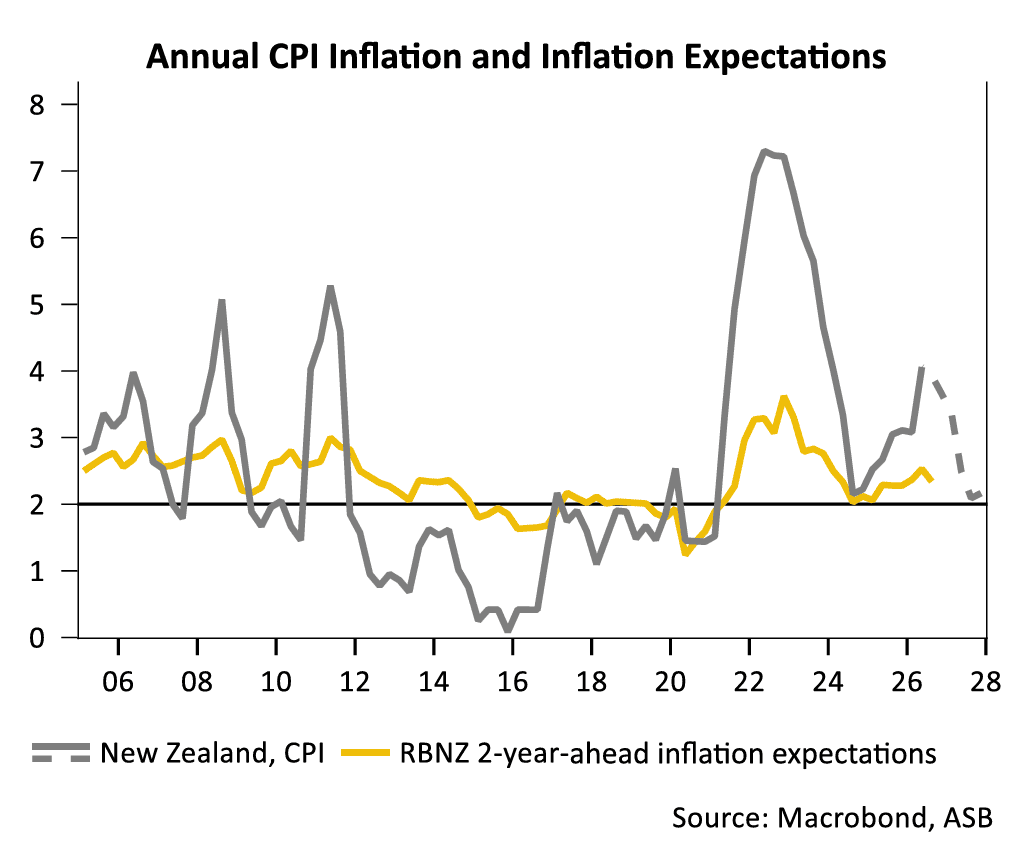
Image courtesy of ASB.
Respondents "do not expect the current uplift in inflation to be enduring," says Satish Ranchhod, Senior Economist at ASB, who notes that every measure in the survey now sits at or slightly below where it was six months ago, before the Iran conflict began.
The rises at the five and ten-year horizons, he argues, fall within the normal quarter-to-quarter volatility of the series.
ASB adds that respondents expect sub-3% inflation to return from the middle of 2027, and that the modest scale of the expected New Zealand recovery, alongside remaining labour market slack, is judged to dampen inflation over time.
Rate Hikes Are Still Coming
The Kiwi dollar's descent could nevertheless be limited if the RBNZ ultimately judges that the disinflationary story is still not convincing enough.
"Further OCR hikes loom," says ASB's Smith, with the timing and scale dependent on how the inflation outlook develops.
Westpac is more specific, and still forecasts two more 25 basis point increases this year, most likely at the September and December meetings.
The RBNZ raised the Official Cash Rate by 25 basis points in July and signalled further moves.
What the survey does is trim the probability of a move at the 2 September meeting at the margin, rather than remove it.
ASB makes the caveat explicit: the RBNZ will want these figures verified against forthcoming household and business surveys and other pricing-side metrics before treating one survey as a trend.
That is the distinction between a Kiwi that pauses and a Kiwi that turns.
What This Means for the Pound vs. New Zealand Dollar
Pound Sterling Live has noted that GBP/NZD has been under near-term pressure since its July peak at 2.3553, with the pace of decline slowing as the pair approached the 2.29 support zone.
The pair sits below its 50-day average at 2.3096, and the 52-week range runs from 2.24 to 2.3546, which places spot in the lower half of the year's distribution rather than at an extreme.
For the Pound-to-New Zealand Dollar forecast, the immediate question is whether 2.29 now holds as a base.
A single survey that both reporting banks attribute to petrol prices is a thin foundation for a sustained sterling recovery, and the September RBNZ meeting still carries a live hike.
The more durable reading is that the Kiwi's rate premium has stopped widening rather than begun to narrow, which argues for consolidation in the 2.29 to 2.31 area rather than a resumption of the decline towards 2.24.
For those with New Zealand Dollar payment requirements, the risk is asymmetric in an unfamiliar direction.
The Kiwi has been the stronger currency all year on a rate story that remains intact, and today's move reflects a marginal repricing of timing rather than a change in direction.