
Image © Adobe Images
A yawning rate gap and firm energy prices keep the pound climbing against the krona.
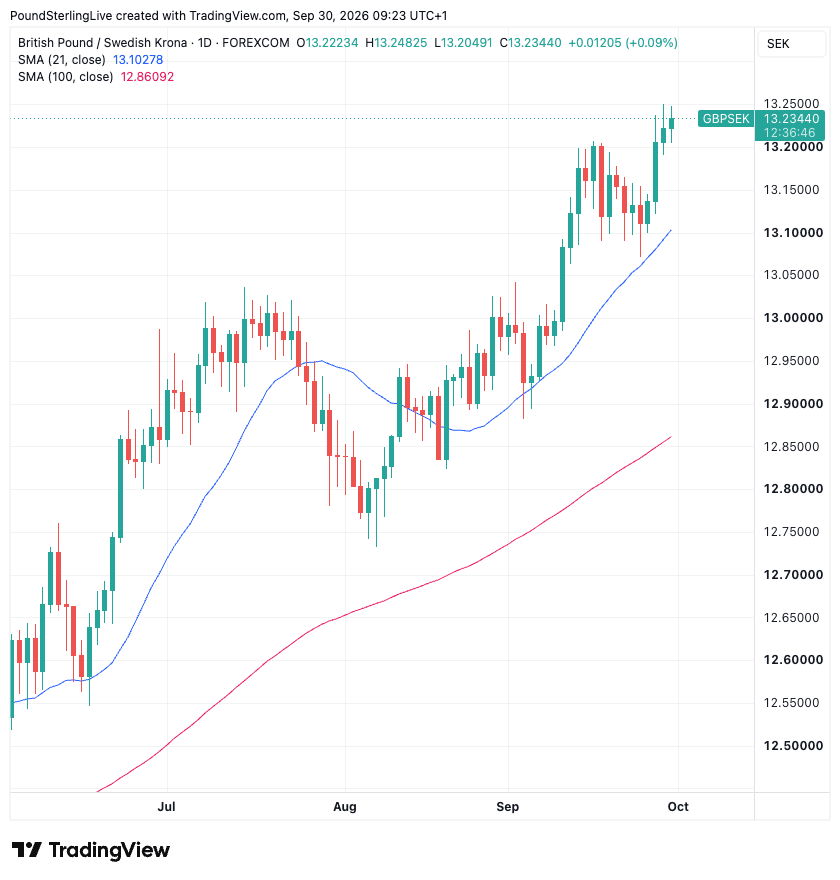
The pound-to-Swedish krona exchange rate extends a seemingly relentless climb to reach 13.2344 on Wednesday, extending a rally that has run almost without interruption since June.
The pair reached 13.2483 in early trade, clearing the mid-September highs near 13.20 and taking the advance from June's 12.55 to more than 5%.
The rally has come without a meaningful correction, and the pullbacks that have occurred have been shallow and quickly bought.
The late-September dip held near 13.07, above the rising 21-day moving average, before the pair pushed on to fresh highs:
Swedish Krona Issued A Red Card in a World of Carry
The rise owes more to krona weakness than to pound strength.
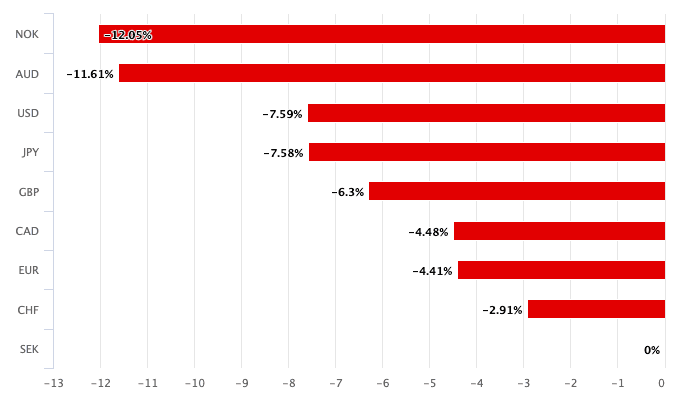
The krona is the worst-performing G10 currency of 2026, down against every major currency, and the pound ranks only mid-table among the currencies that have outperformed it.
The krona is down 6.3% against the pound this year, 12.05% against the Norwegian krone and 7.59% against the US dollar.
Even the Swiss franc, among the weaker major currencies this year, has gained 2.91% on the krona.
"We underestimated the robustness in energy prices which both weighs on SEK and reduces investor appetite to rotate into lower yielding but cyclically sensitive currencies," says a research note from Morgan Stanley.
The two burdens Morgan Stanley identifies are energy and yield, and the second is the heavier.
The Riksbank's policy rate stands at 1.75%, against 2.50% for the European Central Bank's deposit rate and 3.75% for Bank Rate at the Bank of England.
That leaves the krona 200 basis points short of the pound in yield terms, a gap that makes it a funding currency in a market that rewards carry.
The krona now trades with shades of the Japanese yen: both central banks are preparing to hike, but from a base so low that markets judge the gap too wide to close.
Rate differentials across the G10 are moving the wrong way for the krona, with the Federal Reserve, the ECB and the Reserve Bank of Australia all hiking this year and the Bank of England widely expected to follow in November.
Nordea notes that central banks around the world are raising rates, putting pressure on the krona.
The Norwegian krone's 12% outperformance of the krona this year reflects that preference, with Norway's oil exports turning higher energy prices into support for its currency.

Daniella Arcadipane, Senior Currency Specialist at Indigo
Moving a life-changing sum abroad? You won’t be doing it alone.
One specialist explains every step in plain English and stays with it until the money lands. FCA authorised, FRN 594433.
Talk to a specialistA Hawkish Riksbank Isn't Moving the Dial
The Riksbank is signalling it is ready to raise rates. Minutes from the September policy meeting, published on Wednesday, show two Executive Board members, Governor Erik Thedéen and Anna Seim, favouring a hike at the November meeting.
"The minutes confirm a rate hike most likely in November," says Anna Westlund, Senior Economist at Nordea.
The Riksbank's rate path implies a 65% probability of a November hike and a 40% probability of a further move in February.
Swedbank expects hikes in both November and February, taking the policy rate to 2.25%.
Even that path would leave the Riksbank below the ECB's current deposit rate and 150 basis points beneath a Bank of England that is itself expected to hike.
The krona has not responded, suggesting the rates gap is simply too large, at present, to shift the dial in SEK's favour.
Energy Adds to the Burden
Unlike Norway, Sweden isn't blessed with an abundance of hydrocarbons, which matters during an energy crisis in which fuel importers are naturally penalised.
"Should energy prices conclusively decline, that may be the signal to buy SEK, but it's probably too early at this point, with NOK looking like a much more appealing Scandi alternative," says Morgan Stanley.
Brent crude trades near $103 a barrel, having held above $100 through most of September on disruption in the Strait of Hormuz.
The Riksbank board is alert to the risk.
Thedéen notes that the Riksbank's forecast assumes both a fall in petroleum product prices and that the weakening of the krona is temporary, assumptions Nordea says have proved wrong in the past.
Deputy Governor Per Jansson highlights the weaker krona as an added risk to inflation.
Quarter-end flows offer the krona only limited relief, with SEB's model indicating that Swedish portfolio managers have some need to buy krona into Wednesday's close.
Until energy prices break lower and the rate gap starts to close, the path of least resistance for the pound-to-krona rate points higher, with the 21-day at 13.10 the level that keeps the uptrend intact.