
Image © Adobe Images
The euro could stay pressured until the ECB signals that French spreads threaten policy transmission.
European bond markets fragmented this week as French debt collapsed in value, heaping pressure on the euro with analysts warning of further weakness ahead.
The gap between French and German ten-year borrowing costs, the favoured measure of French stress, widened to 141 basis points on Thursday, with the Italian equivalent out to 119bp, while German two-year yields fell 14bp on flight-to-quality flows.
"This is no longer merely a risk. The European market, particularly on the fixed-income side, has fragmented," says a Morning Line Express note from Natixis, the French investment bank.
The French spread is now the widest since 2012, a reading that only arrives in periods of serious political stress.
"The minority government of Sébastien Lecornu is struggling to pass a budget to prevent a rise in the public deficit from 5.4% in 2026 to 6% in 2027," says Holger Schmieding, Chief Economist at Berenberg.
The 2027 draft finance bill presented this week sets out €43bn of measures to limit the budget deficit expansion, worth 1.4% of GDP, intended to bring the deficit down to 5.0% instead.
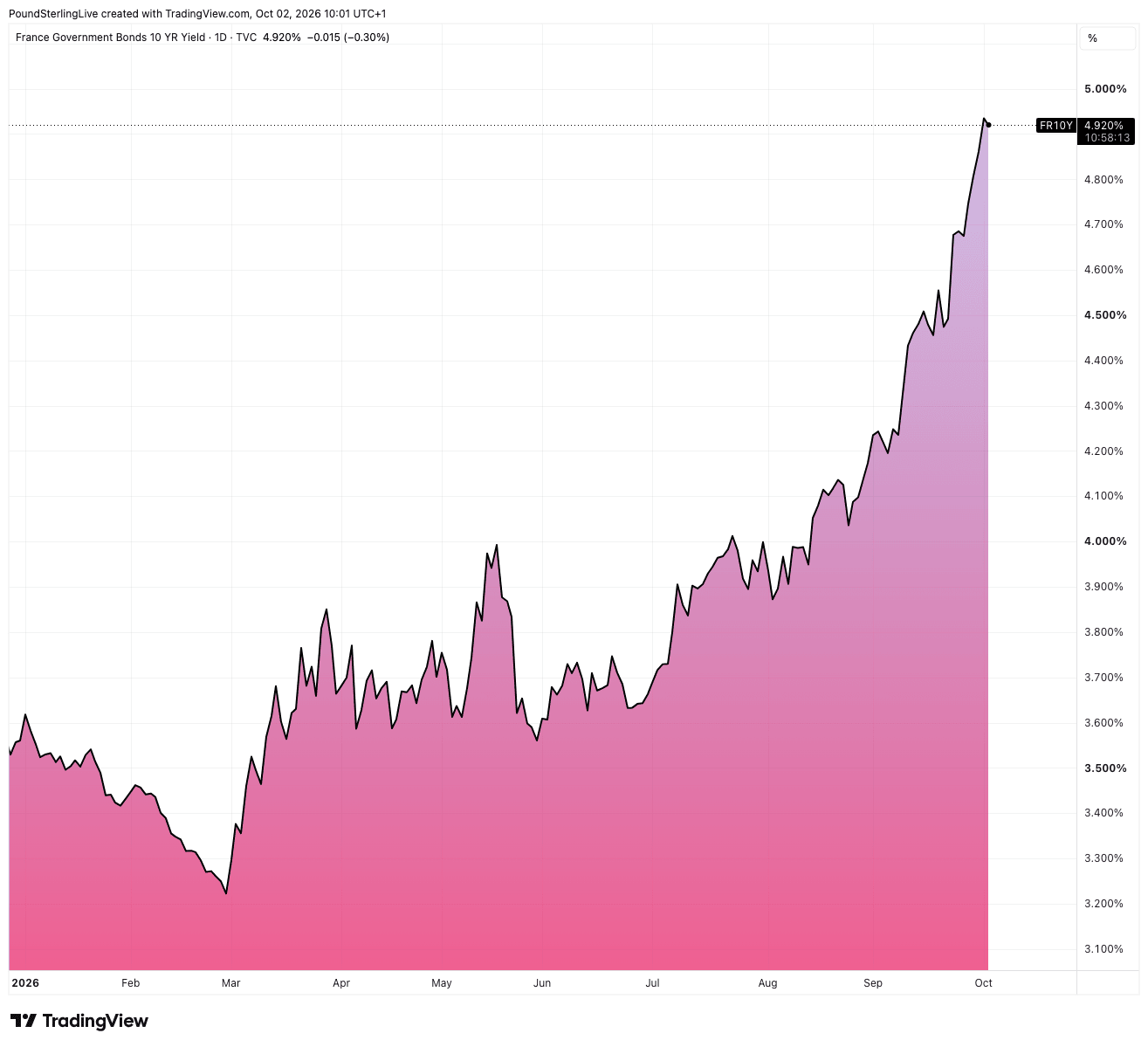
Chart courtesy of TradingView
Barclays expects the bill to pass, though not through a parliamentary vote.
"We see a high likelihood that the prime minister will resort to article 49-3 of the Constitution, although we do not rule out the use of budgetary ordinances," says Saadalla Nadra-Yazji, an economist at Barclays.
Barclays does not expect French debt dynamics to inflect before next year's presidential election and sees the deficit staying well above 5% of GDP in 2027 whichever route the budget takes.

Daniella Arcadipane, Senior Currency Specialist at Indigo
Moving a life-changing sum abroad? You won’t be doing it alone.
One specialist explains every step in plain English and stays with it until the money lands. FCA authorised, FRN 594433.
Talk to a specialistEUR/USD and EUR/GBP: Where the Euro Sits
The euro-to-dollar rate trades at 1.1235 on Friday, having taken out the 1.1312 floor of the range that held from May 2025 and printed a cyclical low at 1.1215.
The euro-to-pound rate trades at 0.8509, equivalent to 1.1752 in pound-to-euro terms, its weakest against sterling since late July.
Beneath the market in euro-dollar sits 1.1200, the 2024 double top, and then 1.1111, the halfway point of the 2025 to 2026 advance.
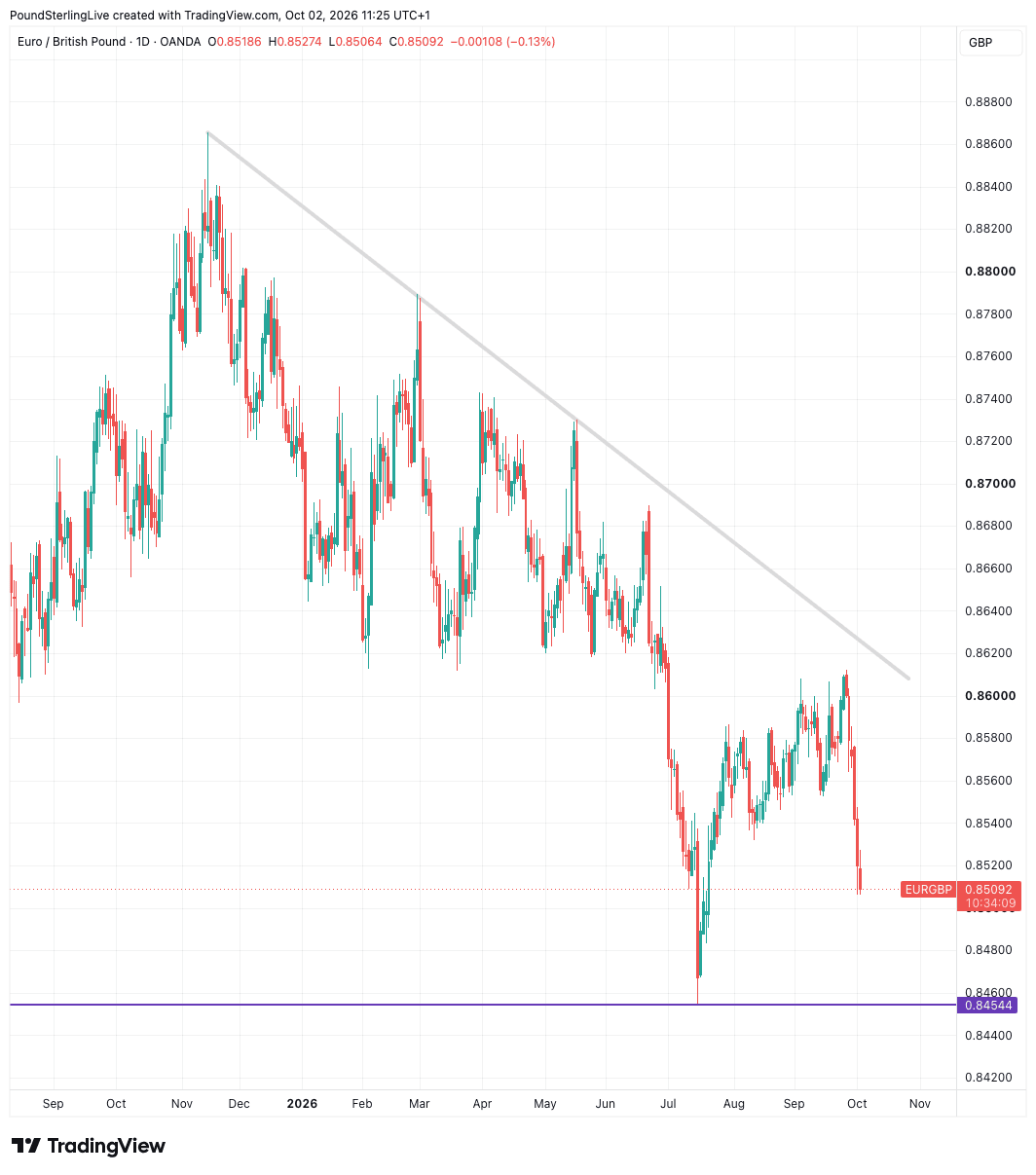
Beneath the market in euro-pound sits 0.8454, July's low, which converts to 1.1828 on the pound-to-euro chart and is the only structure left before the year's extremes.
Overhead, 0.86 is the level the euro repeatedly failed at through August and September, or 1.1628 in pound-to-euro terms, and it is now the line a euro recovery has to reclaim.
Neither pair has had help from Thursday's data: eurozone headline inflation rose to a three-year high of 3.8% in September, with core at 2.5%.
Higher inflation would normally be euro-supportive through the rate channel, but the bond market took the opposite message this week.
Money markets now discount three ECB hikes over the next twelve months, down from four a few days ago, and give October only a 20% chance.
Christine Lagarde did the repricing herself on Monday by noting that the rise in long-term yields restrains the economy and reduces the need for further tightening.
The French spread is therefore doing double damage to the euro, adding a credit risk premium while removing the rate support that carried the currency through the first half of the year.
EUR/USD and EUR/GBP: Will the ECB Step in?
The question underneath every euro forecast now is at what point the ECB intervenes.
"Spread levels alone are unlikely to trigger a response," says Evelyne Gomez-Liechti, Multi-Asset Strategist at Mizuho EMEA.
Gomez-Liechti notes the Transmission Protection Instrument was built to address disorderly market dynamics that threaten the transmission of policy, not to cap spreads at a number.
The complication is that the current widening can be explained by fundamentals: heavier issuance, a deteriorating fiscal path, political uncertainty and no large central bank balance sheet standing behind the market.
Mizuho sets out four conditions it would need to see together before the ECB moves:
1. Contagion, with stress broadening from France into Italy and Spain
2. Persistence, rather than isolated episodes of volatility
3. Funding stress, which is the category that distinguishes a repricing from a market functioning problem
4. A shift in ECB language towards fragmentation and unwarranted tightening in financing conditions
"Spreads are flashing warning signs, but the broader transmission story is not there yet," says Gomez-Liechti.
The option of quietly skewing reinvestments towards a country under pressure went when the pandemic programme's reinvestments ended in 2024, which leaves a wide gap between doing nothing and activating a formal tool.
For the euro, that gap is the problem: the currency has to absorb the spread widening for as long as the ECB can justify waiting.
EUR/USD and EUR/GBP: The Case Against More Weakness
The counter-case rests on the market being wrong about how far this goes.
France placed €12bn of OATs on Thursday into cumulative bids approaching €27.5bn, which is not the auction of a sovereign being refused funding.
"France's budget and continued demand for its debt reduce near-term funding risks," says Mark Haefele, Chief Investment Officer at UBS Global Wealth Management.
UBS reads the rise in European yields as creating selective opportunities in high-quality bonds and sees higher yields doing part of the ECB's work for it.
Berenberg still expects France to muddle through to the presidential election, and thinks the three or four hikes priced from the major central banks are overdone.
Schmieding expects central banks to raise rates over the next few months and then hold through 2027, as a correction in oil prices eases the inflation pressure without further tightening.
A pause signalled on that basis would pull yields lower across the board and take the rate support out of the dollar as well as the euro.
EUR/GBP: Sterling Is the Beneficiary, With a Date in the Diary
The pound is a clear winner from the euro's troubles, holding a rate advantage of around 144 basis points.
"The pound is now clearly outperforming the euro so far this week, with GBP/EUR breaking out of the range it has held for the best part of the last couple of months," says Matthew Ryan, Head of Market Strategy at Ebury.
Ryan attributes part of the move to Burnham's pledge to open a formal debate on rejoining the European Union, while cautioning that a referendum is fanciful and unlikely to provide lasting support.
Britain's recent economic performance is the more durable argument, and it has shown up in the gilt market as well as the currency.
Berenberg notes the spread of UK yields over the rest is declining, which suggests Burnham has convinced investors he will continue the fiscal consolidation his predecessor began.
That conclusion carries a condition attached to a date.
"So long as the new administration does not surprise the market with higher borrowing in the 28 October budget, UK government bond yields should fall back into the international pack next year," says Schmieding.
Equals Money holds a modest upside bias on the pound-to-euro rate in the near term and a sideways view over six months.
"French political risk favours the pound over six months, but the Budget on 28 October and the BoE on 5 November could change the picture quickly," says Thanim Islam, Head of FX Analysis at Equals Money.
Our view is that the euro's break beneath 0.86, or above 1.1628 in pound-to-euro terms, holds while French spreads stay at these levels, with 0.8454 and 1.1828 the next objective.
September payrolls land at 13:30 BST and a soft print is the one event that could hand the euro a bounce today, though on the week's evidence it would be met with selling into 1.1312 in euro-dollar and 0.86 in euro-pound.
Daniella Arcadipane, Senior Currency Specialist at Indigo
Moving a life-changing sum abroad? You won’t be doing it alone.
One specialist explains every step in plain English and stays with it until the money lands. FCA authorised, FRN 594433.
Talk to a specialist