
Image © Adobe Images
Flows linked to high bond yields, fading budget risks and euro downside related to France's budget are in play.
Pound sterling posted widespread gains through the final day of September, with gains against the euro proving meaningful for those with near-term Eurozone payments.
The pound-to-euro exchange rate reclaimed 1.17 for the first time since early August and holds at 1.1701 in early Thursday trade, pushing euro-sterling down to 0.8547.
French debt concerns are likely having a negative influence on the euro, while there's some relief in pound sterling as Burnham's spending plans run over a ten-year timeframe.
"All eyes this morning are on France, where Finance Minister Lecornu is presenting the draft finance and social security bills to the Council of Ministers ahead of parliamentary debate beginning on 13 October," says Evelyne Gomez-Liechti.
French bonds are collapsing and yields surging: long-dated French bonds sold off again on Wednesday squeezing their yield's ever-higher, even as yields fell across the rest of Europe, widening the gap with German Bunds to 126 basis points.
French 30-year yields rose 9 basis points to 5.46%, now 152 basis points above German equivalents, which markets often read as a sign of a country-specific market stress:
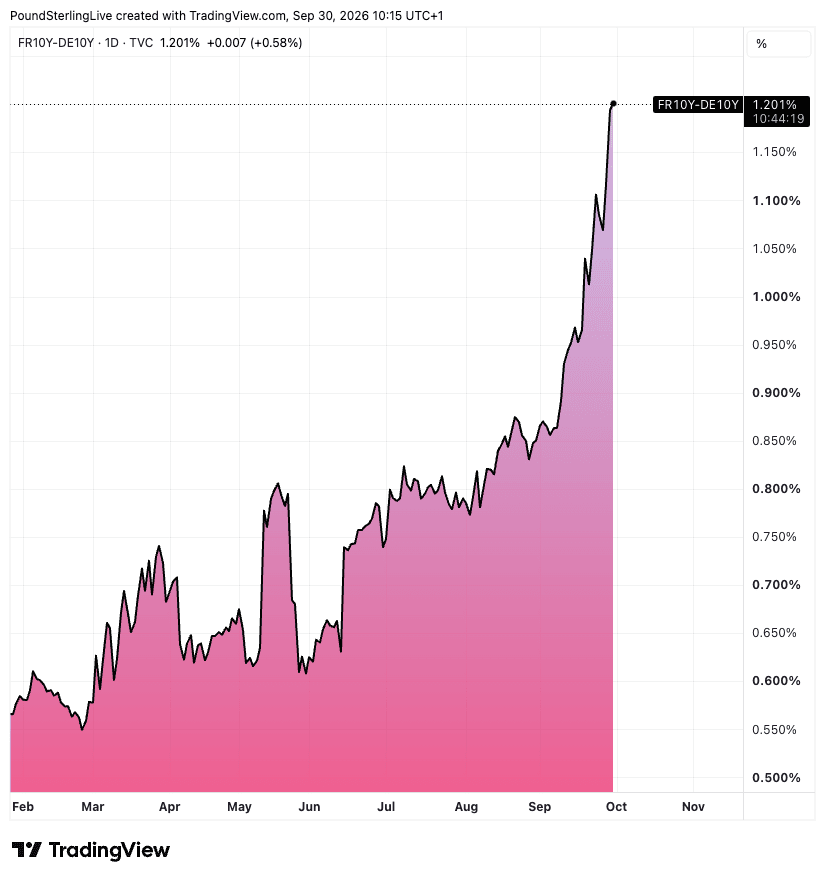
Above: The gap between French and German ten-year yields shows markets are very concerned about France's finances.
The bond market dynamics reflect the significant issuance of bond debt (OATs) into the market by a French government incapable of cutting spending owing to a fractured political landscape. Funding needs keep growing, with France's debt agency projecting record borrowing of €340bn in 2027.
"OATs stayed under heavy pressure yesterday, with the 10Y OAT-Bund spread briefly testing the 128bp area as investors continued to demand a larger fiscal risk premium. The move increasingly feels self-reinforcing: higher supply expectations widen spreads; wider spreads reduce demand and poor demand risks widening spreads further," says Gomez-Liechti.
KBC Bank warns today that the euro is vulnerable to a continuing underperformance of sovereign credit, with investors targeting France especially.
Despite the developments, euro exchange rates are relatively resilient, but we can't help feel this scenario isn't helping and bears watching.
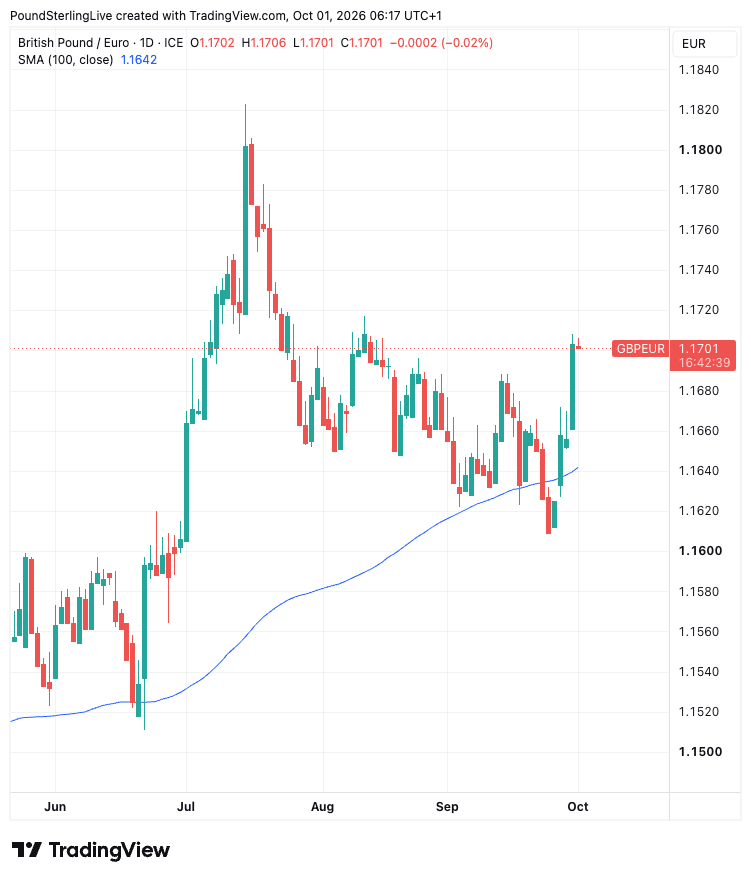
Above: GBP/EUR reclaims 1.17.
Burnham's Sober Timeline
Turning to sterling, the spending and borrowing debate is overshadowed by that of France, something Prime Minister Andy Burnham and his government might take with a sense of relief.
Tuesday's conference speech was a big test for the UK fiscal framework, and by extension, the pound. What was unveiled was an ambitious spending agenda that would have spooked the gilt market were it not for the concession by Burnham that his agenda will need a decade to implement.
The commitments were big: a National Care Service free at the point of use, public control of water, council homes at scale, intervention in energy markets and a closer relationship with the European Union.
The timeline was sober: with the pension triple lock savings meant to fund the care plan arriving only from 2030-31.
Pantheon Macroeconomics says the proposals remain too vague for precise costing and do little to alter near-term borrowing, putting the care plan's cost at £7.5bn to £18.5bn a year depending on its scope.
"Burnham's sums do not seem to add up," says Kathleen Brooks, Research Director at XTB.

Daniella Arcadipane, Senior Currency Specialist at Indigo
Moving a life-changing sum abroad? You won’t be doing it alone.
One specialist explains every step in plain English and stays with it until the money lands. FCA authorised, FRN 594433.
Talk to a specialistBrooks notes the Prime Minister steered clear of tax rises - something that the budget on October 28 will have to address - and that Labour is already scaling back the care plan, which is why the bond market is willing to look past it for now.
The important developments for the pound, therefore, are:
• Burnham's spending wish-list isn't an imminent threat to the finances, as he clearly puts a 10-year timestamp on delivery.
• The budget is likely to be less flashy than some would like: the money is tight, Burnham and Healey know that, and they won't rock the boat.
Front-Running the Budget
Pound Sterling Live's medium-term thesis holds that GBP is under pressure into the budget, but rises in the aftermath if it proves unremarkable and the government playing it safe in order to avoid a Liz Truss moment.
If our thesis is to be proven true, the market would presumably front-run the event itself by buying GBP now. That's a typical market process: get ahead of the curve.
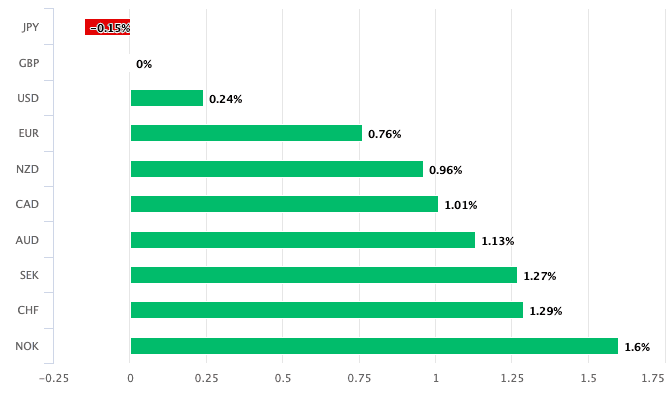
Above: GBP outperforms the majority of G10 over a one week screen.
A Sturdy Economy Underpins Our Constructive Sterling Thesis
Pound Sterling's in-house modelling predicts that GBP will stay well supported medium-term, thanks largely to the ongoing resilience of the economy.
That was confirmed by Wednesday's ONS GDP review, which revised second-quarter growth up to 0.5% from 0.4%, following unrevised growth of 0.6% in the first quarter, as we reported.
"Sterling's hawkish BoE momentum is extended today by an upward revision to Q2 growth (0.5% Q/Q from 0.4%) and by PM Burnham opening the door to a potential Brexit reversal," says a daily note from KBC, the Belgian bank.
Business investment drove much of the upgrade, with annual growth now reported at 5.2% against 0.8% previously, according to Investec.
Brooks notes that UK growth over the first half of the year is running at the fastest pace in the G7.
"With activity repeatedly beating the MPC's expectations, we think rates are providing little restriction and remain comfortable forecasting a hike in November," says Rob Wood, Chief UK Economist at Pantheon Macroeconomics.
Investec's Sandra Horsfield cautions that growth has tended to cool in the second half of recent years, and higher energy prices could repeat that pattern in 2026.
Bond Yields and An Intact Carry Trade
The carry trade remains intact: the UK's high bond yields are attracting foreign exchange inflows, even if the ten-year gilt's close at 5.436% is an outright headache for the government.
That's the highest close since June 2007.
As long as UK yields remain attractive in a low-volatility environment, GBP should find a persistent layer of support.
Daniella Arcadipane, Senior Currency Specialist at Indigo
Moving a life-changing sum abroad? You won’t be doing it alone.
One specialist explains every step in plain English and stays with it until the money lands. FCA authorised, FRN 594433.
Talk to a specialist