
Image © Adobe Images
French debt concerns are brewing, and we think this is one to watch when considering the euro-to-dollar rate's outlook.
The gap between French and German ten-year borrowing costs has surged and is now 120 basis points, a signal of growing market stresses that pose significant downside risks to the euro.
"OATs facing a perfect storm of political radicalisation, shifting opinion polls, weak growth, large deficits and borrowing needs (which the Treasury estimates will rise by €28bn in 2027, to €340bn)," says Frederik Ducrozet, Head of Strategy & Macro Research at Pictet Wealth Management.
The spread between the German and French ten-year yield has doubled since February and widened from under 90 basis points at the start of September, accelerating to over 120 pts over recent days:
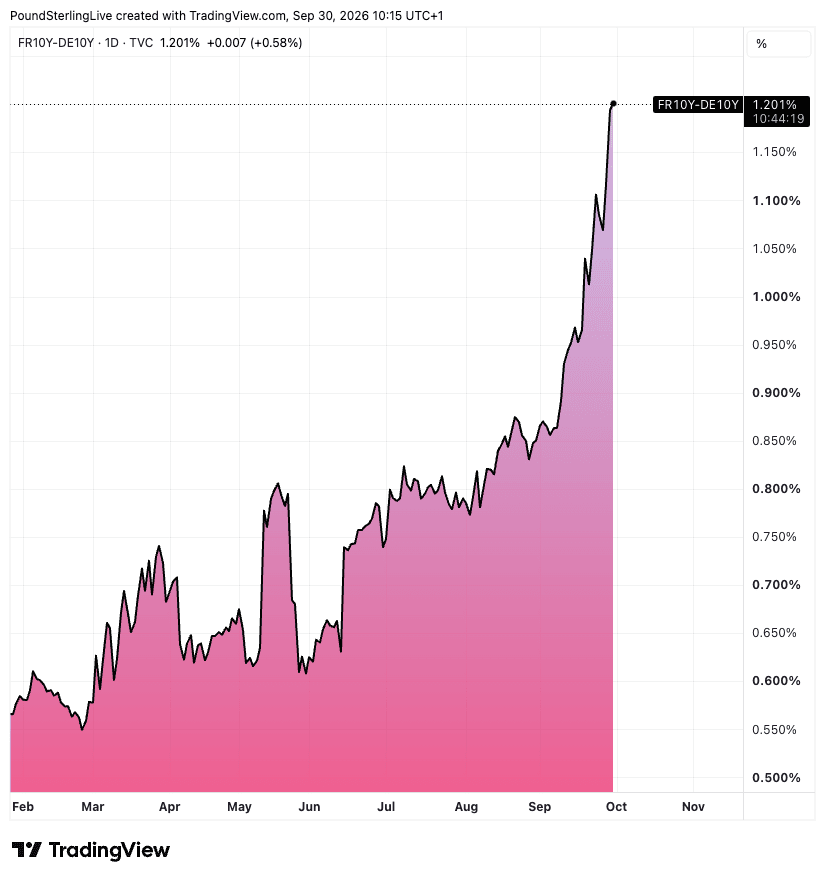
Above: The gap between French and German ten-year bond yields.
The ten-year OAT yield now sits at its highest level since 2008 and ING's rates strategists now forecast the spread to sit between 100 and 125 basis points in the coming months, a range the market is already testing.
Why France Is a Euro Problem
Nobody seriously expects France to stop paying its debts, yet that is a source of the risk for the currency.
"It is precisely because France won't be allowed to default that you should worry," says Jeroen Blokland, Founder of Prestige Investment Partners.
France borrows in a currency it co-controls with other Eurozone states, which leaves the European Central Bank, and by extension the euro, carrying the burden of keeping French debt sustainable.
"As the European debt crisis showed, eurozone policy, including monetary policy, is ultimately shaped by the need to prevent its weakest links from breaking the system. And today, France is increasingly becoming that weak link, not least because of its sheer size," says Blokland.
"The sheer scale of money creation and yield suppression required to keep an ever-growing debt mountain sustainable risks creating relentless inflationary pressure and should force you to rethink both the value of money and the role of debt in your portfolio," explains Blokland.
For the euro, that is a debasement risk.
A Record Funding Bill
France's debt agency, the Agence France Trésor, put numbers on the funding strain on Tuesday:
• Borrowing needs rise to a record €340bn in 2027, up €28bn from 2026
• The deficit stands at 5% of GDP
• The interest burden climbs to €73bn, up €10bn
• Redemptions rise to €190bn, up €19bn
Higher yields lift the cost of servicing the debt, which widens the deficit the market is worried about.
Scope Ratings downgraded France to A+ this month, as headlines on the 2027 budget process began to build.

Daniella Arcadipane, Senior Currency Specialist at Indigo
Moving a life-changing sum abroad? You won’t be doing it alone.
One specialist explains every step in plain English and stays with it until the money lands. FCA authorised, FRN 594433.
Talk to a specialistPolitics Adds the Tremor
The 2027 budget draft, due today, must pass a parliament with no majority in the final session before April's presidential election.
Marine Le Pen of the National Rally leads first-round polling for that vote.
"A tough draft budget for 2027 risks toppling the government despite a widely held desire to avoid a political crisis before the presidential election next spring," says Mujtaba Rahman, Managing Director for Europe at Eurasia Group.
A government collapse would leave France without a budget as its funding needs reach a record.
The ECB's Dilemma
Chris Attfield, European rates strategist at HSBC, says the ECB would likely only intervene if market moves became disorderly, and notes that non-domestic ownership of French bonds now exceeds 50%.
Foreign holders are the investors most likely to sell, and the ECB is the backstop most likely to be called upon.
An ECB watching French spreads also has reason to tread carefully on rate hikes, and President Christine Lagarde signalled a "measured response" to the energy shock on Monday.
Slower ECB tightening would erode the rate support that lifted the euro through much of the year.
The Counterweight
The euro's recent weakness against the dollar has been a dollar story, and TD Securities sees that USD rally running out of road.
"September month-end rebalancing, softer US payrolls, and stretched USD uptrends are imminent catalysts for the USD rally to consolidate," says Howard Du, FX Strategist at TD Securities.
TD Securities maintains a bullish year-end forecast for the euro-to-dollar rate, viewing a near-term Fed hike as priced in while growth outside the US remains resilient.
"We do not see the USD breaking out to a new high in the current Fed rate hiking cycle unless the Fed can out-hawk global central banks like in 2022, or RoW growth outlook starts to falter ahead of the US," says Du.
However, a French debt shock that weighed on eurozone growth would meet the second of those conditions.
The Technical Picture
The euro-to-dollar rate is holding above 1.1312, the floor of a range that has held since May 2025, with the 100-day moving average at 1.1521 turning lower.
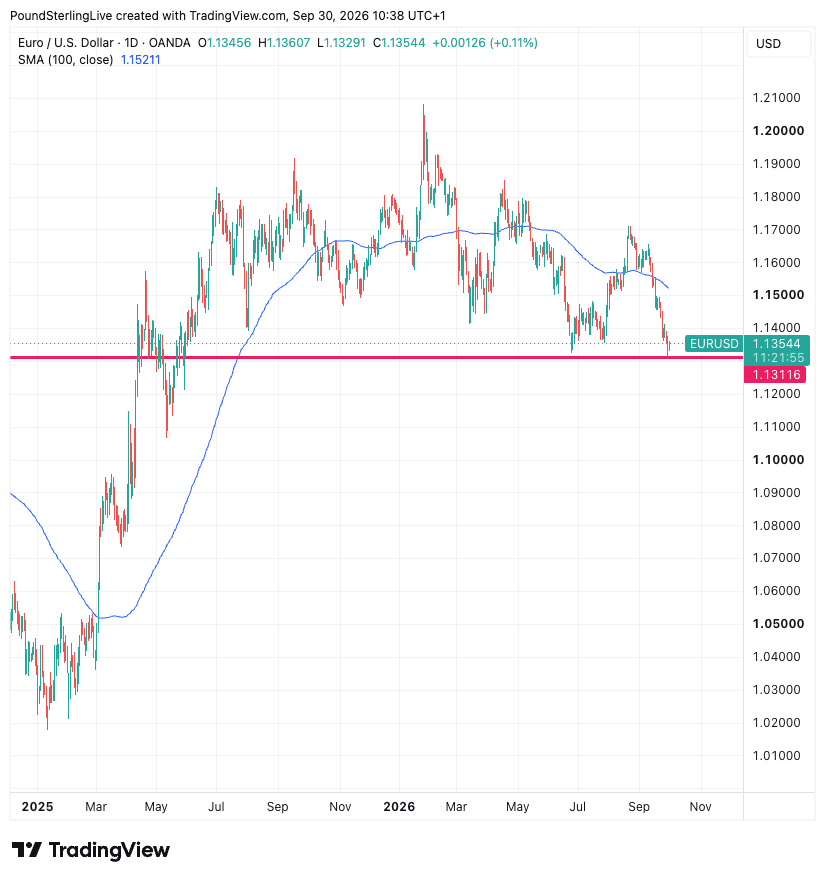
Above: EUR/USD at daily intervals, with the 100-day moving average.
KBC flags 1.1340, the 38.2% retracement of the 2025-2026 advance, as key support, with a break opening the way to 1.1214/02.
A dollar consolidation would see that floor hold, but a French budget crisis would bring euro-specific selling that puts it at risk.
Daniella Arcadipane, Senior Currency Specialist at Indigo
Moving a life-changing sum abroad? You won’t be doing it alone.
One specialist explains every step in plain English and stays with it until the money lands. FCA authorised, FRN 594433.
Talk to a specialist