The selloff looks stretched and a correction is due, with CIBC eyeing a short-term Dollar reversal.
The Euro rose against the Dollar on Friday after a bruising week that took the exchange rate to its lowest level in two months.
Oil prices eased on reports that US and Iranian negotiators are exploring a seven-day deal to reopen the Strait of Hormuz, cooling the global bond selloff and slowing the Dollar's rally.
"Technicals are stretched but a deeper drop cannot be ruled out in 4Q. For the ECB, the weaker euro and elevated oil prices complicate the inflation challenge and only adds to the asymmetric sell off in European debt, raising the burden for governments to stabilise debt levels," says a strategy note from Societe Generale, released Friday.
The Euro to Dollar exchange rate (EUR/USD) was quoted at 1.1389 at the time of writing, a touch above Thursday's low of 1.1366.
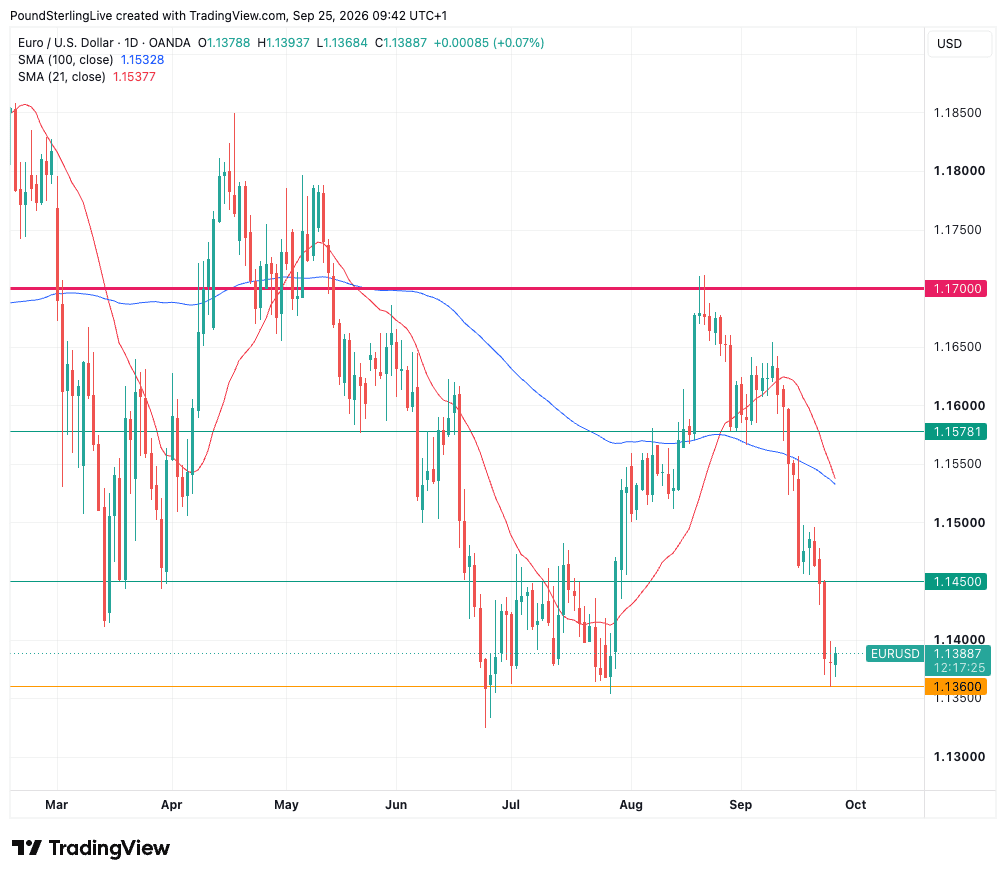
Chart: TradingView
Above: EUR/USD at daily intervals with the 21-day (red) and 100-day (blue) moving averages.
The daily chart shows the spot rate has moved further from its 21-day moving average than is typical. A move back towards the falling average, currently at 1.1538, looks likely.
Solid graphical support at 1.1360 adds to that conviction. This is where the July selloff found a floor.
The first hurdle for any recovery is horizontal resistance at 1.1450. The 21-day average and the 1.15 figure come after that.
CIBC Looks for a Short-term Dollar Reversal
CIBC Capital Markets expects the Dollar's recent run to pause. Brent crude is trading near $110, the level that prompted the US and China to try to talk down oil prices in mid-September, and USD/JPY is close to 160.
"We are close to important red lines for the USD," says Noah Buffam, Director of FICC Strategy at CIBC Capital Markets.
CIBC also sees downside risks to next week's US payrolls report. It looks for EUR/USD to move towards 1.15 in the short term.
The Canadian lender still expects the Euro to underperform Sterling and the Swiss Franc, because its forward-looking surprise model points to soft European data in the near term. If eurozone inflation comes in soft next week, markets should price out some of the chance of an October ECB rate hike. CIBC expects the ECB to skip that meeting.

Daniella Arcadipane, Senior Currency Specialist at Indigo
Moving a life-changing sum abroad? You won’t be doing it alone.
One specialist explains every step in plain English and stays with it until the money lands. FCA authorised, FRN 594433.
Talk to a specialistRate Differentials Keep the Euro Under Pressure
The forces that drove the Euro lower remain in place, and they limit how far any bounce can run.
"Worryingly, the stronger services PMI data in September for Germany and France, and the latest rise in the German IFO business survey, failed to attract dip buying. The euro limped to a low of 1.1366, tracking the widening of 2y UST/EGB to 159bp and the 10y OAT/Bund spread to above 110bp," says Societe Generale.
The first spread is the gap between two-year US Treasury yields and European government bond yields. The second is the premium France pays over Germany to borrow for ten years – a gauge of stress in eurozone sovereign debt.
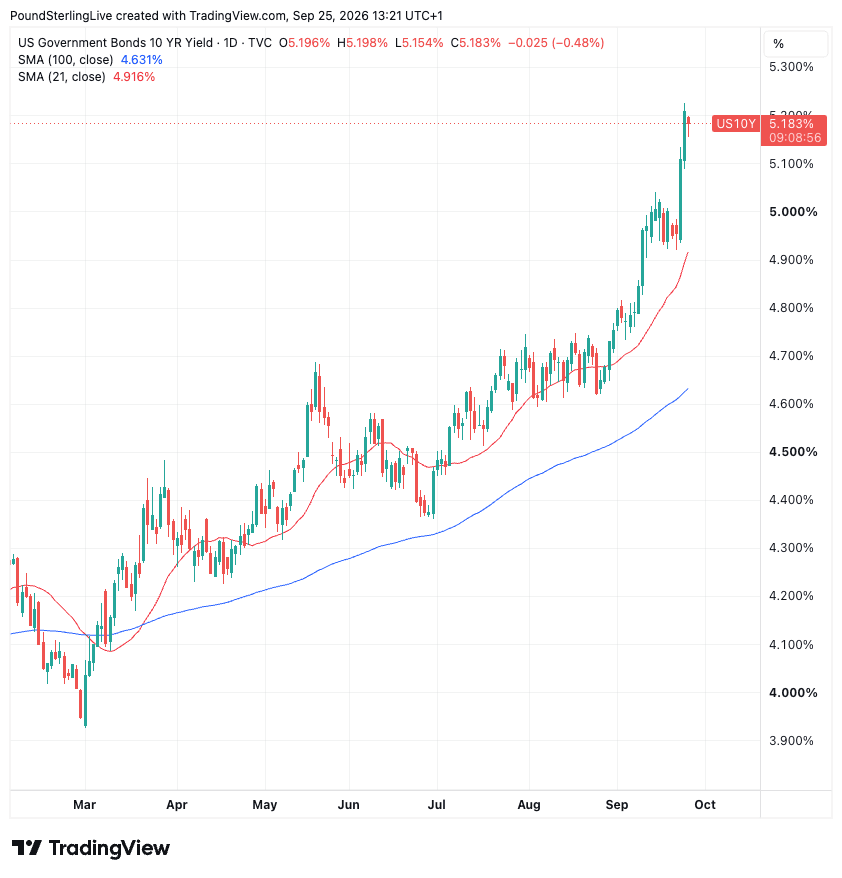
Above: U.S. ten-year bond yields are on a tear.
The Dollar starts next week near two-month highs against the major currencies, says a weekly FX note from Intesa Sanpaolo. Treasury yields are at their highest since 2007, and the market puts an 83% chance on a further Fed rate rise in October.
Brown Brothers Harriman says the Dollar can keep benefiting from widening interest rate differentials between the US and the other major economies. However, tightening by other central banks limits how far US policy can diverge, so the Dollar should struggle to hold any overshoot of its June high.
BBH adds that foreign investors bought $1,754bn of long-term US securities in the 12 months to July. That is more than twice the US trade deficit of $743bn, which points to solid underlying demand for the Dollar.
A separate note from Societe Generale's Kit Juckes raises a longer-term question about that demand. The US net international investment deficit has hit a record $22.4 trillion, and the French bank asks whether foreign capital will keep flowing into the US as readily as it has in recent years.
In the near term, the chart favours a recovery towards 1.1450 and then the 21-day average near 1.1540, with CIBC targeting 1.15. A daily close below 1.1360 would weaken the case for a rebound and expose the late-June lows near 1.1330.
Next week, the US payrolls report and eurozone inflation data will test whether the rebound can hold.
Daniella Arcadipane, Senior Currency Specialist at Indigo
Moving a life-changing sum abroad? You won’t be doing it alone.
One specialist explains every step in plain English and stays with it until the money lands. FCA authorised, FRN 594433.
Talk to a specialist