
Image © Adobe Images
Fading RBA hike bets are dragging the New Zealand dollar lower, lifting the pound towards its July high.
The pound-to-New Zealand dollar exchange rate is edging higher at 2.3474 on Wednesday, pressing against the top of its fortnight-long range as the New Zealand dollar gets caught up in Australia's repricing.
The move follows a surge in the pound-to-Australian dollar rate through its 100-day average, after soft Australian core inflation pared bets on another Reserve Bank of Australia hike.
Trimmed mean CPI rose 0.2% in August, below the 0.3% consensus, and markets now price around a 23% chance of a November RBA hike, down from around a third before the data.
That retreat in Australian rate expectations has spilt across the Tasman.
New Zealand two-year yields fell 8 basis points to 3.85% and ten-year yields fell 7 basis points to 5.04%, a bigger rally than in Australia itself.
Commonwealth Bank of Australia's rates team notes that New Zealand outperformed "despite possessing none of the drivers itself."
The two currencies trade as close proxies for one another, and a fall in yields on both sides of the Tasman removes support from the New Zealand dollar as surely as from the Aussie.
The pound is a beneficiary, rising against both.
Domestic Data Adds to the Pressure
New Zealand's own data offered little to lean against the move, with CBA noting that the activity outlook and business confidence surveys were a little softer in September.
Monthly house prices are due later today.
The Technical Picture
Monday's week ahead forecast looked for a renewed push towards the July peak, with the pair consolidating above its rising 21-day moving average.
Wednesday's high of 2.3481 takes the pair back to the ceiling near 2.35 that has capped three attempts since mid-September.
A daily close above 2.3544, the July peak, would mark a breakout and extend the uptrend.
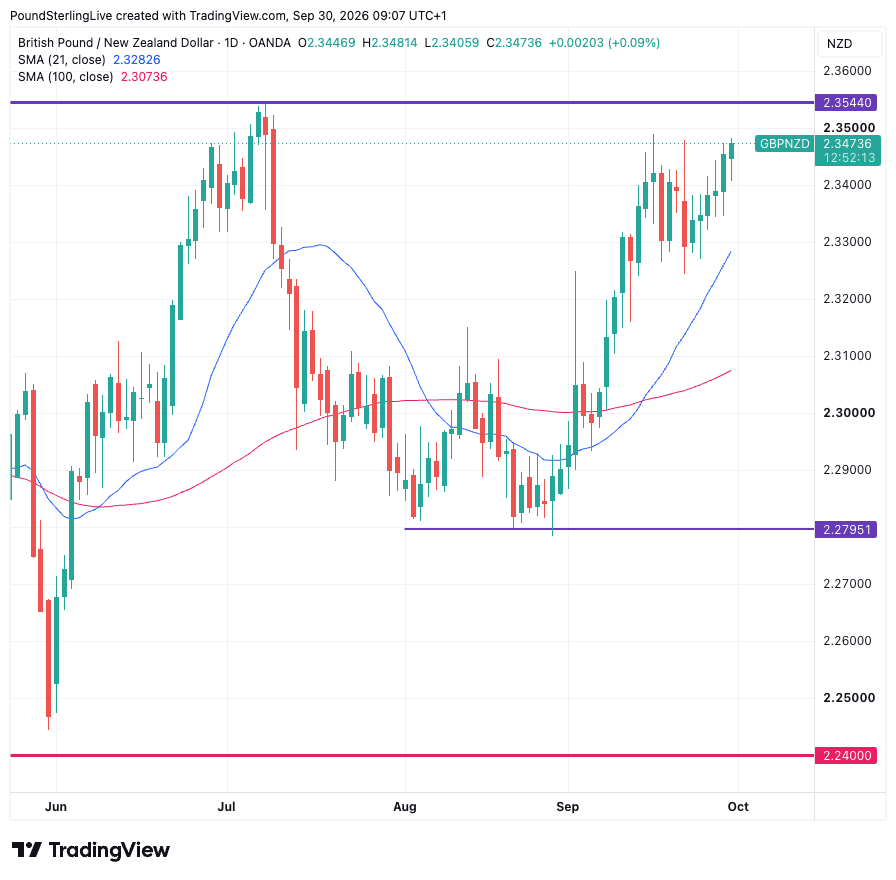
Above: GBP/NZD at daily intervals, with the 21-day (blue) and 100-day (red) moving averages.
The 21-day moving average has climbed to 2.3283 during the consolidation, closing the gap with price without the pound having to give ground.
The 100-day at 2.3074 is also rising, and both averages sit beneath the market, a stack consistent with a young uptrend.
The rally from late August's double bottom at 2.2795 has now retraced almost all of the July-to-August decline.
RBNZ Offers the Kiwi a Floor
The Reserve Bank of New Zealand is the main source of support for the currency.
Money markets priced around a 75% chance of a hike to 3.00% at the 28 October meeting after Governor Anna Breman warned that higher oil prices would push near-term inflation above the bank's forecasts.
OCBC has added a 25bp RBNZ hike in the fourth quarter to its forecasts and retains a further hike in the first quarter of 2027.
That hiking path limits the scope for a deep New Zealand dollar selloff, and it marks the key difference from Australia, where OCBC expects the RBA to hold.
The RBNZ decision lands on the same day as the UK budget, making 28 October the pivotal date for both sides of the pair.
Until then, a daily close above 2.3544 would put the pound-to-New Zealand dollar rate in fresh territory for the uptrend, with the rising 21-day at 2.3283 the support that keeps it intact.

Daniella Arcadipane, Senior Currency Specialist at Indigo
Moving a life-changing sum abroad? You won’t be doing it alone.
One specialist explains every step in plain English and stays with it until the money lands. FCA authorised, FRN 594433.
Talk to a specialist