Image © Adobe Images
The pound's rally against the New Zealand dollar should fade, faster if Trump and Xi extend their truce.
The Pound to New Zealand Dollar exchange rate's advance looks to be stalling after a strong run, with recent gains beyond the current highs sold into, and we see risks building for a pullback in the coming days.
Certainly, the Kiwi's weakness has been relentless, leaving it the worst performer of the major currencies covered here last week, and with a thin domestic diary it needs a turn in global sentiment to arrest the selling.
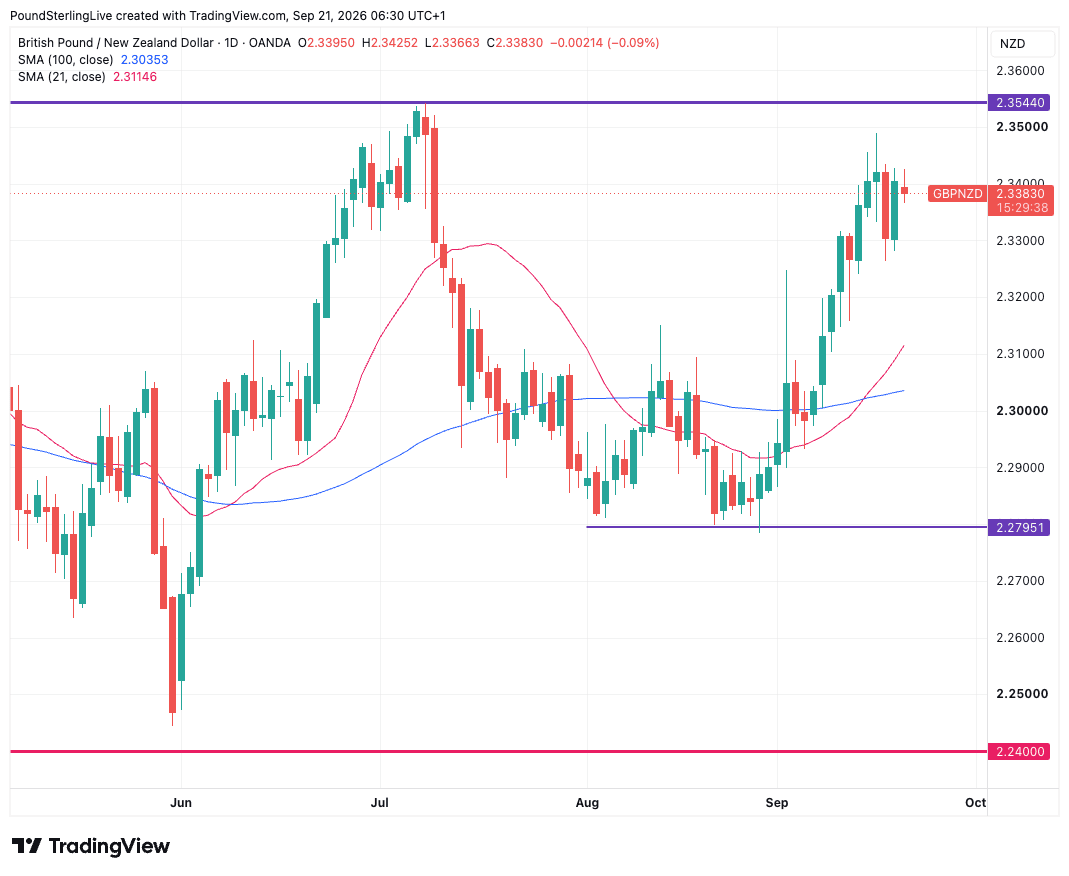
From a technical perspective, the rally is losing momentum just ahead of the more significant resistance zone set by the July peak:
Above: GBP/NZD daily chart. Image © Pound Sterling Live, chart created with TradingView.
GBP/NZD trades at 2.3383 in early Monday trade, having closed Friday at 2.3406, which puts it on the 2.34 area where attempts to push higher have been sold into.
2.34 lies just ahead of the more significant graphical horizontal resistance zone at 2.3540, the July peak, and a market that struggles to hold above the first level looks poorly placed to challenge the second this week.
Beneath the market, a confluence of moving averages has formed around 2.30 to 2.31, making a support band where a pullback would meet its first real test.
We think the risks favour a pullback towards that band this week, and a daily close above 2.3540 would put the rally back in charge. That tilts the Pound to New Zealand Dollar forecast lower after a strong run for Sterling.
Trump-Xi Summit Could Hand the Kiwi a Recovery
The Kiwi's fate this week rests largely on global sentiment, since Westpac-McDermott Miller employment confidence is the domestic calendar's sole release, a second-tier survey where a stronger reading would support the currency and a weaker one would weigh on it under the usual FX rule.
Risk-off conditions have weighed on high-beta currencies, leaving the Kiwi among the weakest G10 performers over the past month, says Danske Bank, even as second-quarter GDP data firmed expectations that the Reserve Bank of New Zealand will raise interest rates [TIMING TO CONFIRM].
Thursday's meeting between Presidents Trump and Xi in Washington is the week's calendar highlight for the Kiwi, with officials describing preliminary talks as "very successful".
"The timing matters: the current US-China trade truce expires on 10 November, putting an extension at the top of the economic agenda," says UniCredit [VENUE AND DATE TO CONFIRM].
The Italian bank judges a grand trade deal unlikely and sees an extended truce with a few tangible wins for both sides as the realistic goal, with pre-summit talks centred on lower or zero tariffs on roughly $30BN of non-strategic goods from each side.
Consensus projections for the next four quarters based on our survey of the world's tier-1 investment banks.
Access the full forecast →
How does a trade deal in Washington reach the Kiwi? New Zealand sells heavily to China, so easing trade tensions brighten its export outlook, and improved risk appetite draws buyers back into high-beta currencies such as the New Zealand dollar.
GBP/NZD also tends to fall when the Dollar weakens, because the Kiwi moves further than the Pound against the U.S. currency, so a summit that lifts sentiment would work against Sterling on two fronts.
The Dollar's firmness since last week's Federal Reserve hike is the chief risk to our view, since a stronger Dollar has tended to hit the Kiwi harder than the Pound.
An extension of the truce is the likeliest trigger for a Kiwi recovery, and it would arrive just as the Pound's rally stalls beneath the July peak. On balance, that is consistent with our Pound to New Zealand Dollar forecast of a pullback towards 2.30 to 2.31.