
Image © Adobe Images
AI isn't coming for your job, but there's bad news if you want to switch or are looking for work, according to the Bank of England.
AI is reducing hiring at British firms rather than prompting layoffs, the Bank of England's November Monetary Policy Report shows.
"In aggregate, firms responding to the DMP survey report close to zero impact of AI on employment so far," says the Bank, referring to its Decision Maker Panel, a monthly survey of company finance chiefs.
The findings provide a critical answer to the lingering fear amongst British workers that they face a jobless future as AI takes their role, as well as those of their colleagues.
Yet, the opportunity to switch jobs is likely greatly diminished as a result of the technological advancements of the past two years. "AI adoption is reducing the likelihood of firms hiring or replacing workers, but not materially increasing the likelihood of firing workers so far," says the Bank, citing contacts of its regional Agents.
Firms that leave a vacancy unfilled when a worker moves on reduce the openings available to job-switchers and jobseekers, while unemployment stays low because nobody is being let go.
"AI is not firing people; it is quietly not hiring them. Still, none of this points to mass displacement. Yet," says ING, the Dutch bank, in an assessment of AI's effect on the global economy.
Three in ten UK businesses now use AI, and among AI users with ten or more staff, 6% report reduced headcount against fewer than 1% reporting an increase, with administrative and clerical roles the most affected.
Firms Expect Half of AI's Productivity Gain to Come From Slower Hiring
Firms responding to the DMP survey estimate that AI has raised their productivity by around 0.5% over the past three years, which the Bank says points to AI adding about 0.1 to 0.2 percentage points a year to productivity growth since early 2024.
The same firms expect AI to boost productivity growth by about 0.9 percentage points a year over the next three years, "split roughly equally between slower employment growth and faster output growth," says the Bank.
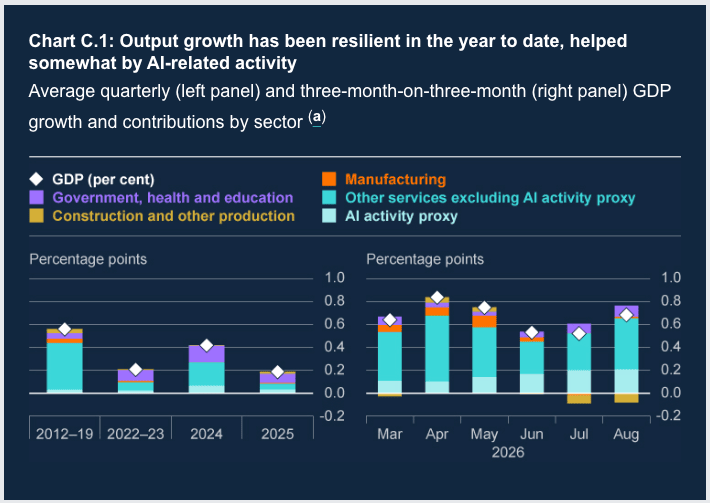
That split means firms plan to take around half of the gain by employing fewer people than they otherwise would, so the hiring slowdown is set to continue.
Contacts of the Bank's Agents "increasingly report that firms using AI proficiently and at sufficient scale can automate routine administrative work and accelerate knowledge tasks."
Pound Sterling Live's House View holds that the AI productivity gain is good for the economy and for workers in employment, while the unemployment it leaves behind sits outside the reach of Bank of England rate cuts.
British firms have the cash to hire if they choose to, with private non-financial corporations holding £576.4bn in sterling bank deposits at the end of August, the highest since January 2023.
A cut in Bank Rate lowers borrowing costs for firms that need credit to expand, so it has little bearing on recruitment decisions driven by technology, which supports interest rates staying higher for longer.
The Bank Says Most of the Productivity Gain Is Cyclical
"Much of the recent strength in productivity growth appears to reflect cyclical adjustments," says the Bank, which sees only "a modest AI-driven rise in UK productivity growth" so far.
A cyclical gain comes from where the economy is in the business cycle, not from a lasting change in how efficiently firms work. Once the conditions behind it pass, it stops. In Table D.A the Bank says a cyclical rise has “likely no material persistent effect on productivity growth”. It sets that against AI, which it calls “structural and likely persistent”.
Firms hoarded labour when hiring was difficult in 2022 and 2023, and have hired fewer workers since early 2024 as output picked up, which lifted measured productivity.
The Bank's Agents report that some contacts have now reached their lower bound for headcount, which limits how far that adjustment can run.
Higher costs from the National Living Wage and employer National Insurance contributions have also cut lower-paid jobs in retail and hospitality, sectors with less exposure to AI.
"Predictions of imminent mass unemployment look far-fetched. Like previous tech revolutions, AI will almost certainly create new jobs as well," says Berenberg, the German investment bank, in a recent update.
Berenberg attributes job losses in the UK's fastest-growing sectors to broad weakness in hiring rather than AI replacing workers.
The labour market remains steady, with unemployment at 4.7% in the three months to August, and the Bank projects a peak of 5.1% with "no widespread labour market shakeout".
For the AI hiring slowdown to register in the official data, output per hour must keep rising in the ONS's new quarterly productivity estimates, due on 17 November.