
Image © Adobe Images
Equity returns will moderate to single digits as AI spending shifts from installing capacity to earning a return on it.
The Nasdaq fell almost 7% in October, its worst month since April 2025 and economists at Standard Chartered responded by cutting their rating on global equities to a Core holding from Overweight, trimming the equity weight in the bank's CIO Foundation Balanced portfolio to 52.5% from 53.2%.
"As structural themes such as AI transition from the rapid buildout phase towards monetisation, diversified exposure across sectors and regions should become increasingly important," says Standard Chartered in a Market Watch note of 30 October.
The bank's capital market assumptions put annual equity returns in the mid-to-high single digits over the next few years, against the 15% to 20% annualised gains of the last few.
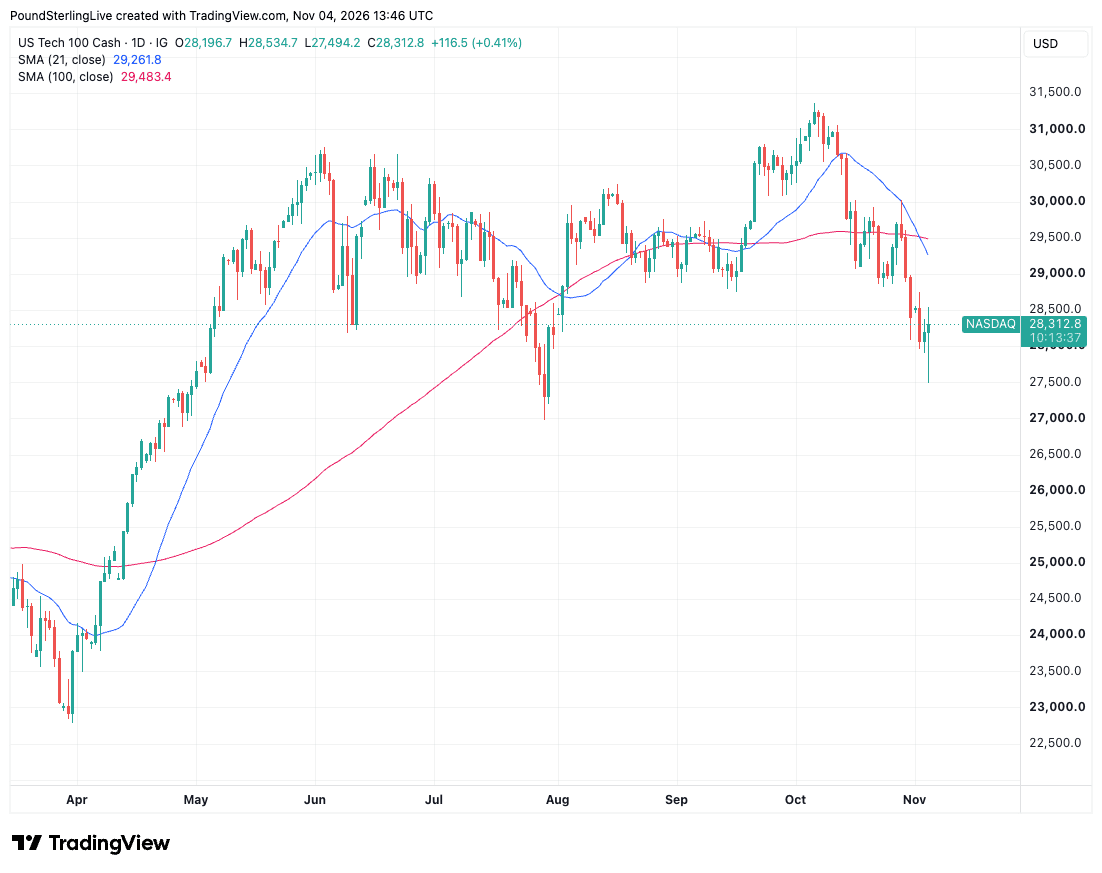
Above: The Nasdaq 100 index.
Index targets stay positive underneath that forecast, with the S&P 500 at 8,400 and the Nasdaq 100 at 32,400 over 12 months, and the FTSE 100 at 11,170 on an Underweight UK allocation.
"We continue to expect positive returns for global equities in the coming 6-12 months, though equity investors may need to recalibrate expectations lower," says Standard Chartered, which expects a more uncertain political backdrop and maturing growth rates in parts of the market to bring more frequent bouts of volatility.
BlackRock sets out the same shift as the governing question for markets, "the key question now is the economic value of the AI buildout: what returns it generates and who captures them. We see a range of possible outcomes for growth, profitability and returns on this investment," says the US asset manager on 2 November.
The Semiconductor Index Has Lost Half Its Peak Multiple
The SOX semiconductor index fell 11% over three sessions into 3 November, with results from Apple and Palantir failing to halt the decline.
"The derating of equity indices is now pronounced, with the SPX's forward P/E down 15% from its peak this year, down 20% for the NDX, and down 50% for the SOX index. However, the sharp acceleration in EPS growth expectations in recent weeks suggests that there is still some downside potential," says Natixis in a cross-asset daily of 3 November.
Analysts at OCBC have withdrawn the assumption that the build-out is a dependable support for US growth, "AI remains broadly supportive of US growth and the USD, but it is no longer a one-way trade," says the Singaporean bank in a weekly FX note of 2 November.
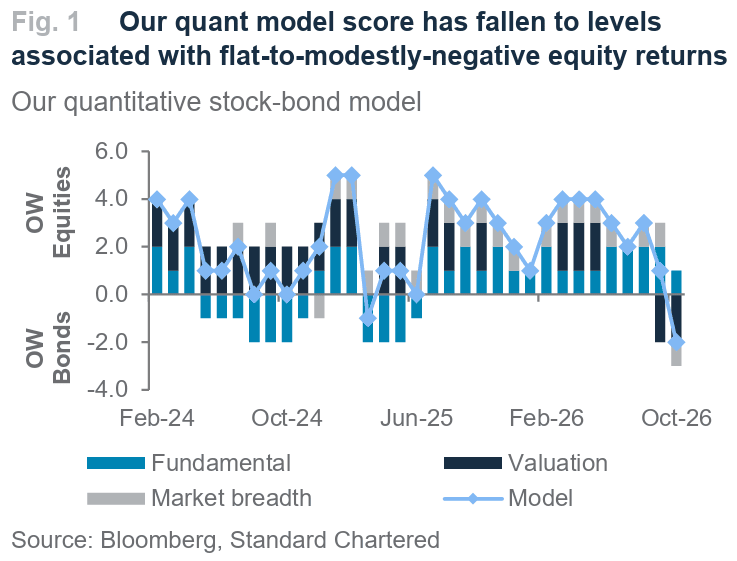
Image courtesy of Standard Chartered.
Hyperscalers raised $48bn in European currencies alone in 2026, more than triple the 2025 total, and borrowed in dollars and Swiss francs alongside.
Borrowing on sterling markets highlighted the surge in debt supply as hyperscalers accounted for 10% of sterling investment-grade issuance versus nothing in 2025.
That 10% share sits above the 8% hyperscalers account for in their home dollar market and below the 22% they take in Swiss francs.
"The scale of hyperscaler financing, which is forecast to rise a further 25% in 2027, will have an even bigger impact on European bond markets," says Huw van Steenis in Apollo's Daily Spark.
This reliance on debt to fund expansion could act as a brake that equity investors must watch.
"Higher US bond yields may start to bite as debt-financed capex takes on a greater share of total capex over the coming year. This, combined with already-high expectations, raises the risk of disappointment and a near-term repricing of expected earnings growth pace," says Standard Chartered in its November Global Market Outlook.
Nineteen of Twenty-Five S&P 500 Sub-Sectors Are Higher Since the October Peak
The S&P 500 has fallen roughly 3.5% from its 6 October peak, and nineteen of its twenty-five industry sub-sectors are higher over the same period, according to Jitesh Kumar at Societe Generale Cross Asset Research, who reads the breadth as a sign that a handful of heavyweight names are pulling the index down while the rest of the market holds.
Barclays finds the economic data underneath intact, "these readings should reinforce the notion that AI is supporting US growth and is not seeing a sharp slowdown, which should help keep the FOMC squarely focused on inflation in considering any additional rate hikes," says the bank.
UniCredit's Investment Institute rejects the dot-com comparison at the infrastructure and foundational-model layer on the grounds that the beneficiaries so far have been profitable incumbents, and places the bubble risk one layer up, in the wave of AI-native businesses now being built on the models.
"A possible risk scenario could involve a wave of failed applications and weaker-than-expected demand for computing power, placing part of today's infrastructure investment cycle under pressure," says UniCredit in a weekend editorial of 31 October.
Slower AI Investment Cuts US Growth to 1.5% by 2028
Berenberg already carries slower AI investment growth in its US forecasts, putting GDP growth at around 1.5% in 2028 alongside the drag from a clampdown on immigration and the gridlock a Democrat Congress imposes on fiscal policy, and expects the United States to contribute less to global growth than before.
Foreign investors have pulled money out of the Korean and Taiwanese equity markets, leaving the won and the Taiwan dollar behind their regional peers.
"Beyond oil, the bigger risk for tech-related Asia FX remains the AI trade, as investors question whether record capex will pay off. The Nasdaq lost almost 7% in October, its worst month since April 2025, while the US midterms add event risk. This keeps foreign equity flows into Asia's tech-heavy markets fragile," says Lloyd Chan at MUFG.
Crédit Agricole's Valentin Marinov ranks an AI boom-bust cycle as the biggest dollar downside risk for 2027 and says growing borrowing and energy costs have already eroded the profitability of many AI investments, a view Pound Sterling Live reported in October alongside modelling that finds the Dollar Index correlates far more closely with the US two-year Treasury yield than with AI stocks themselves.
Data Centre Projects Are Concentrated in Texas, Where Polling Is Tight
Democrats have taken both chambers of Congress, and investors are reading the result as a tightening of oversight on the spending itself.
"Markets are unwinding 'US exceptionalism' trades. Treasury yields are falling across the curve, equity futures are tumbling, and the dollar is extending its losses against its major counterparts, suggesting investors expect Democrats to rein in the administration's spending plans, subject the artificial intelligence buildout to tougher oversight, and constrain the president's trade and foreign policy moves," says Corpay.
OCBC expects federal regulation to face significant political hurdles under President Trump, which limits what a Democrat Congress can impose, and Barclays points to the state races instead.
"The fate of the Texas gubernatorial election could end up mattering much more for the AI trade than that of Congress or the Senate, given the heavy concentration of upcoming data center projects in this state and tight opinion polling," says Barclays.
Hyperscalers will report those returns quarter by quarter, and with their borrowing forecast to rise a further 25% next year, each quarter that passes without them raises the cost of carrying on building.