
Image © Adobe Images
An AI boom turning to bust is now the biggest downside risk for the dollar in 2027, and it would reach the currency through lower Fed rate expectations.
The dollar will weaken in 2027 if the AI investment boom reverses and forces the Federal Reserve to cut interest rates, according to Crédit Agricole, which now ranks that outcome as the currency's biggest downside risk.
The AI boom has delivered a positive demand shock to the US economy, lifting growth and inflation and prompting the Fed to hike in September with another move expected in December, which is why the dollar has tracked the two-year Treasury yield higher through 2026.
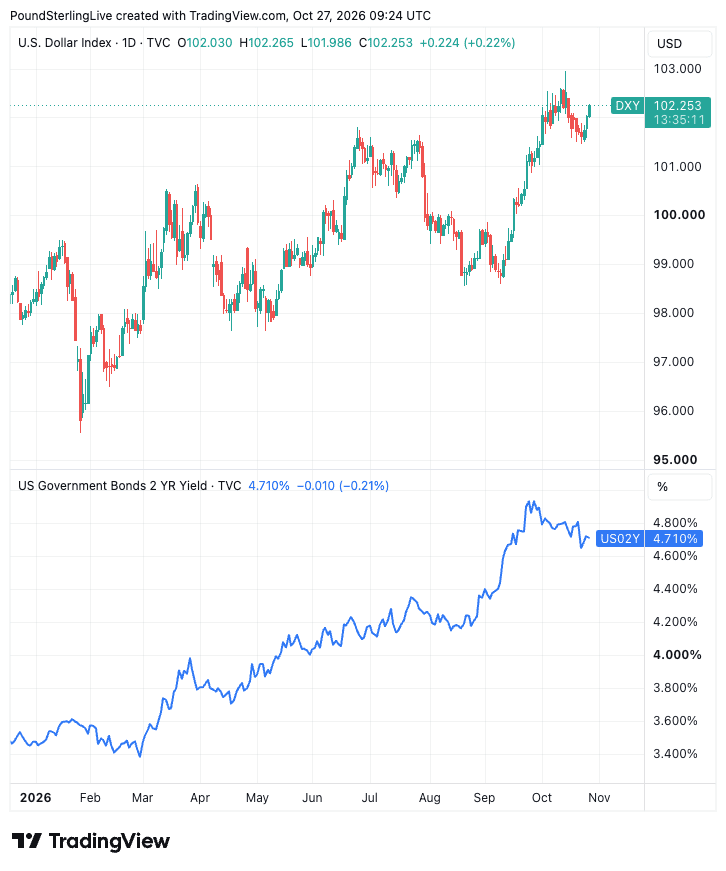
Above: The Dollar Index against the US two-year Treasury yield at daily intervals.
Pound Sterling Live's modelling finds the Dollar Index correlates far more closely with the two-year yield than with AI stocks themselves, so a stock pullback in its own right leaves the dollar standing; the dollar falls when that pullback lowers Fed expectations.
"An AI boom-bust cycle has now become the biggest USD-downside risk in 2027, in our view," says Valentin Marinov, Head of G10 FX Strategy at Crédit Agricole.
Marinov draws the parallel with 1999, when the dot-com boom supported US growth and inflation and forced the Fed into a tightening cycle that peaked in late 2000, lifting the dollar on a growing rate advantage and heavy foreign capital inflows.
The dot-com bust of 2002 reversed those inflows, and the Fed's aggressive cuts after the 2001 recession eroded the dollar's rate appeal across the board, ushering in a period of dollar weakness that lasted at least until 2005.
"The USD gains so far in 2026 have been driven by unhedged foreign inflows into AI-linked US stocks and credit while demand for USTs remained languished due to the very weak US fiscal position and the weaponisation of the USD by the US," says Marinov.
That leaves the dollar vulnerable to a stop in foreign inflows during risk-off, and Crédit Agricole has reshaped its "dollar smile" into a "smirk" to reflect the currency's reduced appeal when risk aversion is centred on US assets.
A Democrat Sweep Would Slow the AI Boom and Shift the Fed
Betting markets point to a decisive Democrat victory on 3 November, and the party has campaigned on slowing data centre expansion and tighter regulation of the technology at the heart of the AI boom.
"A slowing AI boom could add to the growth and inflation headwinds in the US and allow the Fed to cut rates in H227," says Marinov, referring to the second half of 2027.
Crédit Agricole's US economist expects US growth to cool and inflation to slow notably in 2027, with the Fed reversing some of its tightening and cutting twice before the end of next year, a more dovish path than the rates market prices.
This is the mechanism in full: the AI slowdown reaches the dollar when it changes what the Fed does, and the two-year yield that has carried the Dollar Index to 102 would turn first.
Marinov doubts a rout on the scale of 2002 is imminent, and growing borrowing and energy costs have already eroded the profitability of many AI investments.
What Keeps the Dollar Bid for Now
The Fed is expected to hold at 4.00% on Wednesday, and SEB puts the probability of a December hike at just over 75%, which means the rate advantage behind the dollar is intact into year-end.
"For the Fed the latest inflation readings should keep Warsh on the hawkish side at the very least whilst sticking to his non-forward guidance so unlikely to be too market moving," says the J.P. Morgan London FX trading desk in a daily note.
Crédit Agricole's own risk scenario cuts the other way: an AI bust that triggers a negative demand shock, or persistently high energy prices feeding stagflation, would lift risk aversion and give the dollar a boost, though a smaller one than in past episodes given its exposure to risk-correlated foreign capital.
The pound stands to benefit if the main scenario plays out: the Pound to Dollar rate is at 1.3318 today, and Crédit Agricole expects the dollar to slide towards the bottom of its smirk in 2027, dragged down by a loss of rate advantage and portfolio diversification flows.
For the pair to make that move, the two-year yield has to roll over first, which means watching December hike pricing after Wednesday's Fed decision and the midterm result the week after.