

Image © HM Treasury
Pound sterling is set to settle lower against the euro this week, and the key risk is the midweek Budget.
The Pound to Euro exchange rate has pulled back from Friday's 17-month high at 1.1959, and with the pair still deeply overbought, we look for consolidation and a shallow pullback in the coming days.
The broader uptrend remains intact, and the medium-term outlook for sterling against the euro stays constructive.
From a technical perspective, the RSI momentum gauge, shown in the lower panel of the chart, has turned lower from a record overbought reading, and that points to a period of consolidation:
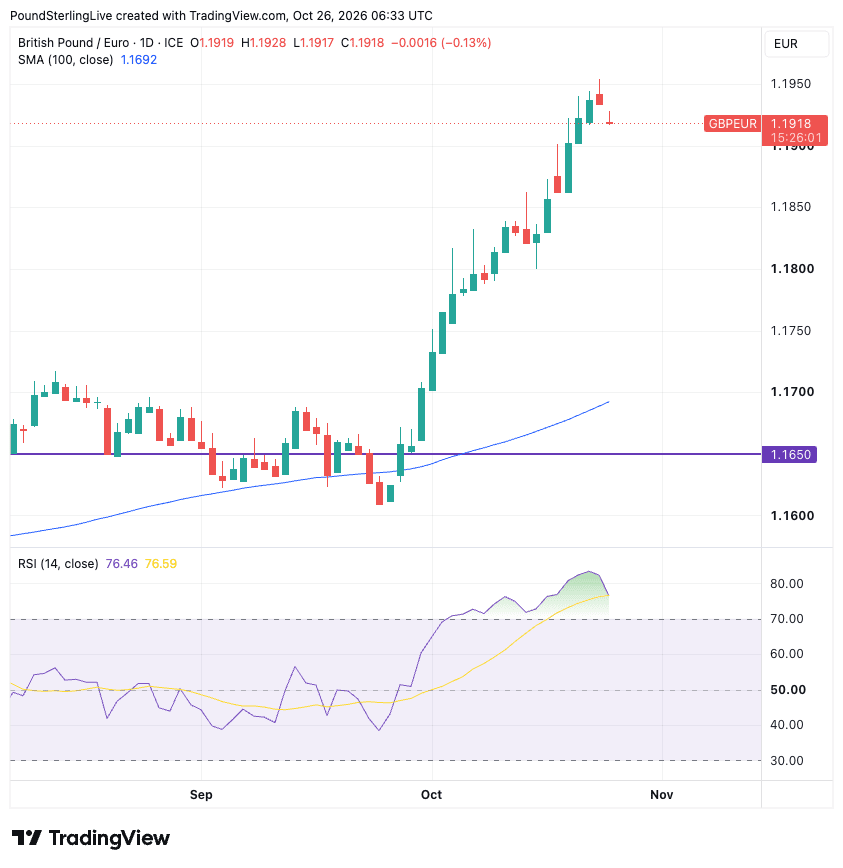
GBP/EUR daily chart. Image © Pound Sterling Live, chart created with TradingView.
GBP/EUR opens the new week at 1.1918 after logging a fourth consecutive weekly gain.
The charts remain bullish. The pair sits well above its 100-day moving average - the blue line - which has been rising since the summer and now stands at 1.1692.
The RSI reads 76, down from above 80 last week but still above the 70 threshold for overbought territory, so the pair has further to go before stretched conditions unwind.
Pound Sterling Live looks for that unwinding to come through sideways trade and a shallow dip, with buyers likely to return on moves towards the 1.1850 area, where the pair consolidated in mid-October.
Further out, GBP/EUR has broken out of the range that held it between 1.16 and 1.17 through August and September, and we think it is forming a new, higher range. A former ceiling at 1.1650, the purple line, now marks the base of the breakout.
That keeps the setup constructive for anyone looking to buy euros, and we continue to target 1.20 before year-end in our medium-term Pound to Euro forecast.
Last week Pound Sterling Live looked for a breather and for the pair to settle slightly lower, but a beat in UK jobs data on Tuesday and an above-consensus inflation print on Wednesday carried it to fresh highs instead.
Healey's First Budget Is the Week's Big Test
Wednesday's Budget, the first from Chancellor John Healey, poses deeper downside risks for the pound should he over-commit to borrowing.
Healey presents at 12:30, and credibility is the test he must pass.
How does a Budget reach the pound? If investors judge the borrowing plans to be excessive, they demand a higher return to hold UK government bonds, and gilt yields rise for the wrong reasons. Sterling tends to fall alongside, as the market reads the move as a risk premium on the UK. A Budget that keeps borrowing in check calms gilts and leaves the pound free to trade on Bank of England expectations.
The starting position is tighter than in March. Government borrowing came in at £24.5bn in September, nearly £2bn more than the Office for Budget Responsibility predicted, and the 10-year gilt yield sat at 5.41%, 12 basis points below its cycle high, according to Saxo Bank's Neil Wilson on 21 October.
Nomura expects Healey to let fiscal headroom fall to around £15bn, from the £23.6bn the OBR estimated in March, and to cover a £4bn overshoot in this year's financing needs with roughly £2bn of extra gilt issuance and £2bn of Treasury bills.
All indicators suggest Healey will play it safe. "The Budget is expected to balance fiscal credibility with temporary and targeted support for the economy," says Hann-Ju Ho, Senior Economist at Lloyds, in the bank's Market Insights Weekly of 23 October.
The market looks relaxed going in. Sterling bulls at Bank of America turned neutral on Friday after their EUR/GBP target was reached, and the bank's FX strategist Kamal Sharma warned: "We would anticipate GBP to consolidate in the coming sessions as the Budget looms."
UK data this week is second-tier, with October's CBI retail survey on Monday and September's mortgage approvals on Thursday, where consensus is 54,000.
Thursday's ECB Decision Is Key for the Euro
On the euro side, Thursday's European Central Bank decision at 13:15 is the week's main event, followed by President Christine Lagarde's press conference at 13:45.
Consensus looks for the deposit rate to stay at 2.50%, so the focus falls on Lagarde's guidance. A hawkish tone that keeps a December hike in play would support the euro, while any sign of caution would weigh on it.
"The risk is that a pure meeting-by-meeting approach could encourage markets to price an even more hawkish ECB (exactly what happened during the September press conference)," says Louis Harreau at Crédit Agricole in an ECB preview of 22 October.
Questions over France will also feature, with the spread between French and German 10-year yields widening to 170 basis points, a level last seen in 2011, according to Lloyds.
Friday brings the first estimate of eurozone third-quarter GDP, with consensus at 0.2% quarter-on-quarter, and German inflation for October, seen at 3.1% year-on-year. Prints above consensus would support the euro and misses would weigh on it.
With the Budget and the ECB landing on consecutive days and the pair stretched after a four-week rally, we see a measured pullback as the most likely outcome this week, consistent with our Pound to Euro forecast of consolidation inside a new, higher range.