

Image © Adobe Images
The British pound rose against the euro and the dollar after UK unemployment fell unexpectedly and pay growth beat expectations.
The UK unemployment rate fell to 4.7% in the three months to August from 4.9%, the ONS said on Tuesday, well below the 5.0% the market expected. The beat leaves the Bank of England with little option but to raise interest rates again next month.
Pound Sterling rose within seconds of the 07:00 release, lifting the Pound to Euro exchange rate from 1.1872 to 1.1887 and the Pound to Dollar exchange rate from 1.3330 to 1.3348.
Both moves are worth about 0.13% to 0.14%, a near-identical gain that confirms a sterling-specific move.
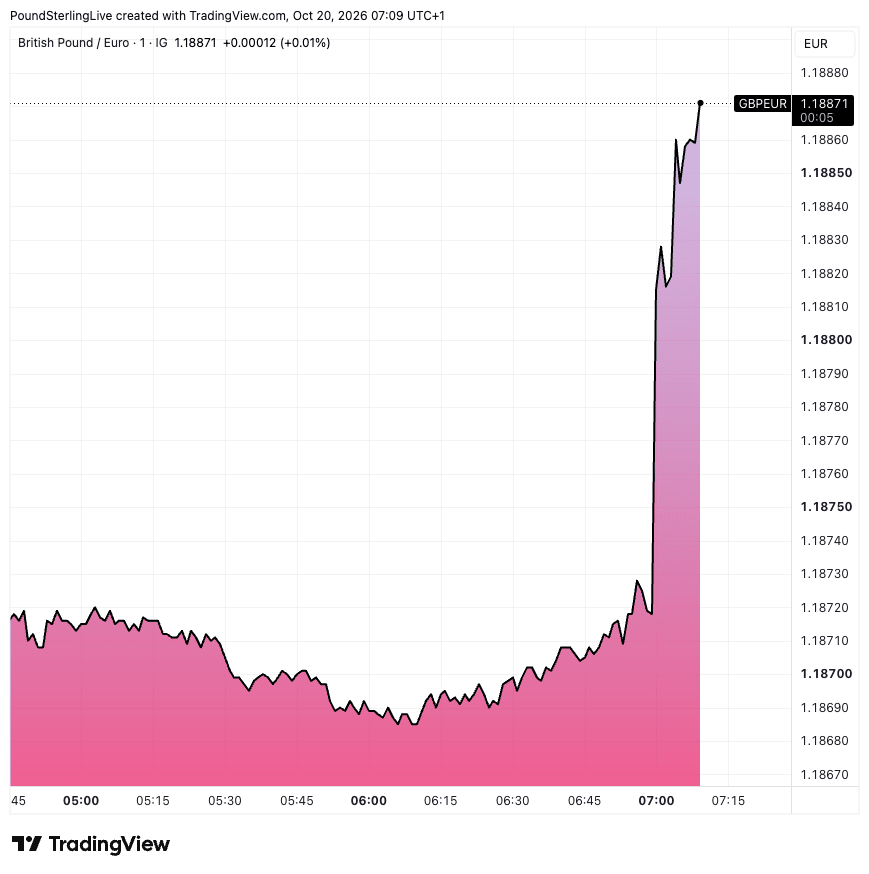
GBP/EUR at one-minute intervals. Image © Pound Sterling Live, chart created with TradingView.
A data print that beats consensus tends to support the currency, and Tuesday's numbers beat on the two measures the Bank of England watches most closely as it will inform the taste of policy to be delivered at upcoming meetings.
The numbers, in effect, nail to the board the prospect of a 25 basis point hike in November and follow-up moves in 2027.
Unemployment came in three-tenths of a percentage point below consensus, a large miss for forecasters who had expected a rise to 5.0%, and the employment rate rose 0.2 percentage points to 75.3%.
Regular pay growth, excluding bonuses, quickened to 3.7% from 3.5%, beating the 3.6% consensus. Private sector regular pay, the Bank's preferred gauge of domestic wage pressure, rose 3.0% from 2.9%.
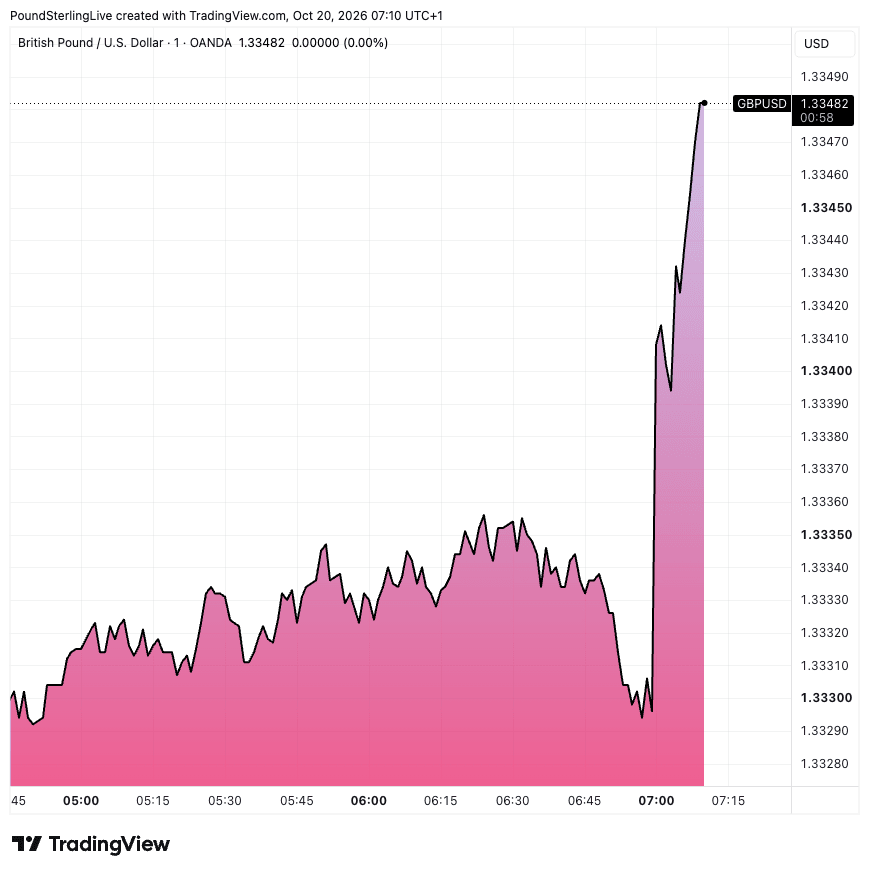
GBP/USD at one-minute intervals. Image © Pound Sterling Live, chart created with TradingView.
The Bank of England has been cautious about raising interest rates further, despite inflation being well above its target, on account of fears the labour market was too soft.
The theory being that a soft labour market is not inherently inflationary.
These numbers will prompt a rethink.
Yet, All is Not Well
It's a classic case of a great headline masking difficulties below the surface, as Britain's labour market is horribly disjointed.
Vacancies fell 21,000 to 691,000 in the three months to September, the lowest outside the pandemic since 2014, with the ONS reporting that smaller firms "may not be recruiting because of increases in labour costs."
"Payrolled employment stalled from July to August, while vacancies fell by 21,000. Reading through it, the labour market looks broadly stable," says Adam Deasy, Economist at PwC UK. "There is still little evidence of a convincing recovery in demand for workers after a long period of softening."
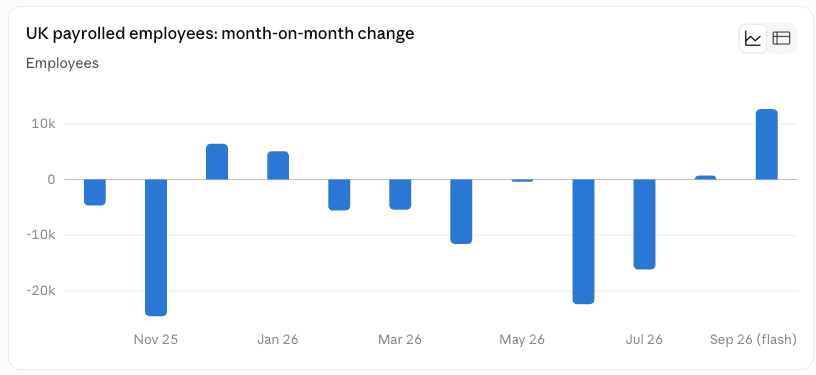
Payrolled employees fell 111,000 over the year to August, though the early estimate for September showed a rise of 13,000 on the month:
The out-of-work Claimant Count for benefits rose to 1.701 million.
Total pay growth, including bonuses, slowed to 3.7% from 3.9%, its weakest since 2020.
Incredibly, the annual average regular earnings growth for the public sector remained at 6.3%, against 3.0% for the private sector.
On its own, that is unsustainable in light of the pressures facing the country's finances.
For Sterling, it's Bank of England Pricing that Matters
The market already priced a better than 90% chance of a Bank of England rate hike on 5 November, so Tuesday's figures reinforce an expectation already in place. A lower jobless rate and firmer pay make it harder for the Bank to step back from that hike.
The pound's reaction is measured for that reason: a beat of this size would ordinarily produce a bigger move, but the November hike was priced before the release.
Wednesday's inflation figures are next, with consensus at 3.4% for September's headline CPI, and another beat would extend the pound's run.
For GBP/EUR, the advance runs against our call for a breather this week and puts Monday's high at 1.19 back in play.

Daniella Arcadipane, Senior Currency Specialist at Indigo
Moving a life-changing sum abroad? You won’t be doing it alone.
One specialist explains every step in plain English and stays with it until the money lands. FCA authorised, FRN 594433.
Talk to a specialist