
Image © Adobe Images
The single currency is holding its ground on a softer US dollar even as French borrowing costs reach their highest since 2002, and strategists question how long the dollar's retreat can carry it.
The Euro to Dollar exchange rate has edged up to 1.1240 on a weaker US dollar, holding firm as the gap between French and German ten-year borrowing costs widened to its largest in 15 years.
The euro usually suffers when that spread widens, because investors read a higher premium on French debt as stress on the eurozone's public finances, and the currency's resilience this week marks a break from that pattern.
"EUR/USD edged higher to around 1.1240 amid a weaker USD. The 10 year French‑German bond spread widened to 159bp yesterday, the most in 15 years, when French 10‑year yields hit 5% for the first time since 2002 amid political unrest and concerns about government debt. However, the spillover from the French fiscal risk premium to EUR has so far been contained," says Commonwealth Bank of Australia in its London Open note.
French ten-year yields rose eight basis points to 5% on Wednesday, after a week of protests over living costs and the 2027 budget.
The euro is lagging the bond market's alarm, says Kit Juckes, Chief FX Strategist at Societe Generale.
"EUR/USD is consolidating, as the FX market isn't reacting to the widening in the Bund/OAT spread to anything like the same degree as the bond market has," he says.
The euro to dollar rate trades just below its 21-day moving average at 1.1252, while the lower panel shows French stress climbing at its fastest pace since the summer:
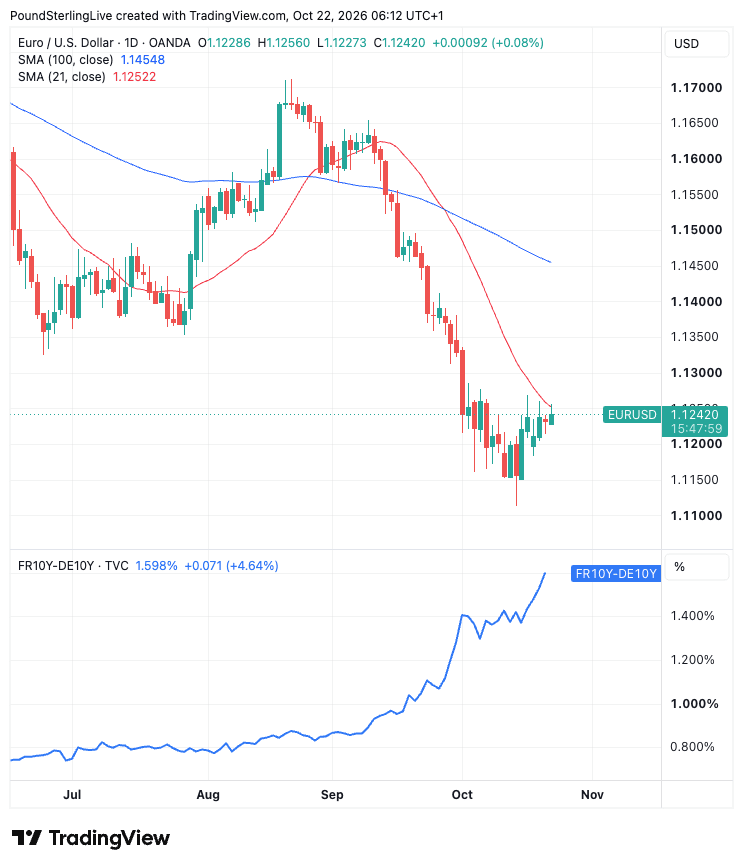
Above: EUR/USD at daily intervals with the 21- and 100-day moving averages, and the French-German ten-year spread in the lower panel.
Juckes says short EUR/USD has been the market's biggest consensus position, and that crowding plays a part in the muted reaction.
German government bonds provide the second anchor, according to Thu Lan Nguyen, Head of FX and Commodity Research at Commerzbank.
"As long as German government bonds retain their safe-haven appeal, the euro's downside should remain limited," she says.
The Dollar Does the Lifting
EUR/USD gains rest on renewed dollar weakness, with the dollar index slipping to around 101.5 in Asian trade as mixed earnings from US technology giants weighed on risk appetite.
The Federal Reserve meets on 28 October, and DNB Carnegie sees no case for a move.
"We do not expect the Fed to see an urgent need to hike just days before the US midterm elections. Instead, we expect the next hike in December," says DNB Carnegie's morning report.
Commerzbank's economists expect fewer Fed hikes than markets currently price, which would erode the dollar's rate advantage.
Helaba adds that the US carries a higher public debt ratio than the eurozone average, alongside higher interest rates, a point it says investors should not lose sight of over the long run.
How Long the Dollar's Retreat Lasts
The euro's own rate support is fading, with ING expecting the European Central Bank to hold on 29 October and strike a less hawkish tone.
"The bond market has taken over the ECB's job," says ING, estimating that the rise in French yields since September has done the work of a 50 basis point rate hike for France.
DNB Carnegie expects pressure on French bonds to persist ahead of next year's presidential election, and judges that the risk of escalation into a sovereign debt crisis has increased.
"Concerns about the EMU debt dynamics have not diminished. That limits the euro's potential against the US dollar," says Helaba in its daily outlook.
Juckes warns the euro "has a chance of ending up the weakest of the G10 currencies this year" once positioning settles.
The euro's troubles have carried the Pound to Euro rate to a record overbought reading, with EUR/GBP at 0.8390 equivalent to GBP/EUR at 1.1919.
The Levels
Helaba says the euro has failed to regain decisive ground against the dollar, and that setbacks towards the year low at 1.1113 remain possible at any time.
A break above the 21-day average would open room to 1.1320, the 38.2% retracement of the decline, according to Helaba.
Our week-ahead call for EUR/USD to hold above 1.1150 has stood, with no daily close beneath that level this month.
Friday's flash PMI surveys are the next test, ahead of the Fed and ECB decisions next week.
A daily close above 1.1252 puts 1.1320 in play; a return of French stress to the currency market brings 1.1150, then 1.1113, back into view.