

Image © Adobe Images
The Australian dollar is slipping as global risk appetite sours, even as markets lift bets on a November rate hike from the Reserve Bank of Australia.
The Australian dollar is falling against the US dollar and the pound as a sell-off in global equities outweighs a further rise in expectations for a Reserve Bank of Australia (RBA) rate hike.
The Aussie is a high-beta currency that tends to track global stock markets, so a broad retreat from risk can weigh on it even when domestic interest rate expectations move in its favour.
"AUD/USD eased to around 0.7010 amid a deterioration in risk sentiment. AUD declined despite a further increase in market pricing for a 25bp rate hike by the Reserve Bank of Australia at the 3 November meeting to near 62%," says Carol Kong, a strategist at Commonwealth Bank of Australia.
That pricing stood at 24% before Deputy Governor Andrew Hauser said this week that Australia's inflation outlook is "materially worse" than the RBA's August forecasts.
The Pound to Australian Dollar rate is 0.30% higher at 1.9096, with sterling holding above its rising 100-day average all week.
Risk Aversion Outweighs Rate Expectations
Mixed earnings from US megacap technology companies weakened the dollar, revived doubts over the AI trade and sent Asian equities lower, with Hong Kong's Hang Seng down 2.7% and Japan's Nikkei down 1%.
Brent crude climbed about 1.5% to near $110.5 a barrel on fears of escalation in the Middle East, after the US State Department ordered non-emergency personnel out of Saudi Arabia because of the threat from Houthi militants in Yemen.
The US dollar fell most against the yen and Swiss franc, the safe-haven currencies investors favour when cutting risk.
The RBA knows the Aussie's exposure to these swings. "If there's a major risk off sort of move in markets, the Aussie dollar usually will follow that," said Assistant Governor Christopher Kent on Monday.
AUD/USD stalled at its 100-day moving average at 0.7033 and is now at 0.7015, with the 21-day average at 0.6978 the first support below.
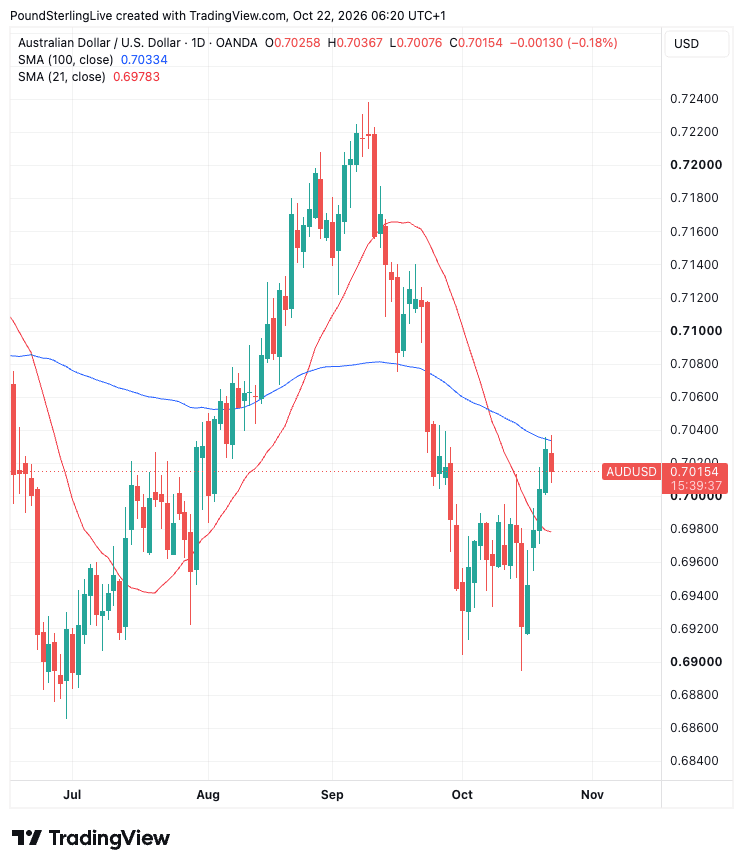
Above: AUD/USD daily chart, with the 100-day moving average in blue and the 21-day moving average in red. Image © Pound Sterling Live, chart created with TradingView.
Turning to the RBA, Hauser also warned that inflation expectations risk becoming de-anchored, pointing to surveys showing a growing share of businesses see inflation of 3-3.5% as "the new normal".
That sits above the RBA's 2-3% target band, with trimmed mean inflation, the RBA's preferred gauge of underlying price pressures, last at 3.6%.
Hauser said the RBA "must" prevent shocks from feeding into expectations, adding that "where the shock is persistent you have to react".
"In a world filled with "hard choices" we think the RBA will raise the cash rate to 4.85% to try and manage inflation risks and to keep inflation expectations anchored," says ANZ in its latest inflation preview.
ANZ forecasts trimmed mean inflation of 1.0% in the third quarter, holding the annual rate at 3.6%, well above the 3.3% the RBA forecast for December in its August projections.
"In our view, inflation should win out and force the RBA's hand to do more," says Peter Dragicevich, Currency Strategist at Corpay. A hike should, on balance, underpin AUD support, provided global markets stabilise following the recent selloff.
Commerzbank Still Sees an RBA Hold
Commerzbank expects the RBA to leave rates unchanged, arguing the central bank is watching other central banks closely because it is concerned about a weaker Aussie and the imported inflation that comes with it.
The German bank still sees near-term gains for the Aussie, driven by its view on the Federal Reserve.
"While a reversal of the recent sharp increase in RBA rate-hike expectations could initially weigh somewhat on the AUD, this is counterbalanced by the fact that our economists also expect fewer Fed rate hikes than are currently priced in by the market," says Norman Liebke, FX and Commodity Analyst at Commerzbank.
A decision to hold would be viewed as a bearish development for the Aussie dollar.
GBP/AUD is up 0.30% at 1.9096 after a dip to 1.9041 found buyers just above the 100-day moving average at 1.9030.
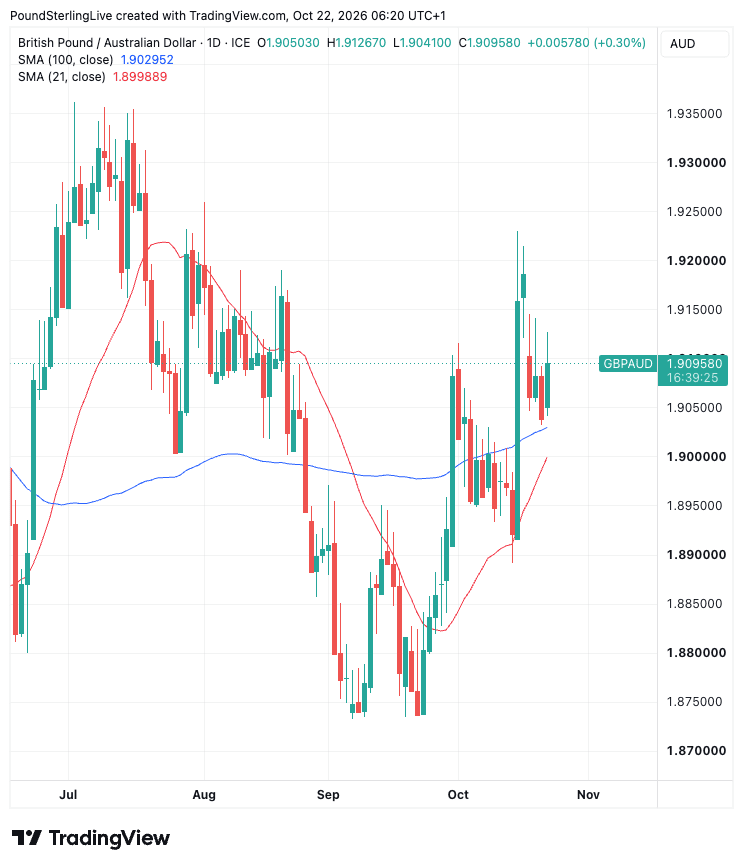
Above: GBP/AUD daily chart, with the 100-day moving average in blue and the 21-day moving average in red. Image © Pound Sterling Live, chart created with TradingView.
The rising 21-day average, now at 1.8999, has converged with horizontal support at 1.9000, giving the pound a firm floor between 1.9000 and 1.9030.
Pullbacks from last week's high at 1.9228 have held above that floor all week, keeping the uptrend from the September lows intact.
The pound has rate support of its own. UK inflation rose to 3.5% in September, its fastest pace in about a year, with services inflation also quickening, and markets almost fully price a Bank of England hike on 5 November.
"Rising carry and an improved growth backdrop also strengthen the GBP outlook despite fiscal risks surrounding the autumn budget," says a daily note from Julius Baer, the Swiss private bank.
A return above 1.9228 would open the way to the July high at 1.9362.
"The September CPI and Governor Bullock's public comments, both on 28 October, will play a big role in the RBA's decision on 3 November and the near term outlook for AUD," says Kong.
A daily close below 1.90 would break the setup and expose the 14 October low at 1.8891.