
Image © Gov.uk
Gilt supply will rise at next week's Budget if the first half's borrowing overshoot carries into the OBR's new forecast.
Gilt issuance estimates are set for an upward revision when the Budget lands on 28 October, with government borrowing running £6.0bn above the Office for Budget Responsibility's March profile at the halfway point of the fiscal year.
"Today's figures continue to point to upside risks around the government's financing requirement and support expectations that gilt issuance estimates may need to be revised higher when the Budget and updated OBR forecasts are published next week, consistent with our Budget projections," says Lloyds Bank.
Borrowing reached £24.5bn in September, £1.8bn more than a year earlier and £1.9bn above the OBR's forecast, which makes it the second-highest September on record behind 2020, according to Office for National Statistics public sector finances figures.
"At the halfway point of the fiscal year, cumulative borrowing stands at £97.8bn. While this is £4.4bn below the same period last year, it remains £6.0bn above the profile implied by the OBR's March forecast," says Lloyds Bank. "As shown in the accompanying chart, cumulative borrowing has continued to track above the OBR profile through the first six months of the fiscal year."
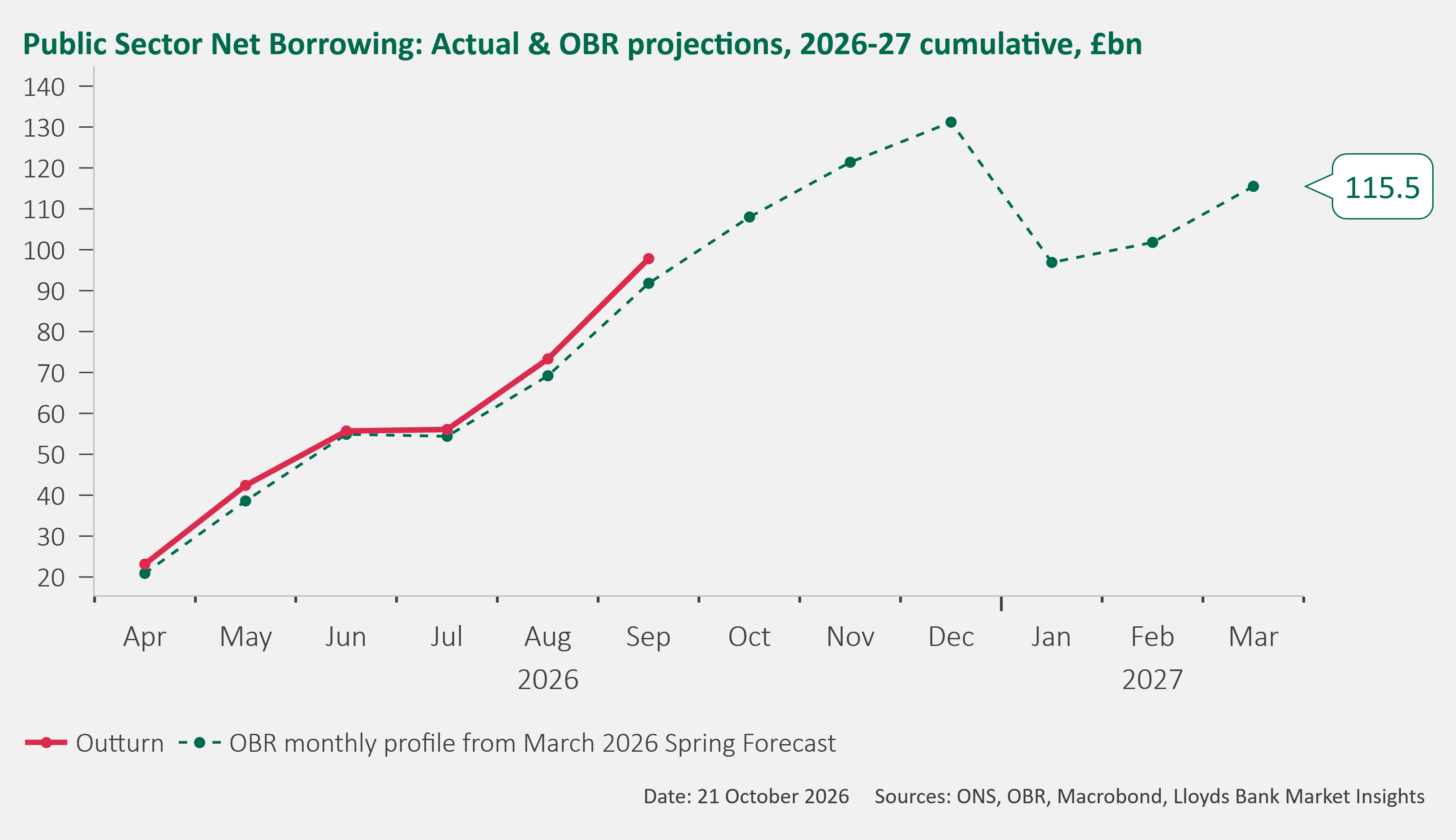
Above: Cumulative public sector net borrowing against the OBR's March 2026 profile. Image courtesy of Lloyds Bank.
The Cash Requirement Sets the Supply
"For gilt market participants, the more relevant measure is the central government net cash requirement (CGNCR), which determines how much funding ultimately needs to be raised from markets," says Lloyds Bank.
The cumulative CGNCR reached £90.0bn by September, £1.5bn above the same period last year.
Deutsche Bank puts the revision to this year's gilt remit at £5.5bn and sees cash borrowing rising by a cumulative £56bn between 2026/27 and 2030/31.
Debt interest payable took £10.9bn in September, £2.0bn above the OBR's forecast and the highest September figure since monthly records began in 1997.
"The £3 trillion debt barrier has also now been broken for the first time, while £10.9 billion was spent on debt interest in September alone," says Richard Carter, head of fixed interest research at Quilter Cheviot. "Those numbers illustrate the difficult circle the government is attempting to square."
He adds that the government wants to pursue an ambitious long-term spending programme while borrowing costs and existing debt already place significant demands on the public finances.
Net debt stood at a provisional £3,005.0bn at the end of September, equivalent to 94.0% of GDP and 1.2 percentage points below the OBR's forecast.
Deutsche Bank Expects Borrowing to Fall
"From a borrowing perspective, we still expect public sector net borrowing to remain on a downward trajectory, albeit on a stickier path than before. PSNB, we expect, will decline from 3.9% this fiscal year to 1.6% by the end of the fiscal forecast horizon," says Sanjay Raja, Chief UK Economist at Deutsche Bank.
Deutsche Bank puts the Chancellor's buffer against the primary stability rule at £15.7bn and the buffer against the secondary debt rule at £18.3bn in 2029/30.
"We think the Chancellor will emerge from the Budget with around £18bn of headroom against his main fiscal rule, down from £23.6bn in March. That is hardly a comfortable cushion, but neither is it a fiscal crisis," says Martin Beck, Chief Economist at WPI Strategy.
Beck expects modest tax increases rather than shock changes, with banks, wealthier taxpayers and some businesses in the firing line.
Pantheon Sees the Risk in Yields
Pantheon Macroeconomics extrapolates the first-half overshoot to a full-year borrowing total of £123bn, against the OBR's £115bn forecast, and expects the OBR's pre-measures forecast to cut the Chancellor's headroom to £11.4bn from £23.6bn.
"The Government's headroom would be around £3bn lower still if the sharp sell-off in gilts since the conditioning window closed is factored in," says Rob Wood, Chief UK Economist at Pantheon Macroeconomics.
Gilt yields carry the risk from here, with Wood saying risks to yields remain skewed to the upside while the administration dodges the big questions on long-term fiscal sustainability and relies on medium-term fiscal plans to make the Budget numbers add up.
September's inflation print at 3.5% adds to that pressure, with higher inflation through the rest of the fiscal year feeding both welfare payments and the debt interest bill.