
Picture: Gov.UK
Analysts warn there is a low hurdle for market surprise against subdued policy expectations, posing downside risks for the pound.
The British pound enters Wednesday's Budget at its strongest level against the euro in 17 months, carrying a market consensus that Chancellor John Healey will deliver a low-key event, and that consensus is where the risk now lies.
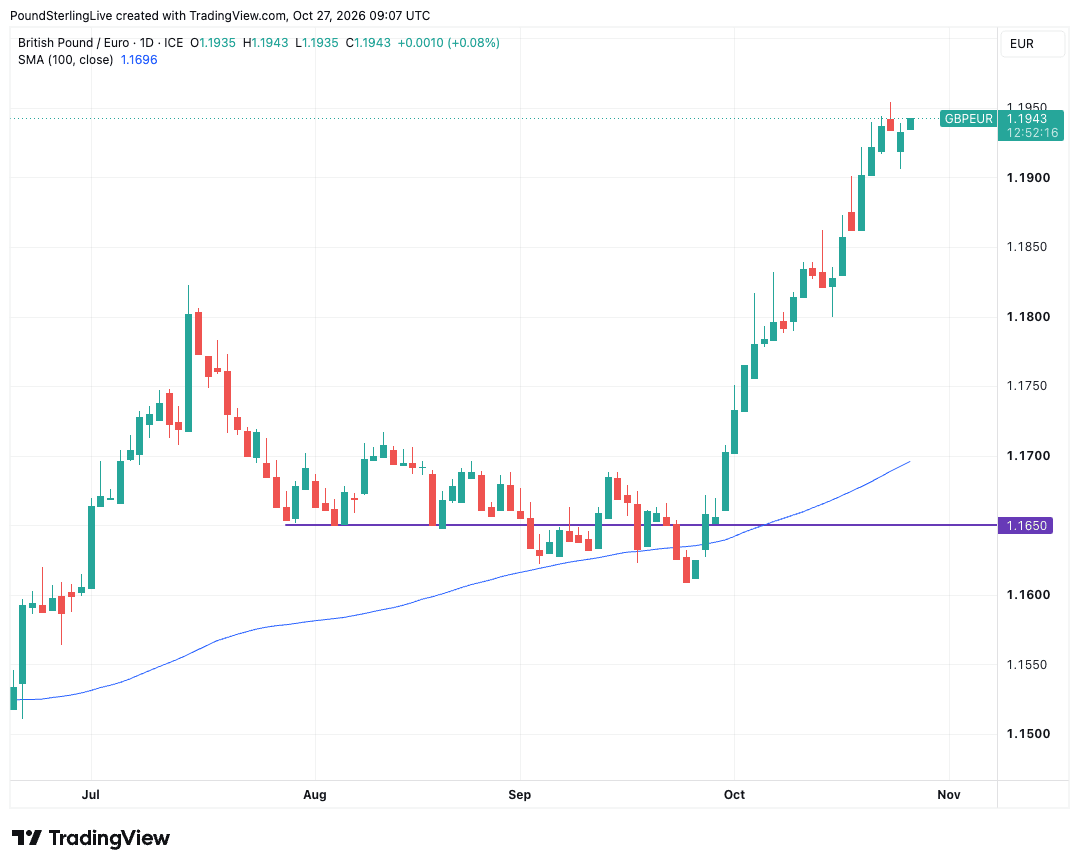
The pound-to-euro exchange rate trades at 1.1943, a fresh 2026 high, and the pound-to-dollar rate at 1.3325.
If the pound is priced for a quiet Budget, the risk is that Chancellor John Healey drops some unwelcome surprises that trigger downside.
"The problem for the market is that we have been here before only for much larger surprises to emerge," says a note from Lloyds Bank, pointing to the 2024 Budget as the most significant in the Office for Budget Responsibility's era outside the pandemic response.
Lloyds agrees in principle that the event will be low-key, given the political signposting towards Prime Minister Burnham's ten-year plan after the fiscal set-piece, but says subdued expectations are their own hazard.
"Once those have been established it then takes relatively little by way of 'news' in order for the market reaction to amplify into more of an event," the note adds.
The benchmark Lloyds sets is the rolling average of cumulative policy revisions over the OBR forecast horizon, which stands at just over £50bn: anything above that could shock the market out of its complacency.
Where the Downside Lies
The pound will be exposed to developments in gilt markets, where traders will reprice Britain's sovereign debt according to the Chancellor's announcements and their effect on bond issuance and inflation.
Analysts say the month's GBP rally has been built on Bank of England rate hike expectations and a fiscal premium that has steadily drained out of UK assets.
"For GBP, stronger fiscal credibility would compete with lower rate support and limit upside. By contrast, fiscal slippage and heavier gilt issuance can drive gilt yields up and GBP down," says Elias Haddad, Head of FX Strategy at Brown Brothers Harriman.
Haddad's first scenario is the one to note: even a credible Budget caps the pound if it does the Bank of England's work for it and trims the four hikes markets have priced.
Fiscal slippage carries the larger risk, with Commonwealth Bank of Australia warning that a repeat of 2022, when the gilt market forced a Chancellor out of office, is the template for the worst case.
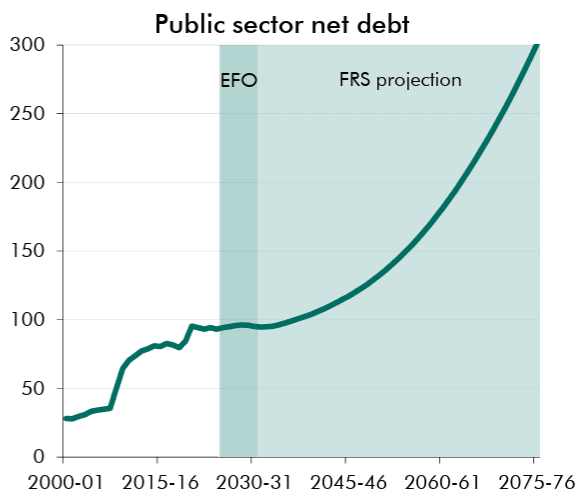
Above: An upgrade to the OBR's debt projections might be taken in a negative light.
"Material loosening in the fiscal rules would sharply push up long term UK bond yields and weigh on GBP/USD like in 2022," says the bank's weekly FX strategy note.
Strategists at Bank of America have pared their bullish stance on pound sterling into the Budget, "we are turning neutral ahead of key event risk," says Kamal Sharma, FX Strategist at Bank of America. The investment bank had targeted a move in EUR/GBP down to 0.84, which gives a rise in GBP/EUR to 1.1905.
"Suite of indicators suggest lot of good news is priced in. Event risk vol for Budget looks underpriced and warrants caution," says Sharma.
Sharma's reference to event risk volatility concerns the options market, where the premium traders pay to protect against a sharp move in sterling around the Budget sits below what Bank of America judges the event warrants, which means the market has bought little insurance against a Healey surprise.
What the Budget Must Do to Trigger an Extension of the Rally
Should the Chancellor meet expectations for a safe Budget, the pound would benefit from a lifting of residual uncertainty.
"We expect that Burnham and Healey will deliver a steady as she goes budget, with no major spending changes, and some tax hikes to keep fiscal headroom around the £15-20bn level. GBP should see a relief rally if we are correct, as the resolution of budget uncertainty should enable carry trades to build," says a note from CIBC Capital Markets.
Karl Schamotta, analyst at Corpay, puts the same scenario as a question of whether the combination of rate hikes and a "steady as she goes" Budget can keep sterling supported.
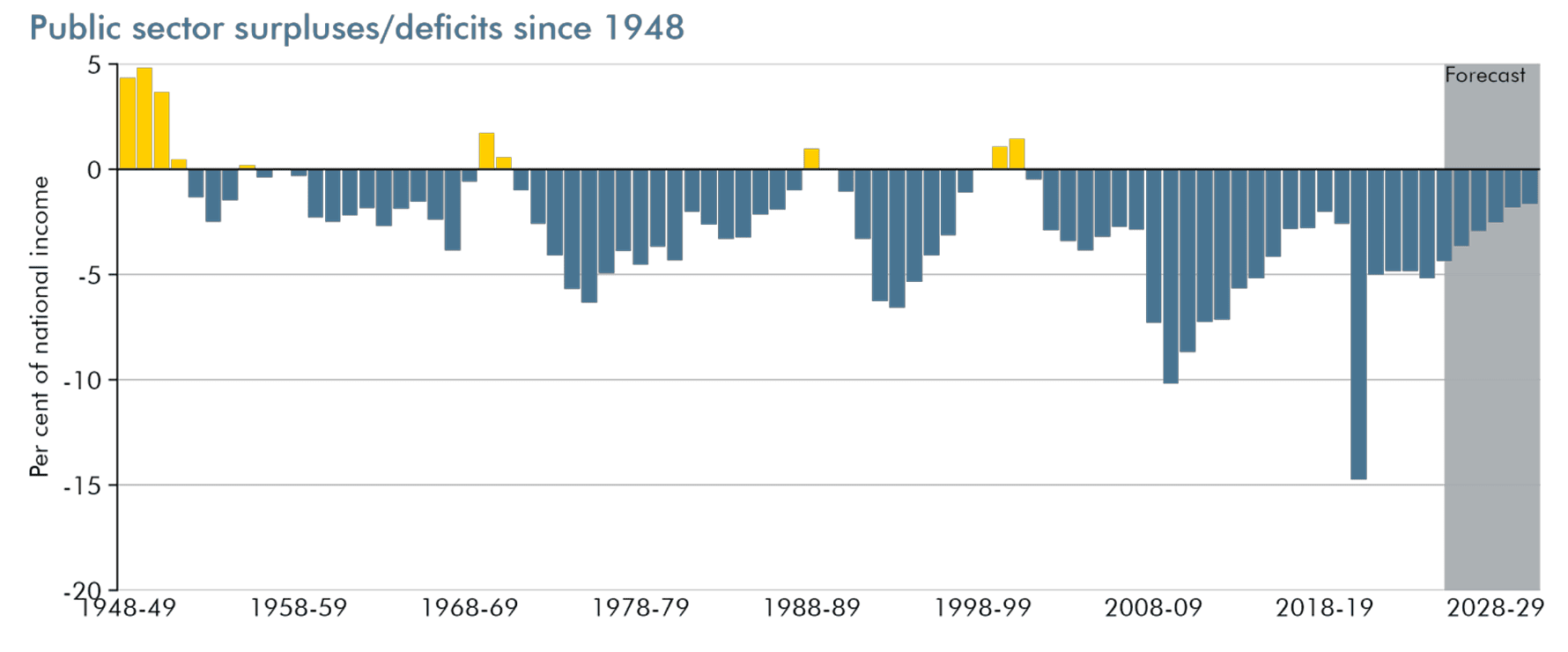
Above: The working assumption at the OBR - which keeps markets on an even keel - is that the deficit will disappear. In reality, it won't. But pretending it will might be enough to convince markets the UK is at least trying.
That matches our in-house modelling, which holds that the pound stays capped into the Budget and recovers once it passes without incident, with the big fiscal decisions deferred to clear the ground for a Spring election.
CIBC's £15-20bn headroom figure is the marker for that outcome: a package that lands near it, funded by tax rises the market has already discounted, keeps policy revisions well inside Lloyds' £50bn threshold.
The Charts Say GBP/EUR Looks Particularly Pricey
The pound-to-euro rate has spent most of October above 1.18 with its momentum readings at record overbought extremes, and spot sits well above its 21-day moving average at 1.1810.
Our modelling says that gap closes through a pullback or consolidation, and the Budget is the event most capable of forcing the pullback route.
A quiet Budget keeps 1.19 as the floor and opens 1.20 as the next target; a surprise above Lloyds' £50bn benchmark would put the 21-day average in play within a session, with the 1.1750 support band beneath it the level a deeper selloff would test.
Five Likely Announcements From Healey
Of the changes floated in the media ahead of Wednesdasy, here are the top five:
1. Business rates threshold up from £12,000 to £18,000
Reported by the Sunday Times, rolling out in England first, taking around 75,000 properties out of business rates altogether. Burnham had earlier floated tapered relief from £15,000 to £21,000, so the threshold version is the harder line.
2. VAT collected at source by online marketplaces
The Times reports platforms would collect VAT for third-party sellers with turnover above £90,000, raising up to £1bn, explicitly earmarked to fund the business rates cut. The two measures are a matched pair.
3. Bank corporation tax surcharge up from 3% to 8%
The Guardian puts this above £2bn a year, possibly alongside a higher bank levy. Kathleen Brooks at XTB wrote on this on 16 October and it is in our index: financials are close to 20% of the FTSE 100, so this is the measure with the clearest equity read.
4. Mansion tax threshold down from £2m to £1.5m
The Times reported the proposal, which would lift affected homes from 165,000 to around 271,000. This one is unstable: Brit Brief reports it is being reconsidered after objections from Labour MPs, and the Standard has London MPs confident it has been ruled out.
5. Energy and fuel relief
The Guardian has an extra £100 on top of the existing £150 Warm Home Discount, funded by taxpayers. Fuel duty is due to rise from about 53p to nearly 56p a litre on 1 January and a freeze is under consideration, with Burnham declining to rule out action.